The whole course, on one page
PALOMA’s wellness world — what we offer, how one thing differs from another, and how far your knowledge goes.
This is for coming back to — before a shift, or with your trainer. The chapter screens are where you work through it the first time.
01The World You've Walked Into
After thisYou can place anything PALOMA offers under one of four doors, and name the two spaces that belong to PALOMA and nowhere else.
Her first week. A guest asks what kind of place this is.
Both answers are accurate.
Four ways in. Everything PALOMA offers sits under one.
Regulation before transformation. Calm comes first; clarity and choice follow from a settled nervous system.
That is not a slogan about the brand. It is the order the doors are in — which is why almost everyone starts at the first one.
- REGULATE
Settling the nervous system. Bodywork, heat, breath, sound. Almost everyone's first door, whether or not they say so.
- CONNECT
Being with other people, or properly with yourself. The Dome is mostly this.
- BEAUTIFY
Skin and results — and never separate from how it feels to receive it.
- DISCOVER
Learning something about yourself you didn't arrive knowing. Crystals, readings, the self-discovery practices.
Three of these sit behind the same door. One does not.
A guest has booked bodywork. She has never heard of a sound bath.
How do the four doors actually help you here?
Two spaces belong to PALOMA and nowhere else.
Most of what PALOMA offers, another good place could also offer.
These two are the reason people describe PALOMA to their friends by describing the building.
- THE DOME
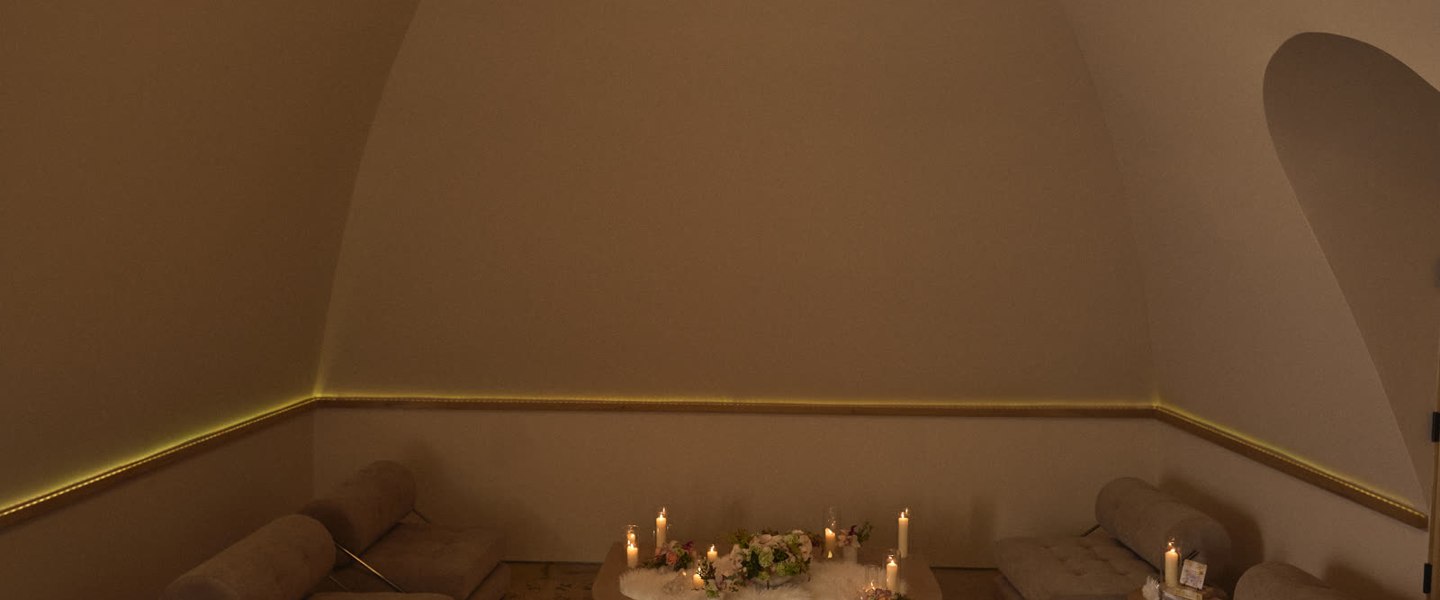
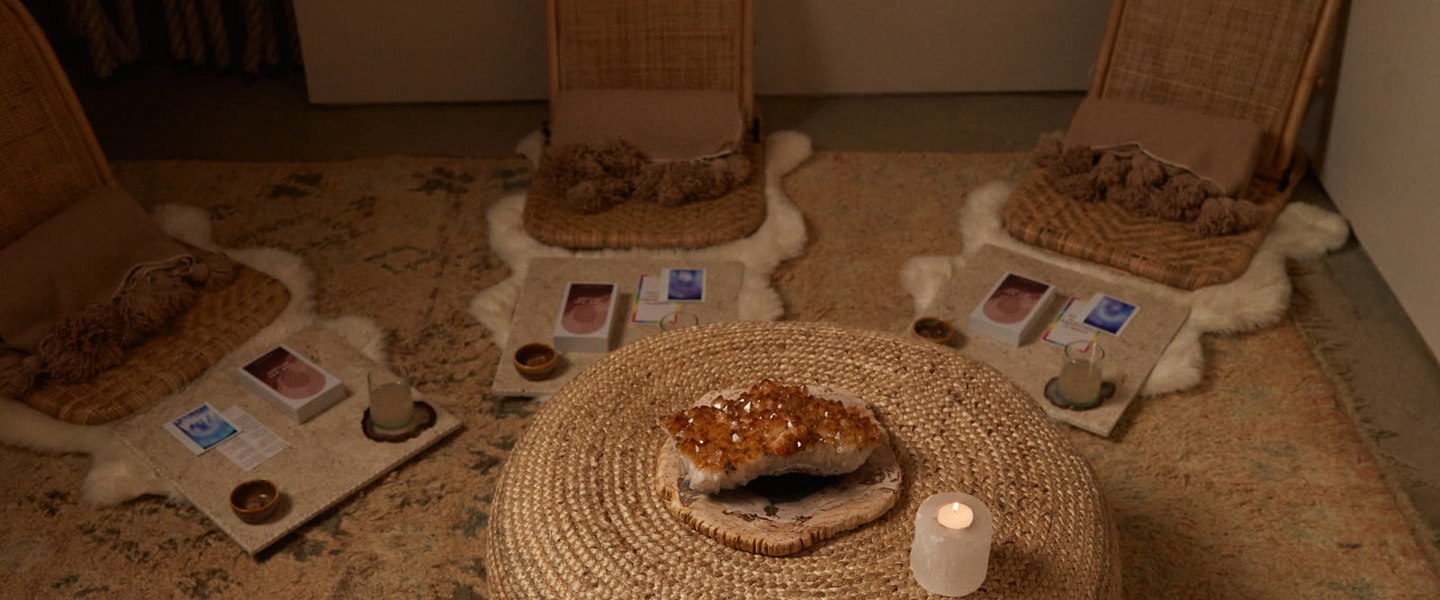
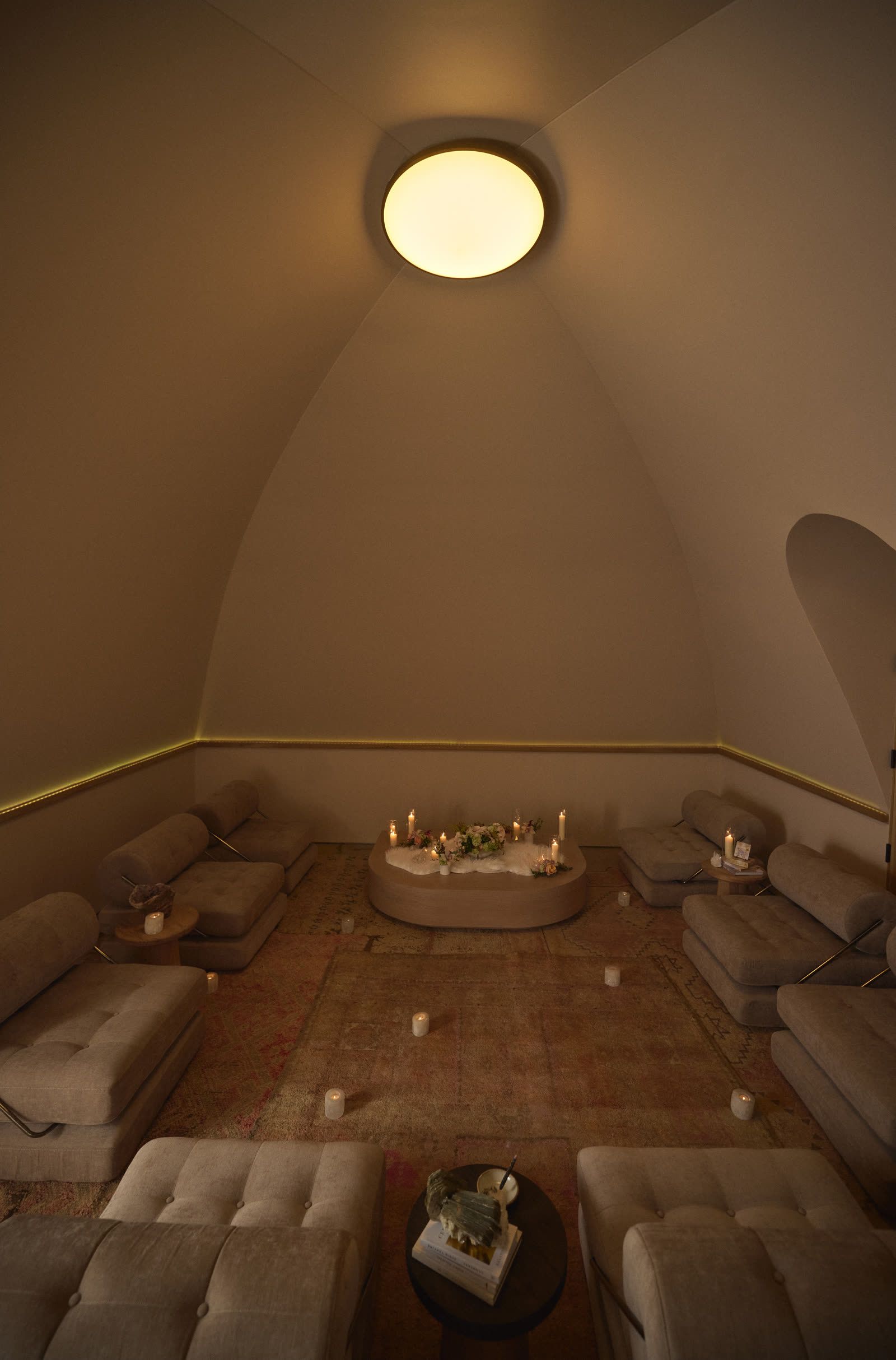
A vaulted community sanctuary. Gatherings, rituals, ceremonies and private sessions. Where PALOMA is a room full of people rather than one person on a table.
- THE CRYSTAL HALLWAY
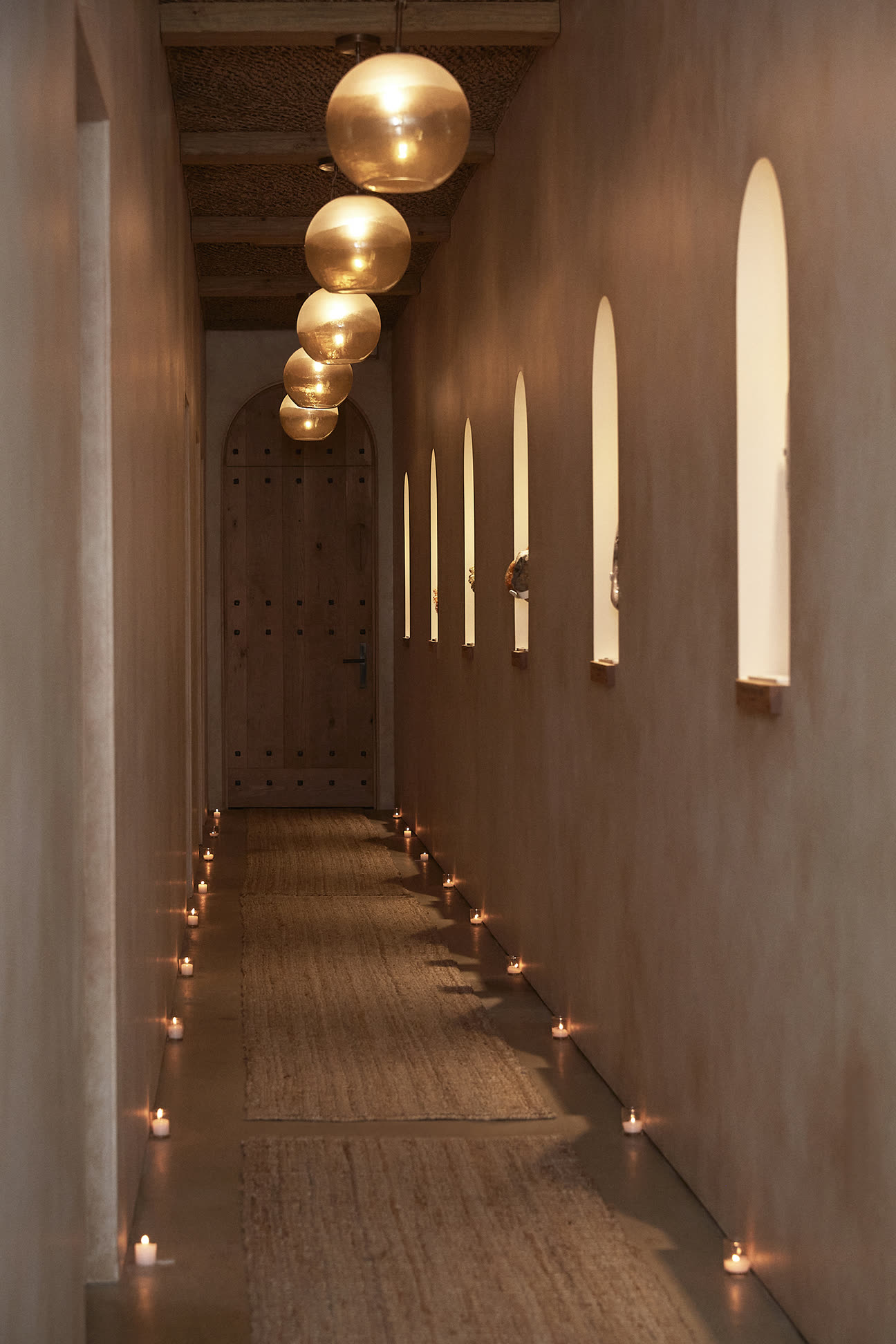
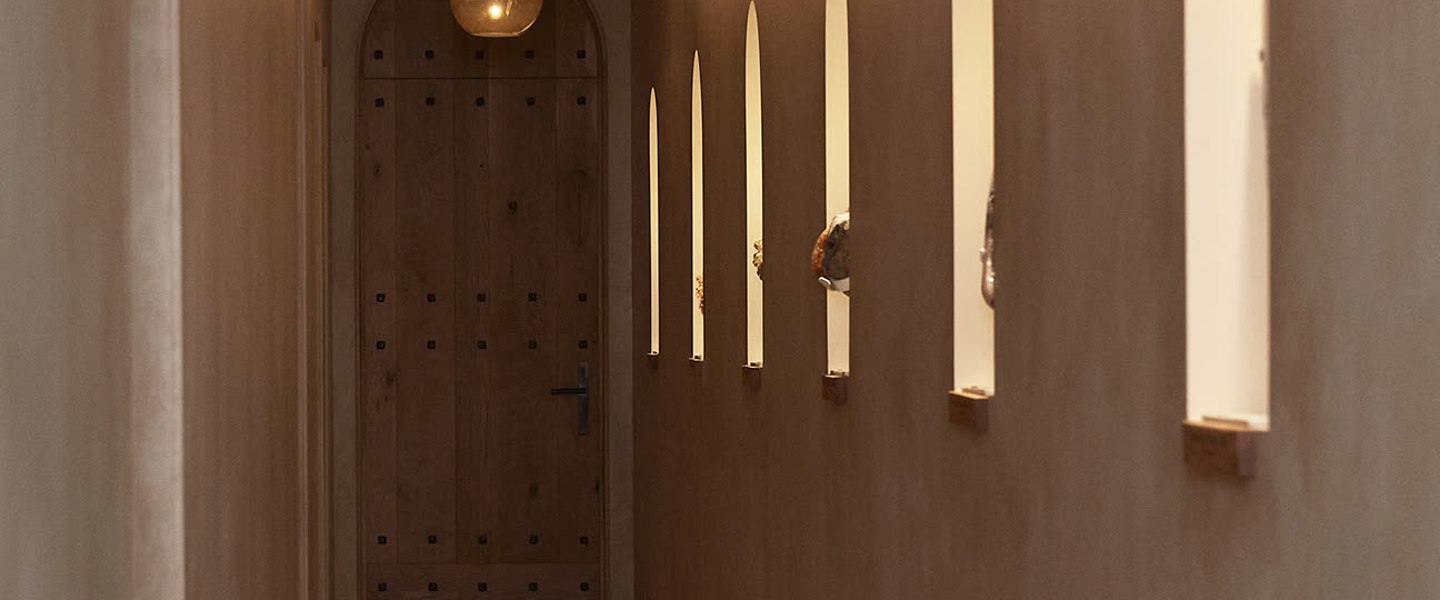
Seven arch niches holding rare specimens. They rotate with the seasons, so it is never quite the same hallway twice.
Where does The PALOMA Edit sit in all this?
You are eight days in. A guest asks you something about a modality you have never seen.
What does this course actually promise you?
Regulate. Connect. Beautify. Discover.
One idea — the whole person — and a range that is the evidence for it.
A map lets you place an unfamiliar question. Placing it is most of what confidence is.
Next: how much of it is yours to explain.
- Regulate · Connect · Beautify · Discover. Four doors, and everything we offer sits under one of them.
- The Dome and the Crystal Hallway belong to PALOMA and nowhere else. They are the two you will never find elsewhere.
- A map lets you place an unfamiliar question. Placing it is most of what confidence is.
Work through “The World You've Walked Into” on the screens →↑ Contents
02Fluency Without Overreach
After thisYou can tell five kinds of statement apart, and you know exactly where your explanation ends.
A guest, curious rather than sceptical, asks how a modality actually works.
Two associates who have both done the reading.
Five kinds of statement. PALOMA uses all five and never confuses them.
Leave room for what we feel. Never confuse the three.
PALOMA does not become scientifically sterile. The point is not to strip the mystery — it is to know which kind of sentence you are in.
- ESTABLISHED
Well-supported. Says so plainly, and only where it is true.
- EMERGING
Being studied. Interesting, and not settled.
- TRADITIONAL
Long used, in a named tradition. Honest about being a tradition.
- SPIRITUAL OR ENERGETIC
Held as meaning rather than as measurement. Welcome here, and never dressed up as science.
- PERSONAL
What someone experienced. True about them, and about nobody else.
Three of these were in the list you just read. One was not.
Four sentences about the same experience. Every one of them is true.
Which one is a practitioner's to say, not yours?
A guest tells you a crystal has been helping her sleep.
You are now standing between two ways of getting this wrong.
A practitioner explains her modality to you beautifully over lunch. You now understand it far better.
What just happened to PALOMA's language?
A guest asks about a modality you're comfortable with. She is genuinely curious.
Describe it to her without explaining why it works.
Nobody is marking your words.
The third check is the whole exercise. Look for a because, a works by, or a that's why — those are the three doors out of your scope, and they all sound helpful.
- One way
“You're lying down, fully clothed, with a blanket, and someone plays bowls around the room for about an hour. Most people go somewhere quite far away in the first ten minutes. A couple of people fall asleep every single time, which nobody minds.”
- Another way
“It's an hour of doing absolutely nothing, on purpose, with sound. I'd say the most common thing people tell me afterwards is that they lost track of time — which sounds small until it happens to you.”
- WHAT HAPPENS
Did you say what she'll actually be doing?
- WHAT PEOPLE NOTICE
Did you offer experience as experience, not as effect?
- NO BECAUSE
Check for the word — did any sentence explain a mechanism?
So where exactly does your explanation end?
Describe freely. Explain carefully.
Guide the experience. Do not interpret the body.
What happens in the room is yours. What happens in a body is not.
Watch for because, works by, and that's why. All three sound helpful.
Spiritual language is welcome here. Spiritual belief dressed as science is not.
Next: the crystals, which have their own language entirely.
- Describe freely. Explain carefully. The room is yours; the body is not.
- Guide the experience. Do not interpret the body.
- Watch for because, works by, and that's why. All three sound helpful, and all three step over the line.
Work through “Fluency Without Overreach” on the screens →↑ Contents
03Crystals + Intention
After thisYou can handle a crystal, describe what it is, and help a guest choose one without claiming anything for it.
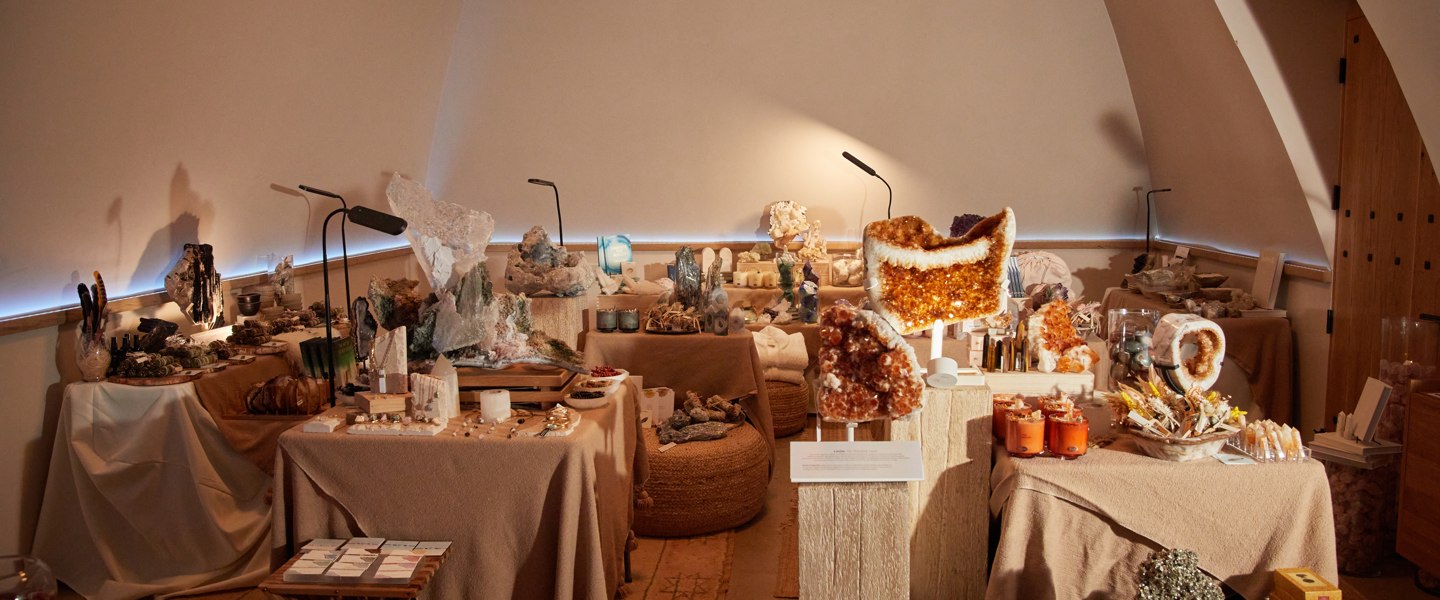
A guest is standing at the crystals, picking things up.
“I don't really know what any of these do.”
Two associates step in.
Three principles. Everything else here follows from them.
Nothing in this chapter is about what a stone does.
All of it is about how a person meets one.
- A SACRED OBJECT
Handle each one as something held rather than stocked. How you pick a crystal up teaches a guest how to pick it up.
- TOUCHING IS THE POINT
Encourage guests to hold them. A crystal nobody has touched has not been chosen — it has been looked at.
- INTUITION BEFORE KNOWLEDGE
“The right crystal often chooses you. Trust what you feel.” Hers first, yours second.
Match each one to what it means.
Eight forms. The shape is doing something, and guests almost never know it.
This is the most useful thing you can know at the shelf, because it works whatever the stone is.
A guest who wants something to carry needs a tumble or a palm stone. That is a form question, not a crystal question — and you can answer it about a stone you've never seen before.
- POINTS
Direct — focus energy outward or inward. Laser-like intentionality.
- SPHERES
Radiate evenly in every direction. Harmonising.
- TUMBLES
Smooth and gentle. Made for carrying and for pockets.
- CLUSTERS
Amplifiers. They cleanse a space and strengthen what surrounds them.
- PYRAMIDS
Focus through the apex. Intention-setting and manifestation.
- HEARTS
Love, healing, emotional balance. Often the one somebody buys for someone else.
- WANDS
Directional. Channel for healing and cleansing.
- PALM STONES
Smooth and comforting. Meditation, grounding, and a hand that needs something to hold.
Three of these were in the list you just read. One was not.
She has chosen one. She asks what it's for.
Four answers about the same stone.
She's taking it home. Three things she'll want to know and won't ask.
These three are the difference between a purchase and a practice.
She will not ask, because asking would mean admitting she doesn't know. Tell her anyway, lightly, as she's paying.
- SETTING AN INTENTION
Somewhere quiet. Hold it, in your dominant hand or both. Breathe, and picture the thing you want or the way you want to feel. Say it — aloud or not. Then carry it, or put it somewhere you'll see it.
- CLEANSING IT
Smoke, from sage or palo santo. Moonlight overnight. Resting on selenite. Sound, from a bowl or chimes. Or cool water and dried properly — only for the stones that take water.
- WHERE IT LIVES
By the door for clearing as you come in. On a nightstand. On a desk. A small altar somewhere. Or a tumble in a coat pocket, which is where most of them actually end up.
Match each one to what it means.
A guest tells you, quite seriously, that a crystal she bought here changed something for her.
Where do you stand?

A guest has been turning a stone over for a while. She hasn't asked anything.
Say the first thing.
Nobody is marking your words.
The third check is the one to watch. This one's for sleep and this one's traditionally associated with rest are the same length and not the same sentence.
- One way
“You can pick them all up, honestly — that's the only way to do it. Any of them feel like yours?”
- Another way
“That's a good one to hold. Do you want to know what it's called, or would you rather just keep going?”
- PERMISSION
Did you make it clear she can hold them?
- HERS FIRST
Did you leave her reaction ahead of your knowledge?
- NOTHING PROMISED
Check for a for — did you say what it would do for her?
You don't pick crystals. Crystals pick you.
Handle them as held, not as stocked. Get them into her hands.
Form is answerable about a stone you've never seen. Properties are a tradition you name as a tradition.
Intention, cleansing, where it lives — the three she won't ask for.
Seven niches in the hallway, rotating with the seasons. Go and look at them before somebody asks you.
- Handle them as held, not as stocked. Get them into her hands.
- Form is answerable about a stone you have never seen. Properties are a tradition, and you name them as one.
- Intention, cleansing, where it lives — the three things she will not think to ask for.
Work through “Crystals + Intention” on the screens →↑ Contents
04How One Differs From Another
After thisYou can place a guest in a family and give her one sentence that actually distinguishes her options.
A guest asks the question you will be asked more than any other.
“What's the difference between them all?”
Two associates who both know the menu.
Two families. Then everything else hangs off them.
Almost every guest can be placed in one of the first two inside a single sentence.
She will not use these words. She will say I just want to switch off or my shoulder is killing me — and those are the two families, said properly.
- RELAXING
Spa-centric. Mood-elevating. The point is how she feels when she leaves, and the work is in service of that.
- RESTORATIVE
Therapeutic. Focused on something specific. The point is the thing she came in about.
- SPECIALTY
Experiences that sit outside both — for a particular circumstance rather than a particular preference.
- ENHANCEMENTS
Not services. Things added to one, which changes what an hour feels like without changing which family it's in.
Three of these were in the list you just read. One was not.
She says her lower back has been bad for months, and that she is exhausted.
She has just given you both families. Which do you lead with?
Two experiences in the same family. She asks how they differ.
What actually distinguishes two things on the same shelf?
She asks what a particular experience is good for.
The question has a shape you should notice.
She said: “I don't want anything intense. I just want to feel human again.”
Place her, then say one sentence back.
Nobody is marking your words.
Notice what neither model did: neither named a condition, and neither promised anything. They placed her and handed it back.
- One way
“Then we're firmly in the switching-off half rather than the fixing-something half. I'd start you somewhere warm and gentle where nothing is asked of you — does that sound like feeling human again?”
- Another way
“Nothing intense, and you want to come out feeling like yourself. That's the relaxing side of the menu, and it narrows it right down. Let me show you two.”
- PLACED
Did you put her in a family rather than reach for a name?
- HER WORDS
Did “feel human again” survive into your sentence?
- NO GOOD FOR
Check for good for, helps with, or for — any of them turn this into a claim.
Two families. Then what's been added.
Relaxing is about how she leaves. Restorative is about what she came in with.
Inside a family, the difference is usually what's added — which is why you can describe something you've never had.
What happens is yours. Who tends to choose it is yours. What it's good for is a claim.
- Relaxing is about how she leaves. Restorative is about what she came in with.
- Inside a family, the difference is usually what has been added — which is why you can describe something you have never had.
- What happens is yours. Who tends to choose it is yours. What it is good for is a claim.
Work through “How One Differs From Another” on the screens →↑ Contents
05The Dome
After thisYou can explain both ways the Dome is used, and answer the availability question without guessing.
The question an Experience Guide is asked more than almost any other.
“What actually goes on in there?”
Two answers. One of them opens a door.
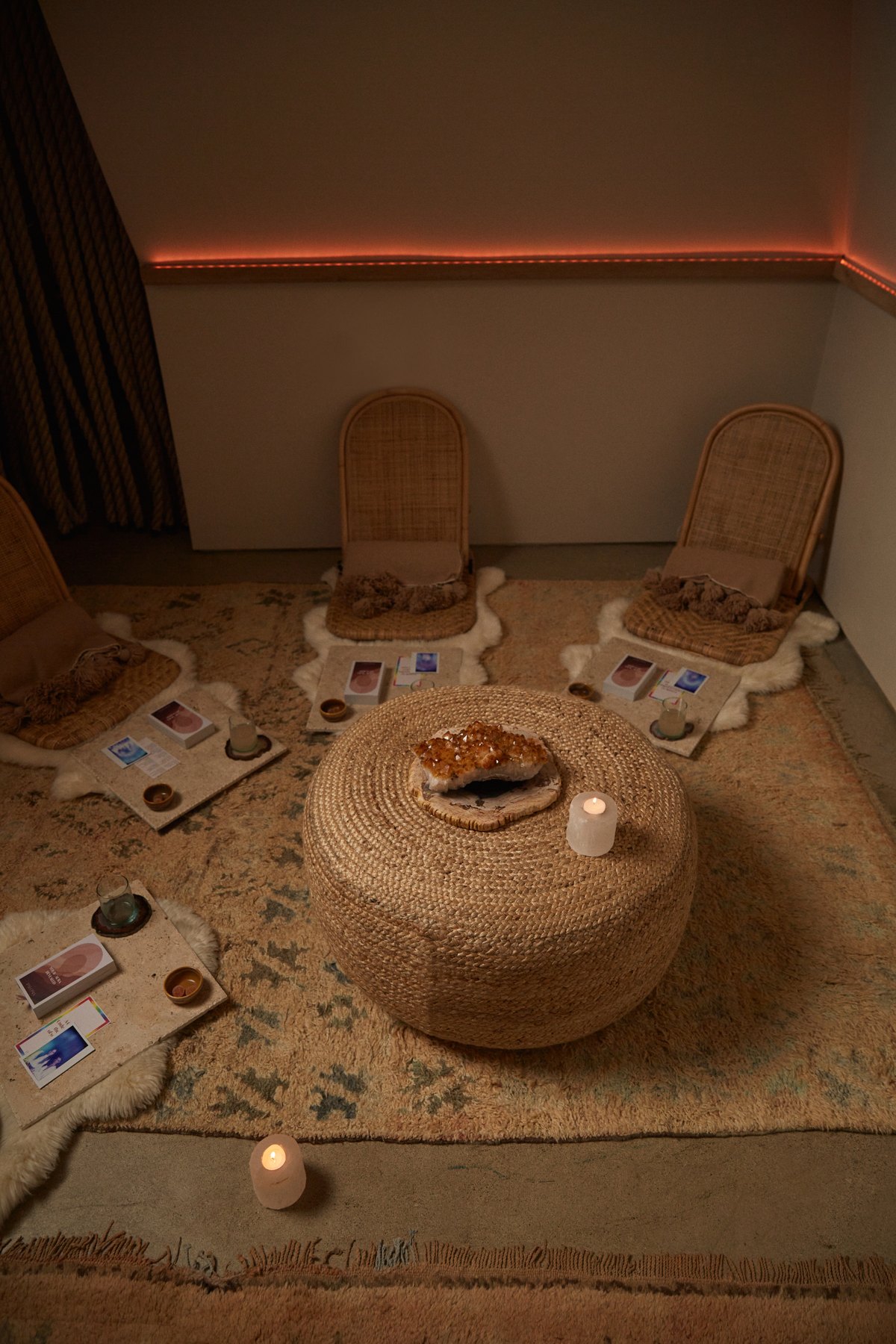
One space. Two kinds of experience, and two ways to have a group one.
A ceremony can be a public class or a private event. Both are real, and a guest may mean either.
The Dome is not an add-on to PALOMA. In the pillars it sits under CONNECT, and it is the clearest expression of that door in the building.
And it is not a niche offering for a certain kind of guest. Every guest should leave knowing what happens in there — whether or not she ever books one.
- PRIVATE SESSIONS
One guest, one practitioner. Reiki, aura photography, palmistry and intuitive readings. Personal, and booked like any other one-to-one service.
- GROUP CEREMONIES — COMMUNITY
Scheduled public classes anyone can book into. Sound, moon and solstice ceremonies held with a small group.
- GROUP CEREMONIES — PRIVATE EVENT
The same ceremonies, taken privately as part of a PALOMA event. Same experience, one group, their own booking.
- WHAT ALL OF IT SHARES
The same room and the same intention — for a guest ready to go past the physical into the energetic, the ceremonial and the spiritual.
Match each one to what it means.
A guest wants to bring eleven people to a ceremony.
You have the room and the date. What do you say?
Up to ten — standard.
Eleven or twelve — management approval.
Never promised above ten without it.
How is the Dome actually different from a treatment room?
Where things happen. This one has a trap in it.
Two of the five private sessions are not fixed, and they are the two a guest is most likely to have heard of.
This is the smallest possible example of the biggest habit in the Academy. Something that is true most days is not something you tell a guest as a fact about today.
- ALWAYS THE DOME
Aura photography. Tarot. Every psychic and intuitive reading. Every group ceremony.
- USUALLY THE DOME
Reiki and palmistry — primarily in the Dome, and occasionally a treatment room depending on availability.
- SO IF SHE ASKS
Confirm with your manager for that day's setup. Do not answer it from memory, and do not answer it from this screen.
Three of these were in the list you just read. One was not.
A group ceremony, from her side of it.
This is the most useful thing you can hold about the Dome, because it answers the question underneath most of her questions: what will actually be expected of me.
Notice what none of that is: a claim. Every line is either what she does, what the room is like, or what people report.
- BEFORE
Arrive ten minutes early. Comfortable clothes. Shoes come off. Nothing heavy to eat for two or three hours beforehand.
- ARRIVING
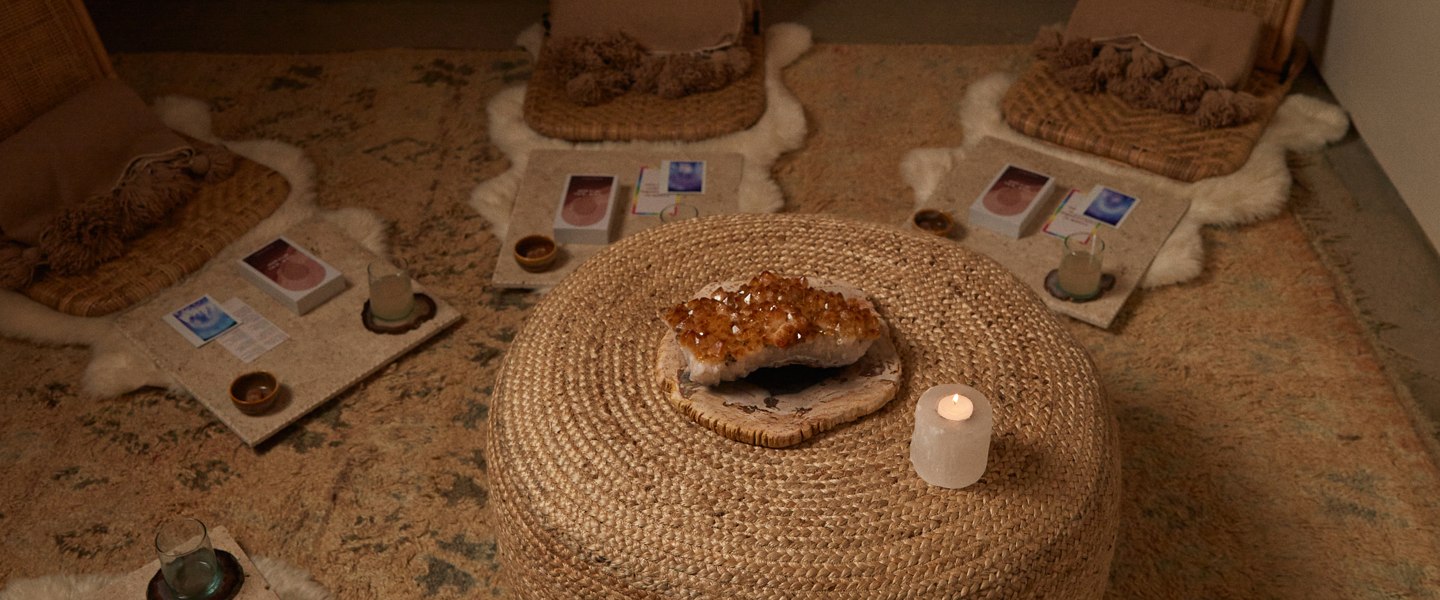
A warm, dimly lit room. Shoes off, and she settles onto a mat in a supported position. A small group — up to ten as standard — and quiet.
- DURING
For a sound bath: completely passive. No movement, nothing to do, no experience needed. A ceremony adds breathwork, reflection, sometimes journaling, and closes in shared silence.
- AFTER
Most people describe feeling lighter, clearer, or deeply rested. Some drift somewhere between awake and asleep. Nobody minds.
Put them back in the order they come.
She's interested and visibly unsure.
“I've never done anything like that.”
What does she need to hear?
A guest asks what Reiki does.
You know a fair amount about it. How much of it is yours?
She has just come out of a massage and looks entirely peaceful.
You think a sound bath would land for her. What do you do with that?
A guest has arrived forty minutes early. The lobby is busy.
The Dome is empty. Is it available?
A guest, mid-checkout, genuinely curious: “What goes on in the Dome?”
Answer her. Out loud is better.
Nobody is marking your words.
The third check is the one that catches good intentions. It's incredibly relaxing and people often say it's the deepest rest they've had are not the same sentence — the second is what people report, the first is a promise.
- One way
“It's our space for the spiritual and meditative side of things — deliberately separate from the treatment rooms. Two kinds of thing happen in there. Private sessions, one-to-one — Reiki, aura photography, readings. And group ceremonies, small groups, sound and moon ceremonies — which you can either book into as a class or take privately for a group. Very different energy from a massage.”
- Another way
“That's where we do everything that isn't hands-on. Some of it's one-to-one — readings, Reiki, the aura camera. And some of it's a group, lying down together, which sounds odd until you've done it. It's the part of PALOMA people don't expect.”
- WHAT IT'S FOR
Did you say what the space is for, not just what's in it?
- BOTH MODES
Did she hear that there are private sessions AND group ceremonies?
- NOTHING PROMISED
Check for an effect — did you say what any of it does for a person?
Two modes. One room, deliberately separate.
Private sessions, one to one. Group ceremonies, up to ten. Under CONNECT, and core rather than niche.
Nothing to do and nothing to believe — that is what the hesitant guest is actually asking about.
Describe the session and say what people report. What it does to her belongs to the practitioner.
Most guests never find the Dome on their own. Say it once, lightly, and let it be.
- Two modes, one room, deliberately separate. Private sessions one to one; group ceremonies up to ten.
- Nothing to do and nothing to believe — that is what the hesitant guest is actually asking about.
- Describe the session and say what people report. What it does to her belongs to the practitioner.
06Wellness Foundations
After thisYou can hold the whole landscape of what PALOMA offers, and place any question a guest asks inside it.
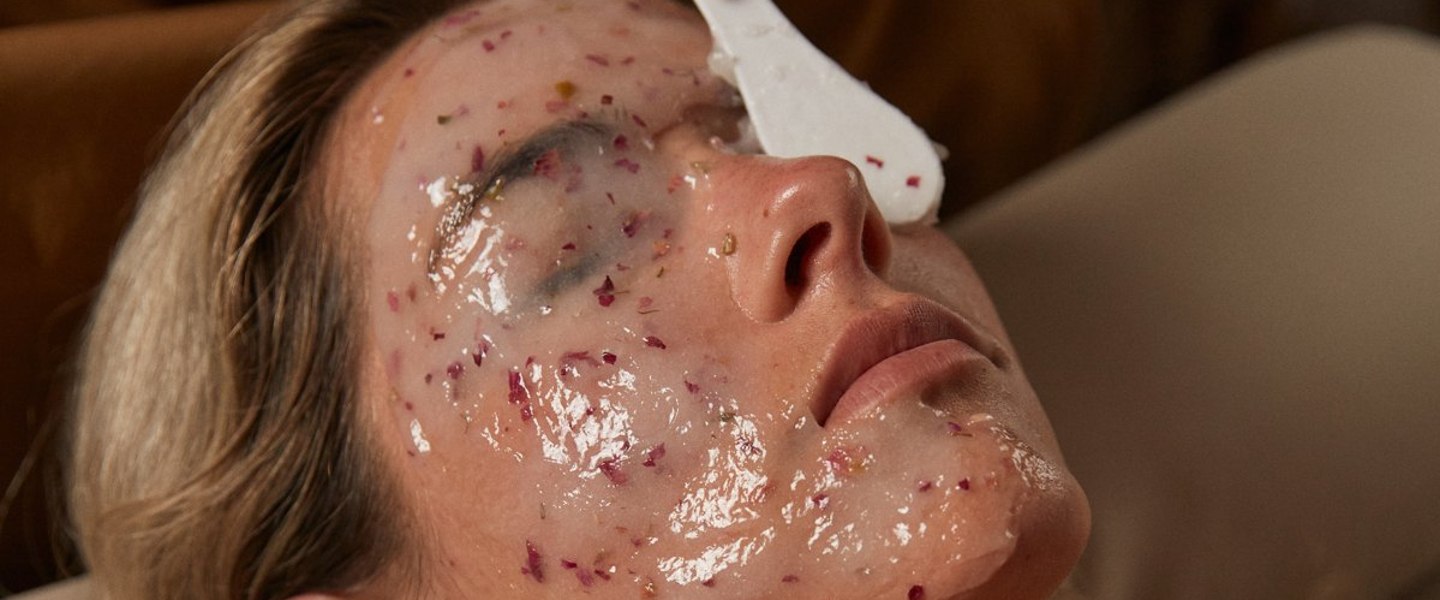
Her first week. A guest asks about something she has never heard of.
Two associates, same gap in their knowledge.
PALOMA's wellness world.
Tap any of them. Two or three at once is better — the comparison is the point.
You are not learning services here. You are learning what kinds of thing exist, so that nothing a guest mentions is a blank.
Some are marked with a dashed outline. Those are real parts of PALOMA's world that PALOMA has not finished writing down. They are on the map on purpose — a map missing a family would read as complete.
Massage + bodywork
REGULATE
- What it is
Hands-on work on muscle and soft tissue, on a table, with oil. PALOMA's largest family by far.
- What happens
She undresses to her comfort, gets under the drape, and a therapist works with her for an hour or so. Superficial to deep to superficial, in every area.
- What it feels like
Unhurried. The opening is deliberately slow, and the close is never rushed — even when the hour has run over.
- How it differs
It splits two ways, and this is the most useful distinction at the desk: RELAXING — spa-centric, about how she leaves. RESTORATIVE — therapeutic, about what she came in with. Inside each, the difference is usually what has been added rather than what is done.
- What you can say
What happens. Which family a service is in. What has been added to it. Whether it is light, medium or firm work — as the service's own description says, not from memory.
- Where you stop
Anything about her body. Pressure she should have, a pain she describes, whether it will help a condition. Her therapist is licensed; you are not.
Infrared sauna
REGULATE
- What it is
A cabin using infrared light rather than heated air. It runs cooler than a traditional sauna and she stays in longer.
- What happens
A private session, programmes she can choose between, and chromotherapy — coloured light during the session.
- What it feels like
Gentler than people expect. A traditional sauna is a heat you endure; this one is a heat you sit inside.
- How it differs
Against a steam or dry sauna: lower air temperature, longer session, and the light is the point rather than the air. Against compression: she is doing nothing rather than being worked on.
- What you can say
That it is infrared rather than heated air. That it feels different from a traditional sauna. The programmes and the chromotherapy colours. And the best question in the whole family: what would you like to feel afterwards — energised, or settled? Use her answer to pick the programme and the colour.
- Where you stop
Why it works. What the light does in the body. Anything about detoxing, immunity, blood pressure or inflammation.
Compression
REGULATE
- What it is
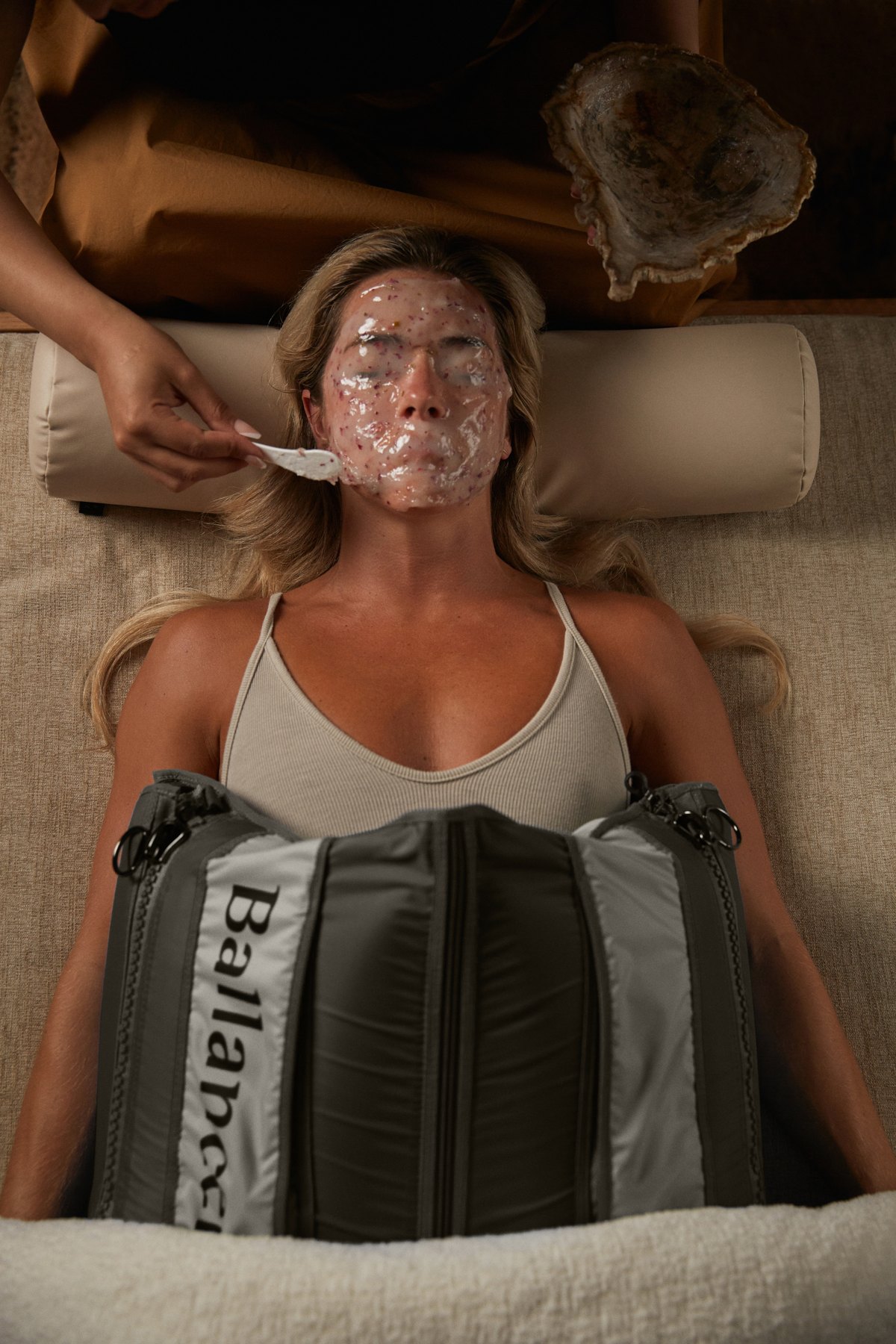
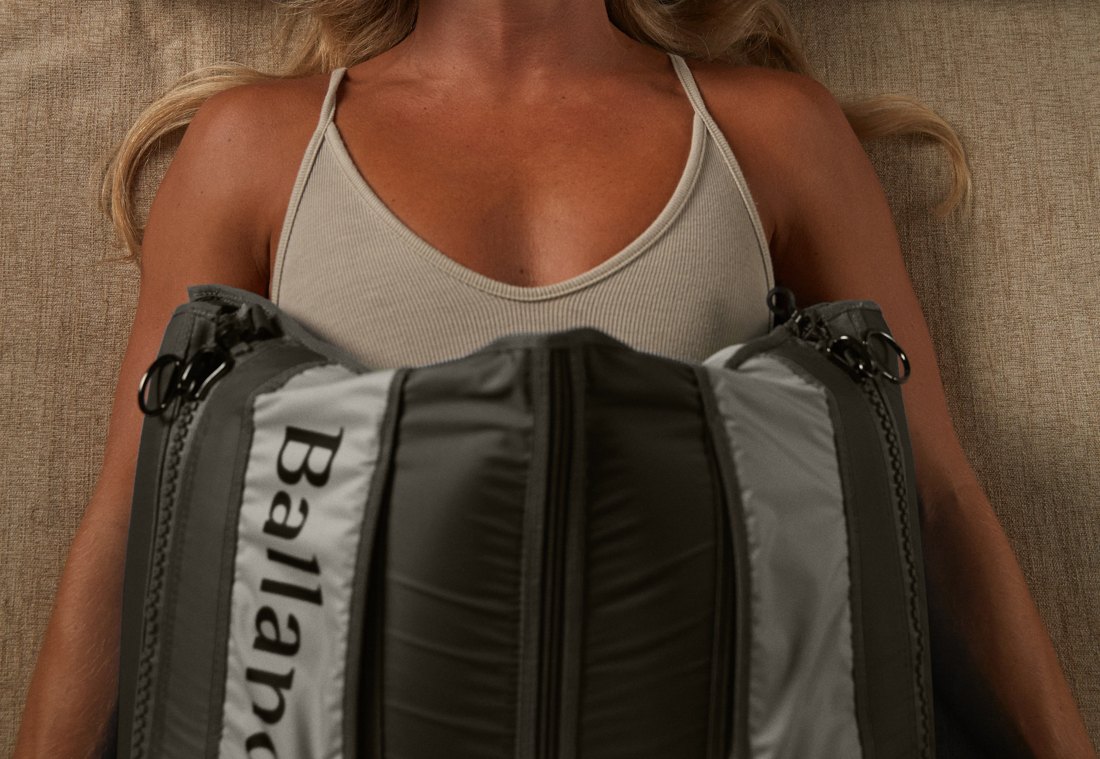
A medical-grade pneumatic compression system — the Ballancer Pro — worn over the lower body.
- What happens
She lies down fully clothed in the garment. Twenty-four chambers inflate in a slow rolling sequence from the feet upward. She does nothing for the session.
- What it feels like
Rhythmic and oddly pleasant. People describe it as being squeezed in a wave. Many find it the most passive thing PALOMA offers.
- How it differs
Against bodywork: no hands, no oil, fully clothed, and the same pressure every time rather than a therapist's judgment. Against the sauna: she is being acted on rather than resting.
- What you can say
What the machine is, what a session involves, and that it is consistent in a way hands cannot be. That it is used in clinical settings is a fact about the device category, and it is safer said as medical-grade than explained.
- Where you stop
What the compression does in her body. If she describes symptoms, you listen; you do not diagnose.
Skin + facials
BEAUTIFY
- What it is
Results-driven skin work, and never separate from how it feels to receive it.
- What happens
On a table, face up, with a facialist working on the skin. Cleansing, treatment steps, and usually something restful in the middle.
- What it feels like
Results without a clinic. The thing guests are surprised by is that a treatment aimed at an outcome is still an hour that feels good.
- How it differs
Three tiers, and the tier is the useful answer: Hydrafacials — device-led · speciality facials — PALOMA's own combinations · foundational facials — the straightforward ones. Against bodywork: face rather than body, and an outcome she can see.
- What you can say
Which tier something is, what happens in it, and that a facialist will assess her skin in the room.
- Where you stop
Her skin. Do not name a concern, do not suggest what is causing something, do not recommend a treatment for a condition.
Sound
CONNECT
- What it is
Live crystal singing bowls played in the Dome while guests lie down. Usually a group, and PALOMA also offers a private session.
- What happens
Shoes off, a mat, a warm and dimly lit room, a small group — up to ten as standard. Completely passive — no movement, nothing to do, no experience needed.
- What it feels like
Most people go somewhere quite far away in the first ten minutes. Some drift between awake and asleep. Nobody minds. The common report afterwards is feeling lighter or deeply rested.
- How it differs
Against everything else at PALOMA: nobody touches her, and she is usually one of a group. A ceremony can be a scheduled public class or a private event — same experience, two ways to book it. Against a meditation class: there is nothing to do correctly.
- What you can say
What happens in the room, what people report, whether it is a class or a private booking, and the sentence that answers the real question: nothing to do and nothing to believe. Up to ten is standard capacity; eleven or twelve needs a manager.
- Where you stop
How it works.
Reiki + energy work
CONNECT
- What it is
A practitioner working with a guest's energy without manipulating the body. One to one, or combined with sound in a group ceremony.
- What happens
She stays fully clothed. She lies down. The practitioner works over or lightly on the body. Usually in the Dome, occasionally a treatment room — confirm the day's setup.
- What it feels like
People commonly describe warmth, tingling, or a sense of something moving. Some feel very little and still leave settled.
- How it differs
Against bodywork: no oil, no undressing, no soft-tissue work. Against sound: one practitioner attending to her specifically.
- What you can say
That it is a gentle energy session, that she stays clothed, what the practitioner does, and what guests tend to describe.
- Where you stop
What it does, and why. An energetic mechanism is still a claim about a person. Offering to ask the practitioner is better than guessing and far better than going blank.
Ceremony + ritual
CONNECT
- What it is
Group gatherings marking something — a lunar phase, a solstice, a turning point. Held in the Dome.
- What happens
A circle, often seated on cushions. Breathwork opens it. Then guided reflection — journaling, visualisation, or simply witnessing. Sound accompanies it. It closes in shared silence.
- What it feels like
More participatory than a sound bath and less demanding than it sounds. Guests often describe feeling connected to something larger, and to the other people in the room.
- How it differs
Against a sound bath: she takes part rather than receives. Full moon and new moon are opposite in intent — release, and intention-setting. Solstice ceremonies happen twice a year and are earth-rooted.
- What you can say
What the ceremony is timed to, what happens in it, and what it asks of her. Naming a tradition as a tradition is an honest sentence.
- Where you stop
Any claim that a lunar phase or a season does something. The tradition is real and the mechanism is not yours to assert — traditionally a time of release is fine; the full moon amplifies energy is not, said as fact.
Crystals
DISCOVER
- What it is
Stones, held and chosen — and PALOMA's clearest bridge between an experience and something she takes home.
- What happens
She picks them up. That is not incidental; it is the method. Seven arch niches in the Crystal Hallway rotate with the seasons.
- What it feels like
Permission. Most people have never been told they may touch anything in a shop.
- How it differs
It is the only family that continues at her house. Against a service: nothing is done to her, and she chooses.
- What you can say
The form — point, sphere, tumble, cluster, pyramid, heart, wand, palm stone — which is answerable about a stone you have never seen. What a stone is traditionally associated with, said exactly like that. How to set an intention, cleanse it, and where it lives.
- Where you stop
What a stone will do for her. Properties are a tradition you name; benefits are a claim you don't. The full property table is on the shelf and is not memorised.
Readings + self-discovery
DISCOVER
- What it is
One-to-one intuitive work — tarot, palmistry, psychic and intuitive readings, and aura photography with a reading. All in the Dome.
- What happens
She sits with a reader. Some come with a question, some come open, and both work. PALOMA's current named rituals include Path of the Spirit (Reiki), Journey of Your Soul (past lives), Spirit Guide, Intuitive Health Mapping, and palmistry at two depths.
- What it feels like
More personal than people expect, and the thing guests say afterwards is usually about being seen rather than about being told something.
- How it differs
Against everything else: it is conversation, not treatment. Against a ceremony: one person, attending to her.
- What you can say
Which reading each is, what happens, and that a reader will meet her wherever she is. Use PALOMA's current ritual names, not the generic modality names — the guest is booking Path of the Spirit, not 'a Reiki session'.
- Where you stop
The content of a reading is the reader's, entirely. And do not explain what the aura camera measures.
Ear seeding
REGULATE
- What it is
Seeds placed on points of the ear — the site calls it acupuncture without the needles. 24k gold or Swarovski seeds.
- What happens
A short private session in the Dome. She leaves with forty additional seeds and a personalised ear map, so she can continue at home.
- What it feels like
Small, precise and surprisingly memorable. The take-home map is the part guests talk about.
- How it differs
The only thing PALOMA offers that continues on her own body afterwards. Against a reading: nothing is interpreted. Against bodywork: nothing is worked.
- What you can say
What it is, what happens, and what she takes home. The phrase acupuncture without the needles is PALOMA's own framing and is safe to use as framing — not as a claim that it does what acupuncture does.
- Where you stop
Anything about points, meridians or effects. The tradition may be named as a tradition; its mechanism is not yours.
Breathwork
CONNECT
- What it is
Guided breathing, used deliberately. At PALOMA it appears inside ceremonies and inside at least one treatment ritual.
- What happens
PALOMA currently offers it as a private session called Basics of Meditation — breathwork and grounding. It also opens the ceremonies and appears inside the Ayurvedic ritual.
- How it differs
Against sound: she is doing something rather than receiving. Against meditation: the instruction is specific.
- What you can say
That there is a private session for it, that it is a starting point rather than an advanced practice, and that it appears inside other experiences too.
- Where you stop
Any physiological effect.
Human Design
DISCOVER
- What it is
A self-discovery system that uses birth information to produce a personal blueprint.
- What happens
Not established at PALOMA.
- How it differs
Against tarot and palmistry: it is calculated from fixed information rather than read in the moment. It is its own framework, and not one PALOMA currently offers as an experience.
- What you can say
A framework people use to explore decision-making, energy, and how they naturally move through the world. Say that; do not extend it.
- Where you stop
Its origins and evidentiary basis. And any reading of hers.
A guest says she wants “something that isn't massage but isn't weird.”
The map earns its keep here. What does she actually mean?
Eight families from the map. Which door does each one sit under?
She has had massages for years and asks what else she should try.
How does a landscape help you answer a question with no wrong answer?
Two families, one question: “what's the difference?”
Which difference is always safe to give?
A guest, entirely new to all of this: “I don't even know what half of this is.”
Give her the landscape in a few sentences.
Neither model named a single service, and both answered her properly.
Nobody is marking your words.
- One way
“Honestly, most of it falls into a few groups. There's hands-on stuff — massage, facials. There's the stuff where you lie there and something happens around you — the sauna, the compression. And then there's the quieter side in the Dome — sound, energy work, readings. Which of those three sounds like you today?”
- Another way
“Think of it as three levels of adventurous. Someone works on you. Something works on you while you do nothing. Or you go into the Dome and it's a completely different thing. Nobody starts at the third one, and plenty of people end up there.”
- SHAPE NOT LIST
Did you group things, rather than name them one by one?
- WHAT SHE DOES
Did you say what she'd actually be doing in each?
- NOTHING PROMISED
Check for a best for, a helps with, or a you'll feel — any of them is a claim.
Twelve families. Four doors.
You are not expected to know every experience. You are expected never to be blank.
Guide the experience. Do not interpret the body.
The detail lives on the shelf, and the shelf is one tap away.
Next: Knowing More Than You Say.
What she does, and what is done to her — the difference that is always safe to give.
- You are not expected to know every experience. You are expected never to be blank.
- What she does, and what is done to her — the difference that is always safe to give.
- Guide the experience. Do not interpret the body.
Work through “Wellness Foundations” on the screens →↑ Contents
06bKnowing More Than You Say
After thisYou can talk comfortably about the wellness world, know more than you say, and turn what a guest tells you into the right experience to offer.
Your ability to speak knowledgeably about wellness transforms transactions into trusted relationships.
Our job isn't to prescribe.
You are a knowledgeable guide. You can know a great deal about this world and talk about it with confidence. What happens inside a guest's body is someone else's to say.
When guests ask “what actually happens during a sound bath,” most staff say “it's relaxing.”
You're going to say something much more interesting — because you'll actually know.
- What most people say
“Sound baths are really relaxing. You just lie down and listen.”
- What you can say
“You're lying down, fully clothed, with a blanket, and someone plays bowls around the room for about an hour. Most people go somewhere quite far away in the first ten minutes.”
What happens, and what people notice — both hers, both substantial.
A couple of people fall asleep every single time, which nobody minds.
The Lymphatic System: Your Body's Hidden Network
This is yours to understand. It is not what any PALOMA service does to her body.
- No pump of its own
Without a pump, lymph moves only through: skeletal muscle contractions (movement), diaphragmatic breathing (deep breathing), intestinal peristalsis (digestive movement), and external compression.
- Nodes
600–700 lymph nodes: Clustered throughout the body — densely in the neck, armpits, groin, and abdomen.
These are the filtration stations of the network, where immune cells process waste and pathogens.
Lymphatic vessels: A second circulatory network running parallel to blood vessels, lined with one-way valves that allow fluid to move in only one direction.
Most people have never thought about their lymphatic system.
Roughly 70–80% of your immune tissue lives in your gut, in a structure called GALT — gut-associated lymphoid tissue.
Sound, light and rest.
The moment a sentence explains WHY, it has become a claim about a body
You can know this. What a guest feels is hers to describe.
- Brainwaves
Your brain is always operating in a brainwave state — measurable electrical patterns that reflect your level of arousal and focus.
Beta · 13–30 Hz · Alert, anxious, busy-minded. Alpha · 8–13 Hz · Relaxed, present, calm. Theta · 4–8 Hz · Deep meditation, creativity, REM. Delta · 0.5–4 Hz · Deep dreamless sleep, profound rest. Being studied, not settled: brainwave entrainment — the idea that the brain naturally synchronizes to a dominant external frequency.
- Infrared
Infrared light exists on the spectrum just below visible red light.
Near Infrared (NIR) 700–1,400 nm · Mid Infrared (MIR) 1,400–3,000 nm · Far Infrared (FIR) 3,000+ nm. What people associate the chromotherapy colours with: Green light — associated with calm and equilibrium. Orange light — associated with joy and emotional release.
- Rest and digest
Your nervous system has a mode for alert and busy, and a mode people call “rest and digest.”
Whose is it to say?
Aura Photography: Beyond “Pretty Colors”
You can know this. What a guest feels is hers to describe.
The content of a reading is the reader's, entirely.
- Bioelectricity
Every cell in your body generates electrical activity.
Neurons fire. Heart cells contract in coordinated electrical cascades. Muscles generate voltage.
- What the camera reads
The aura camera's hand sensors measure changes in the skin's electrical conductance.
Galvanic Skin Response (GSR) — the same technology used in lie detectors and biofeedback therapy. GSR shifts with emotional state, stress levels, and physiological arousal in measurable, reproducible ways. Heart Rate Variability (HRV): Some advanced systems read subtle cardiac signals through fingertip sensors. The algorithm: Sensor data is processed through interpretation software that maps specific readings to color spectra based on frequency and intensity patterns.
- Where it comes from
Modern aura cameras evolved from Kirlian photography, discovered in 1939 by Semyon Kirlian, which photographed the corona discharge of electrical fields around living things.
- Rare
Our aura camera is genuinely rare.
These systems are produced in very limited quantities, and PALOMA is one of only a handful of wellness spaces in the region — or the country — that has one.
- Colour, in the tradition
In aura photography's tradition, each colour carries associations, and so does where it appears.
Red — Vitality, passion, physical energy, grounding, determination. Orange — Creativity, joy, social warmth, enthusiasm, emotional expressiveness. Yellow — Mental clarity, optimism, intellectual energy, confidence, inner sunshine. Green — Heart energy, healing, balance, growth, compassion, natural abundance. Blue — Communication, calm, truth, spiritual awareness, sensitivity and intuition. Purple / Violet — Spiritual awareness, deep insight, connection to higher consciousness, transformational energy. White — Pure energy, enlightenment, integration, spiritual clarity. Pink — Gentle love, compassion, openness, sensitivity, emotional receptivity. · Above the head — Higher self, consciousness, spiritual connection. Left side — Incoming energy. Right side — Outgoing energy. Throat / neck area — Communication, expression. Heart / chest area — Emotional state, love, connection. Lower body / base — Grounding, physical vitality, security. · The reading is an invitation to reflection, not a verdict. Ask open-ended questions: “Does that resonate? Is there anything happening in your life right now that connects to that?”
Listen, offer, route.
- Listen for what she wants — Ask what they're hoping to feel afterward — energized or relaxed, released or restored.
- Offer the experience — Offer one step sideways and one step further, and let her pick the distance.
- Anything about her body goes to a practitioner — The moment a guest mentions pregnancy, a medical condition, a medication or a recent surgery, the answer comes from a practitioner.
What would you like to feel afterwards — energised, or settled?
What she does, and what is done to her.
Her therapist, or the manager on duty if no therapist is free.
At the desk, a guest says:
“I sit at a desk all day.” … “I just feel kind of... heavy and stuck.”
What do you do?
Describe freely. Explain carefully.
Massage, cold and skin are being written; ask your trainer meanwhile.
Next: Heat, Light + Compression.
This is not a smaller answer. It is a more reliable one
- Your understanding got better. What you may say did not change.
- Ask what they're hoping to feel afterward — energized or relaxed, released or restored.
- The moment a guest mentions pregnancy, a medical condition, a medication or a recent surgery, the answer comes from a practitioner.
Work through “Knowing More Than You Say” on the screens →↑ Contents
07Heat, Light + Compression
After thisYou can describe the three things PALOMA does to a body without hands, and route every question about effect.
Two Guides are asked the same question about the infrared sauna.
Both have read the same things. One of them has stepped over a line.
Three ways PALOMA works on a body without a pair of hands.
What these three share is the thing to hold: the equipment does the work, in the same rhythm, every time.
That is the honest difference from bodywork, and it is one a guest can feel the moment you say it. A therapist reads a body and changes what she does. A garment does not.
- HEAT YOU SIT IN
The infrared sauna. A cabin, to herself, with six named programmes rather than six rooms. Four of the six run short and two run long.
- COMPRESSION BY GARMENT
She lies in a garment that inflates and releases in a rhythm. Nobody touches her and she stays covered. Six names, most of them in two sizes.
- HEAT AND COLD INSIDE BODYWORK
Warmed salt stones, and chilled marble used alongside warm work. These are not separate experiences — they are part of a service with hands in it.
Match each one to what it means.
“I'd like to book The Protector.”
This family has more name collisions than any other. What do you ask?
“What does the compression actually do for you?”
The most common question in this family. What can you say?
She asks for the bigger compression session, and you are about to book it.
What do you do about the length?
“I had surgery a few months ago — is the compression all right for me?”
Where does this one go?
Describe the room. Let the effect belong to someone else.
You can say more about this family than you think — the cabin, the dry heat, the garment, the rhythm, being untouched, staying covered, how long you are in there for. None of that is a claim, and all of it is what she actually wanted to know.
What you cannot say yet is what any of it does. For heat and for compression alike, that is still being validated, and so is who each one is not for.
Which room, which programme, how long and how much are all on the screen. Read them; do not remember them.
- You can say more about this family than you think — the cabin, the dry heat, the garment, the rhythm, being untouched and staying covered.
- What you cannot say yet is what any of it does. For heat and compression alike, that is still being validated.
- Which room, which programme, how long and how much are all on the screen. Read them; do not remember them.
Work through “Heat, Light + Compression” on the screens →↑ Contents
08Journeys + Groups
After thisYou can host a journey from arrival to departure, and run the five movements of the retail floor.
A guest booked three services back to back. She has just finished the first.
Two versions of the next ninety seconds.
The journey host. One person, one visit, start to finish.
A journey guest is a VIP, and the mechanism is not luxury — it is that one person is accountable.
She has committed to a full day, often to mark something. Nothing about it should feel coordinated in front of her.
- ASSIGNED BEFORE SHE ARRIVES
One Experience Guide is designated for the duration. Not the person who happens to be free.
- OWNS THE FULL ARC
Arrival through farewell. She introduces herself as the host: I'm your person if you need anything at any point.
- PRESENT AT EVERY TRANSITION
Not only when something goes wrong. Waiting when the guest emerges, rather than scrambling to find her.
- HOLDS THE SEQUENCE
Who collects the guest, when, in what order, from where. Confirmed with every provider before the day starts.
- WATCHES THE WHOLE GROUP
If friends are on the journey together, all of them — not just the one who booked.
Three of these were in the list you just read. One was not.
You are hosting a journey tomorrow. Three services, one guest, a friend joining midway.
What has to exist before she walks in?
Provider one is running fifteen minutes over. The guest is about to come out into a corridor.
What do you actually do?
Two friends are doing a journey together. One of them booked and paid.
How do you treat the one who didn't?
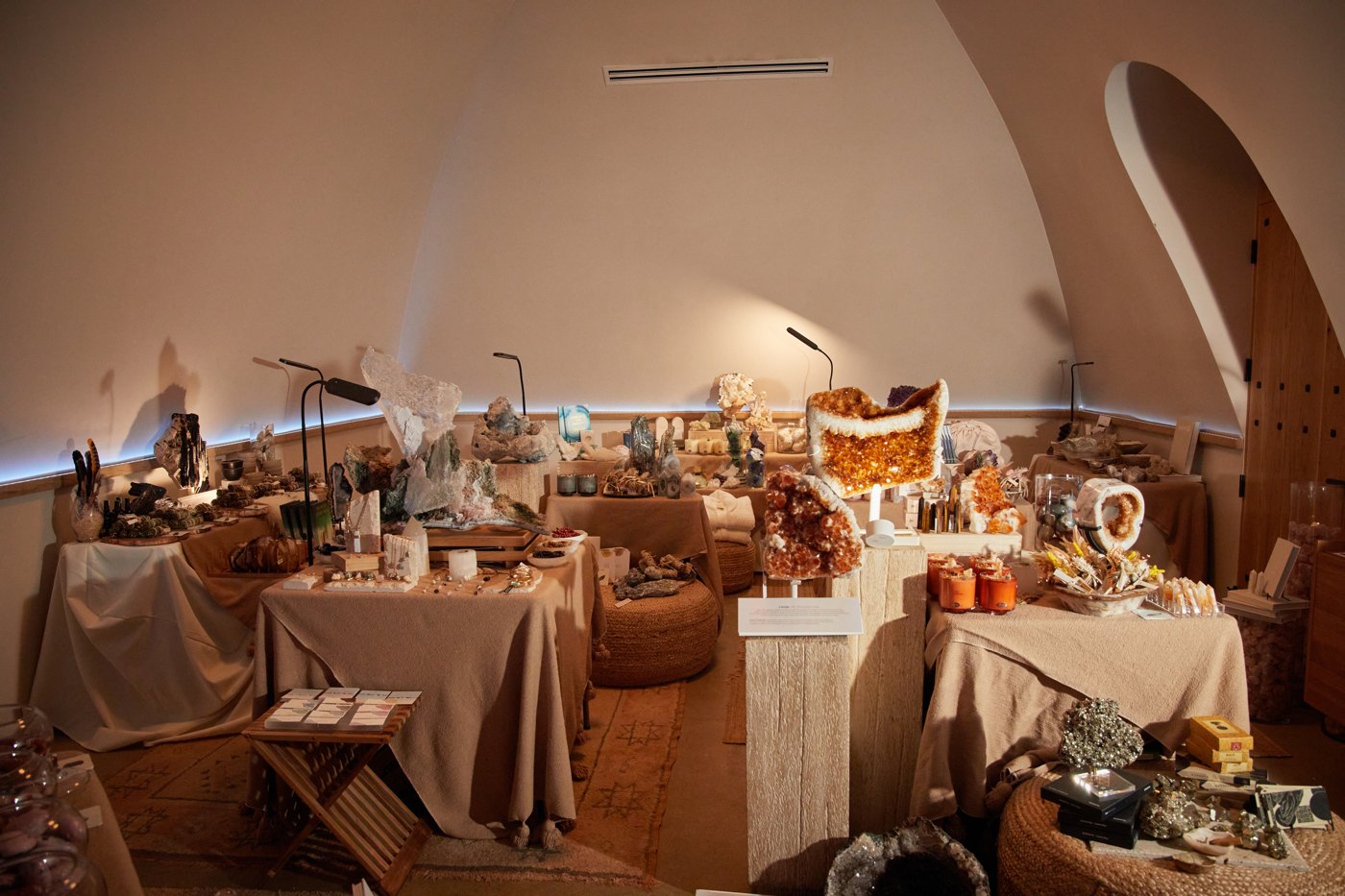
Retail is a journey too. Five movements.
The best greeting prompt in the estate is the one that sounds least like retail: how would you like to feel when you use this?
It is the same question the sauna family uses, and the same one Know + Guide opens with. PALOMA asks about the feeling first, everywhere.
- GREET WITH INTENTION
An open question, to understand what she needs and to spark curiosity. Not can I help.
- REMAIN ATTENTIVE
Linger. Tidy, fill shelves, be reachable — available without hovering.
- ENCOURAGE SAMPLING
Let her try things on her skin. Texture and scent do the work no description can.
- ENGAGE THROUGH STORY
How something fits into a ritual. Yours, or a guest's.
- OFFER FOLLOW-UP
Let her know you're nearby. Then leave her alone.
Match each one to what it means.
Your journey guest walks in. You have been assigned as her host and you have never met her.
Say the first thing you'll say to her.
Nobody is marking your words.
The third check is the one that goes wrong under pressure. A nervous host recites the day. She does not need the itinerary; she needs to know she does not need the itinerary.
- One way
“You must be Maya — I've been looking forward to this. I'm Stella and I'm yours for the whole day, so if you need anything at any point, I'm your person. Come and sit, I've got something for you.”
- Another way
“Welcome — I'm your host today, which means you don't have to keep track of anything. I'll come and get you between everything. Shall we get you settled?”
- YOU'RE HER PERSON
Did you make clear that you are hers for the day?
- ALREADY BEGUN
Did anything signal that the experience has started, rather than is about to?
- NOT A BRIEFING
Check the length — did you hand her a schedule?
Journeys have names, and each one has its own preparation.
One host. One visit. Start to finish.
Assigned before she arrives. Present at every transition, not summoned to one.
Plan B, C and D exist before she walks in. A contingency thought of in advance is calm; the same one improvised is visible.
Never a hallway. Have somewhere ready, and say her time is protected.
If friends are together, all of them. The one who didn't book is the one who tells people.
- Assigned before she arrives. Present at every transition, not summoned to one.
- Plan B, C and D exist before she walks in. A contingency thought of in advance is calm; the same one improvised is visible.
- Never a hallway. Have somewhere ready, and say that her time is protected.
09Which One Do You Mean?
After thisYou can resolve any shared name in one question, without making a guest feel she got it wrong.
“I'd like to book The Healer, please — Thursday if you have anything.”
A guest calls. "I'd like to book The Healer."
Eight names. Each one is more than one thing.
- THE HEALER
A 30-minute focused massage · post-operative compression · pain-relief infrared sauna. Three rooms, three prices.
- THE PROTECTOR
A HydraFacial · full-body detoxification compression · a detoxification infrared sauna. Three again.
- THE PALOMA
The Swedish massage — our signature — and the customized facial. Both are the house anchor in their own family.
- THE MONSOON
A 90-minute massage and a 60-minute facial. Both are about moisture.
- THE SCULPT
A lymphatic drainage facial and a compression session.
- PEACEFUL WARRIOR
Muscle-recovery compression and a stress-management sauna.
- BURNING MAN
A compression session and an infrared sauna.
- CODE OF YOUTH
A facial and a sauna.
She says one of these. Which room was she thinking of?
So what is the question you actually ask?
“I want the detox one. My friend did it here and said it was amazing.”
Harder. She gives you a description instead of a name.
“The Monsoon — the facial. Ninety minutes, like last time.”
She is certain. And she is describing something else.
Which room were you thinking?
Eight names, each of them more than one thing. One question that resolves all eight.
You are not expected to hold the grid. You are expected to hear a shared name and reach for the question before you reach for the calendar.
Next: the whole menu, family by family.
- Eight names, each of them more than one thing. One question resolves all eight.
- “Which room were you thinking?” — asked before you reach for the calendar.
- You are not expected to hold the grid. You are expected to hear a shared name and stop.
Work through “Which One Do You Mean?” on the screens →↑ Contents
10The Whole Menu
After thisYou know what to carry, what to recognise and what to look up — and you can place a guest who has named nothing.
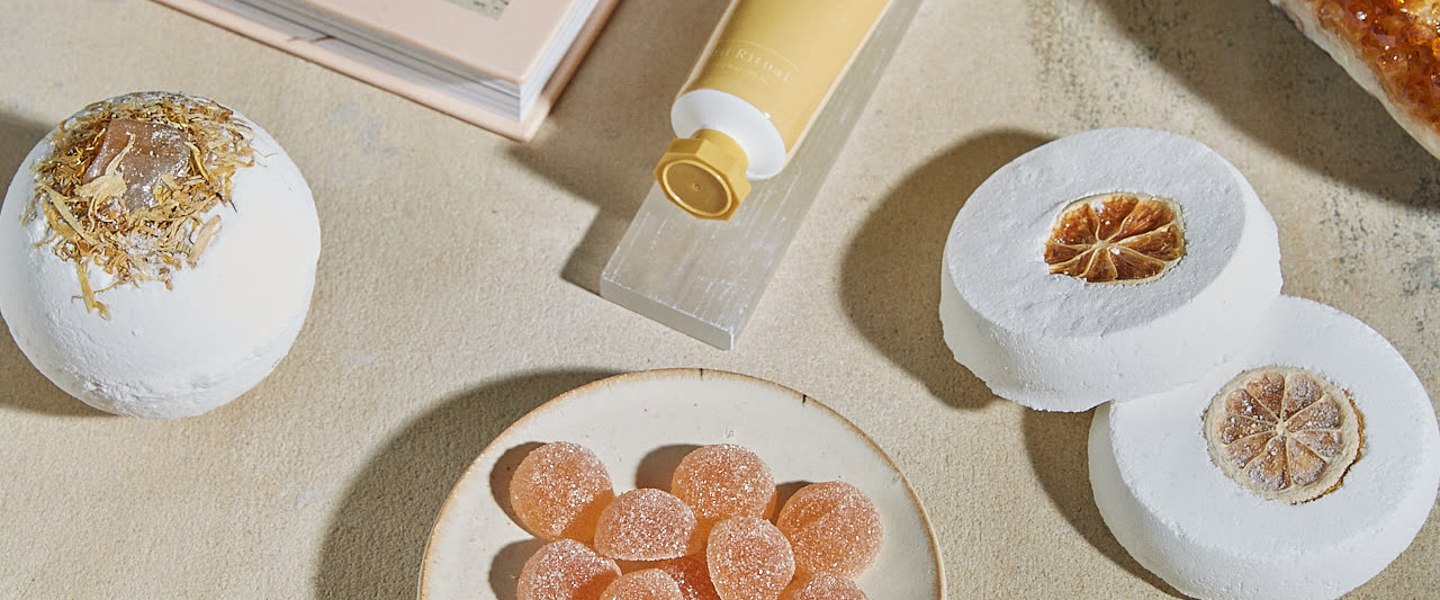
“So what do you actually have here?”
Two Guides, same question, same first week.
Three kinds of knowing. You need all three, differently.
- KNOW
In your head. A guest asks and stopping to look it up would itself be the problem.
The families. The few experiences at the front of each. The differences guests actually ask you to explain. Where your part ends.
- RECOGNIZE
You are never surprised by the name, you know which family it belongs to, and you know where the rest lives.
About forty names sit here — the fifteen facials, the compression and sauna tiers, the packages, the less common rituals.
- LOOK UP
Price. Duration. What is actually available on Thursday. Who delivers it. What is in a package.
These change, which is exactly why you check them rather than remember them. A confident wrong price is worse than a moment's pause.
Three of these were in the list you just read. One was not.
PALOMA, family by family. Open anything.
Eight families. Tap a family, then tap an experience. Some cards are fuller than others — where something is still being written down, it says so.
The Paloma | Swedish Massage
massage · Know this · 60 or 90 minutes · $104 / $144
- What it is
The signature massage, and most guests' first experience of PALOMA. Swedish — long, flowing, moderate pressure.
- What happens
Static touch and several deep breaths before anything begins. Then the work. Then breaths again, a full re-drape, and the chime.
- How it differs
Against The Power: pressure. The Paloma is the one you offer when she has not said she wants to be worked on.
- She might say
I just need to switch off for an hour.
- How to guide it
This is your default. If she has no strong preference, this is the one — and saying so plainly is more useful than offering her twelve options.
- Shares a name with
The Paloma | Customized Facial
The Power | Deep Tissue Massage
massage · Know this · 60 or 90 minutes · $124 / $164
- What it is
Deep pressure, full body. The massage for someone who wants to be worked on rather than soothed.
- What happens
The same four beats as any PALOMA massage — arrive, work, close, follow up. The difference is in the hands, not the shape.
- How it differs
Against The Paloma: pressure, and intention. Against Clear The Path: The Power is full-body deep work; Clear The Path is focused release.
- She might say
I carry everything in my shoulders and I want someone to actually get in there.
- How to guide it
Offer it when she asks for pressure in her own words. Do not upgrade her to it because she mentioned pain — pain is a conversation for her therapist.
The Healer | 30 Minute Focused Massage
massage · Know this · 30 minutes · $58
- What it is
Thirty minutes on one area, chosen by the guest: head and neck, legs and feet, or shoulders and back.
- What happens
One region, the whole time. She chooses which when she books.
- How it differs
Against a full massage: it is not a shorter version of one, it is a different thing — all of the time in one place.
- She might say
I only have half an hour before a meeting.
- How to guide it
The best answer for a short window, and a genuinely good first PALOMA experience. Ask which of the three areas before you book.
- Shares a name with
The Healer | Post-Operative compression · The Healer | Pain Relief Infrared Sauna
Clear The Path | Myofascial Release
massage · Recognise it · 60, 90 or 120 minutes · $248 / $328 / $398
- What it is
Focused myofascial work — slow, sustained release through the fascia rather than through muscle.
- How it differs
Against The Power: The Power is deep pressure across the body; this is slow, specific and unhurried. It is also PALOMA's longest and highest-priced massage, and the only one available at two hours.
- She might say
I've had deep tissue and it never quite gets it.
- How to guide it
Recognise it and route it. A guest asking for this usually knows what myofascial work is — if she does not, her therapist is the right person to explain it.
The Paloma | Customized Facial
skin · Know this · 60 minutes · $128
- What it is
The customised facial — built around her skin on the day rather than around a named protocol.
- How it differs
Against the named facials: every other facial on the menu has a purpose in its name. This one is shaped in the room.
- She might say
I don't really know what my skin needs.
- How to guide it
This is the right answer for exactly that sentence. A guest who cannot name what she wants should not be choosing between fifteen facials.
- Shares a name with
The Paloma | Swedish Massage
The Protector | HydraFacial
skin · Recognise it · 60 minutes · $198
- What it is
The first of three HydraFacial tiers. The other two add a booster, and then a booster plus lymphatic drainage.
- How it differs
Against the other facials: HydraFacial is a device-led treatment and sits in its own ladder of three. Against the other two tiers: this is the base.
- She might say
My friend gets HydraFacials — do you do those?
- How to guide it
Yes, and there are three. Say there is a ladder, offer to check which suits her, and do not guess at what a booster does.
- Shares a name with
The Protector | Full Body Detoxification compression · The Protector | Detoxification Infrared Sauna
The Sculpt | Compression
compression · Recognise it · Core & Lower Body 60 min · Full Body 40 min · $178 / $248
- What it is
A Ballancer compression session. The garment does the work, in a rhythm, rather than a therapist's hands.
- How it differs
Against massage: nobody touches her, and she stays dressed in the garment. Against the other compression sessions: they differ by area and by rhythm, and the names describe what each one is FOR.
- She might say
What's the machine one?
- How to guide it
You can name it, say it is compression, and say whether it covers core and lower body or full body. You cannot say what it will do for her — the name says Cellulite, and a name is not a promise you are able to make.
- Shares a name with
The Sculpt | Lymphatic Drainage Facial
Burning Man | Infrared Sauna
sauna · Recognise it · 10 minutes · $35
- What it is
One of six infrared sauna tiers. Each tier is a different programme in the same room.
- How it differs
Against the other five tiers: the programme and the length. Two of the six run longer — one at thirty-seven minutes and one at forty-five.
- She might say
I want to use the sauna — which one do I pick?
- How to guide it
Name the six as programmes and check the current list with her. The names describe what each is for; they are not outcomes you can promise.
- Shares a name with
Burning Man | Reduce Inches compression
Path of the Spirit | Reiki Ritual
energy · Know this · 60 minutes · $165
- What it is
An hour of energy healing. A practitioner works with her energy field; she stays clothed and still.
- How it differs
Against massage: no pressure, no oil, often no touch at all. Against sound: sound fills the room; reiki is directed at her.
- She might say
I don't really know what reiki is, but someone said I should try it.
- How to guide it
You can say what happens and that plenty of guests arrive unsure. You do not need to sell her on believing in it — she does not have to believe in any of it to be here.
- Also called
Reiki Sessions · Reiki
Intuitive Health Mapping
energy · Recognise it · 60 minutes · $165
- How it differs
It sits with our readings rather than with anything on the table.
- She might say
What's Intuitive Health Mapping? Is it like a check-up?
- How to guide it
Name it, say it is with Flor, and bring her in. This is the clearest case in the house of a question you hand over rather than answer.
Meditative Sound Ceremony | Immersive Sound Bath
dome · Know this · About 60 minutes · $40
- What it is
A sound bath in the Dome. Crystal singing bowls, a group, and nothing required of her but to lie down.
- What happens
She arrives, finds a mat, and the room is played. No participation, no speaking, no experience needed.
- How it differs
Against a one-to-one sound session: this is a group, and the room is part of it. Against the moon and seasonal ceremonies: those change with the calendar; this one runs regularly.
- She might say
I've never done anything like this — will I have to do something?
- How to guide it
The best first ceremony for someone nervous. Standard capacity is ten; eleven or twelve needs management approval, and you never promise above ten without it. The current ceremony names change with the season — always read them off the schedule rather than from memory.
Fire Within
journeys · Recognise it · 130 minutes · $248
- What it is
A journey rather than a service: two experiences made into one hosted visit — a ninety-minute Grounding Stone massage and time in the sauna.
- How it differs
Against booking the two separately: a journey is hosted start to finish by one person, and each journey has its own arrival beverage, its own preparation and its own parting gift.
- She might say
I want to make an afternoon of it.
- How to guide it
Name the two journeys and what is in each. Then look up what this one needs prepared — the beverage and the gift are specific to the journey, and preparing them from memory is how a parting gift goes missing.
Crystal Healing Therapy
enhancements · Recognise it · Adds 10 minutes · $10
- What it is
An enhancement added to a facial — weighted crystals resting on the body during the treatment. It adds ten minutes.
- How it differs
Against a service: an enhancement is never booked on its own, and each one attaches only to certain services. This one goes with a facial.
- She might say
What's the crystal one I saw on your website?
- How to guide it
Offer it with a facial. It adds ten minutes. If a guest mentions the crystal blanket she saw on our website, this is the one she means.
- Also called
Crystal Weighted Blanket (as it appears on our website)
The Himalayan | Salt Stone Massage
massage · Recognise it · 60 or 90 minutes · $148 / $188
- What it is
Swedish worked with warmed Himalayan salt stones.
- How it differs
Against The Grounding Stone: both are warm salt stone. The Grounding Stone adds warm oil. That is the difference a guest will ask you for.
- She might say
Which of the hot stone ones should I have?
- How to guide it
Name both, name the oil, and let her choose. They are genuinely close and she is allowed to pick on instinct.
The Grounding Stone | Hot Salt Stones + Warm Oil
massage · Recognise it · 60 or 90 minutes · $158 / $198
- What it is
Warmed salt stones with heated oil.
- How it differs
Against The Himalayan: the oil. Warmer, heavier, and the more indulgent of the two.
The Higher Realm | CBD Massage
massage · Recognise it · 60 or 90 minutes · Swedish $128 / $168 · Deep Pressure $148 / $188
- What it is
A CBD massage, offered at two pressures — Swedish or deep.
- How it differs
One service with a pressure choice, not two services. Ask which pressure when she books.
- She might say
Do you do the CBD one?
- How to guide it
Yes, and ask Swedish or deep. That one question is the whole of it.
The Mother | Pre & Post Natal Massage
massage · Recognise it · 60 or 90 minutes · $148 / $188
- What it is
Pregnancy and post-natal massage, with positioning adapted for it.
- How it differs
It is the one massage with its own positioning. Not a Swedish with cushions.
- How to guide it
Book it by name. Anything about her stage, her comfort or her clinician goes to her therapist, not to you.
The Meridian Ritual | Cupping Massage
massage · Recognise it · 60 or 90 minutes · $148 / $188
- What it is
Cupping massage, worked along the meridian lines.
- How it differs
The only massage on the menu that uses cups. Not an add-on — a service in its own right.
- She might say
Do you do cupping?
- How to guide it
Yes, and it is a full service rather than something added to another massage. Mention that the cups can mark the skin and let her therapist explain the rest.
The Monsoon | Moisture Drench Massage
massage · Recognise it · 90 minutes · $188
- What it is
A ninety-minute massage built around moisture, with a sea mineral scrub on legs and feet.
- How it differs
Against the facial of the same name: this is the massage. Ninety minutes, on the table.
- Shares a name with
The Monsoon | Moisture Drench Facial
The Reformer | Therapeutic Massage
massage · Recognise it · 60 or 90 minutes · $148 / $188
- What it is
Therapeutic massage — myofascial work, passive stretching and focused attention.
- How it differs
Against Clear The Path: both are therapeutic. The Reformer adds stretching, and costs $100 less at sixty minutes.
UMA Detoxifying Ayurvedic Body Ritual
massage · Recognise it · 90 minutes · $228
- What it is
A ninety-minute Ayurvedic body ritual — lymphatic massage, dry brushing and breathwork.
- How it differs
The only massage that includes dry brushing and breathwork. It is a ritual rather than a treatment, and it is priced accordingly.
The other thirteen facials
skin · Recognise it · 30 to 90 minutes · $68 to $298
- What it is
Beyond the customised facial and the HydraFacial ladder, the rest of the menu is named for what it is for.
- How it differs
Soothing reset — The Alchemist. Moisture — The Monsoon. Brightening — The Lightworker. Acne — The Clearing. Anti-aging — Code of Youth. Lymphatic — The Sculpt. Ritual facials — Sacred Blooms and Ojas UMA. Short — Second Skin and The Awakening at thirty minutes, The Clean Slate at seventy-five.
- She might say
I don't know which facial I want.
- How to guide it
Walk the line with her: soothing, moisture, brightening, acne, anti-aging, lymphatic — or customised if none of those is it. That is six questions, not fifteen options.
The other compression sessions
compression · Recognise it · Core & Lower Body 45–60 min · Full Body 40 min · $178 / $248
- What it is
Five names, most in two sizes — Core & Lower Body, or Full Body.
- How it differs
The Sculpt · Burning Man · The Protector · The Healer · Peaceful Warrior. They differ by area and by rhythm, and each name says what that one is for.
- How to guide it
Name them, ask which area, and read the current price off the screen. Every one of these names also belongs to something else in the house.
The other sauna programmes
sauna · Recognise it · 10 to 45 minutes · $35 to $45
- What it is
Six named infrared programmes in one room.
- How it differs
The Protector · The Healer · Peaceful Worrier · Burning Man · Code of Youth · Sacred Heart. Four run short; The Protector runs thirty-seven minutes and Sacred Heart forty-five.
- How to guide it
There is also a four-session pack and an unlimited monthly option — mention them to anyone using the sauna more than once.
Palmistry, tarot and the readings
energy · Recognise it · 30 or 60 minutes · Focused $55–$85 · Comprehensive $105–$165 · Aura for two $120
- What it is
Readings at two depths: an hour comprehensive, or thirty minutes focused on one question.
- How it differs
PALMISTRY — comprehensive, or focused on Love, Career or Wellbeing. TAROT — comprehensive, or focused on Love, Career or Direction. Plus Journey Of Your Soul, Spirit Guide Intuitive Reading, and Aura Photography with a reading, which is also offered for two.
- She might say
How long is a reading?
- How to guide it
Ask whether she has one thing on her mind or wants the whole picture. That is the sixty-versus-thirty question, and it is the only one she needs to answer.
Sound Healing
energy · Know this · About 60 minutes · Ceremony in the Dome $40. Private session: confirm at the desk
- What it is
Crystal singing bowls, played for her. Offered one to one as well as in the Dome as a ceremony.
- What happens
She lies down. The bowls are played. Nothing is asked of her.
- How it differs
Against reiki: sound fills the room; reiki is directed at her. Against the Dome ceremony of the same shape: one is hers alone, the other is a group.
- She might say
What's the one with the bowls?
- How to guide it
The easiest yes in the house for someone curious about the quieter side. Check whether she means the private session or a ceremony in the Dome — they are priced differently.
Moon, equinox and seasonal ceremonies
dome · Recognise it · About 60 minutes · $38 to $115 depending on the ceremony
- What it is
Ceremonies that follow the calendar rather than a fixed menu — full moon, new moon, the equinox, and specials through the year.
- How it differs
They change. A name that runs this month may be gone next month, which is why you read the current ones off the schedule rather than from memory.
- She might say
What's coming up in the Dome?
- How to guide it
Open the schedule with her. Standard capacity is ten; eleven or twelve needs management approval and you never promise above ten without it.
Nourish Within
journeys · Recognise it · 150 minutes · $378
- What it is
The second journey — a ninety-minute Monsoon massage and the Monsoon facial, in one hosted visit.
- How it differs
Against Fire Within: this one pairs a massage with a facial rather than with heat. It is the longer and more expensive of the two.
Packages
enhancements · Look it up · $98 to $2,256
- What it is
Ten packages: massage six-packs, a sauna four-pack, an unlimited monthly sauna, and the lymphatic ladder in three, six and twelve.
- How it differs
A package is a container, not an experience. What is in it and what it costs are looked up in front of her, every time.
- She might say
Is it cheaper if I buy a few?
- How to guide it
Yes, and open the list with her rather than quoting from memory. Anything about how a package is redeemed, shared or expires: bring a manager in.
The other enhancements
enhancements · Recognise it · $7 to $35
- What it is
Small additions to something already booked. Aromatherapy, a hot towel foot treatment, a CBD treat, dermaplaning, a hydrojelly mask, and LED.
- How it differs
Each attaches only to certain services — some to massage, some to a facial, one to both. Three of them add time to the appointment.
- She might say
Is there anything I can add?
- How to guide it
Offer by what she has booked, not by the whole list. Check the pairing and the added time at the desk before you promise either.
“I ran a half marathon on Sunday and my legs are wrecked. I've got about forty minutes.”
She has not named anything. Place her.
“So what do you have here?” Four sentences. Yours.
Not the list. The shape of the house, and then a question back.
- One way
“Four kinds of thing, really — bodywork, skin, heat, and the quieter side: sound, energy work, readings, ceremonies in the Dome. Most people start on the table or in the Dome. Which of those sounds more like today?”
- Another
“We're a wellness house rather than a spa, so it's broader than you'd expect — massage and bodywork, skin, sauna and compression, and then sound, energy and readings. I'd usually start someone on the table. What brought you in?”
- Did you give her shapes rather than categories?
Bodywork, skin, heat, the quieter side. Four is holdable. Nine is a list.
- Did you name a default?
Most people start on the table or in the Dome. A guest with no idea needs a starting point more than she needs options.
- Did you end with a question?
Anything that hands it back to her. Which sounds more like today?
- Did you promise anything?
Check your own sentences for what an experience will do for her. Naming is yours. Outcomes are not.
Eight families. A few at the front of each. Everything else, look up.
Seventy-two things a guest can book. Eleven things you actually hold in your head.
That is not because the menu is small. It is because fluency was never memorisation — it is knowing the shape of the house well enough to place someone inside it, and knowing exactly where to look for the rest.
The families that are still filling in will fill in. The way you use them will not change.
- Seventy-two things a guest can book. Eleven you actually hold in your head.
- Fluency was never memorisation — it is knowing the shape of the house well enough to place anything in it.
- The families still filling in will fill in. The way you use them will not change.