Module 3 · The Guest
Guest Engagement
How to greet, connect with and delight every guest, from the door to the warm goodbye.
About 55 min to read · then Check yourself
Chapter one
How PALOMA sounds
Everything in this module happens in a voice. Before we follow a guest through the door, it helps to hear what that voice is, because a guest hears it before she understands a single word you say.
A guest walks in for the first time. Which one helps her exhale?
Tap the answer you would give.
Worth a second look.
A isn't unfriendly. It's efficient.
But it asks her to answer four things before she's arrived.
Yes.
Both are friendly. Both are competent.
A gives her four things to process before she's put her bag down. B gives her room.
Same information. Different nervous system.
Both of those were friendly, and both were competent. One gave her four things to process before she had put her bag down; the other gave her room. Same information, different nervous system. That difference is the whole of PALOMA's voice, and there is a test you can run on any sentence, forever:
If the words don't help you exhale, they probably aren't PALOMA.
PALOMA's voice has four dimensions, and each one is easiest to hear by what it is not.
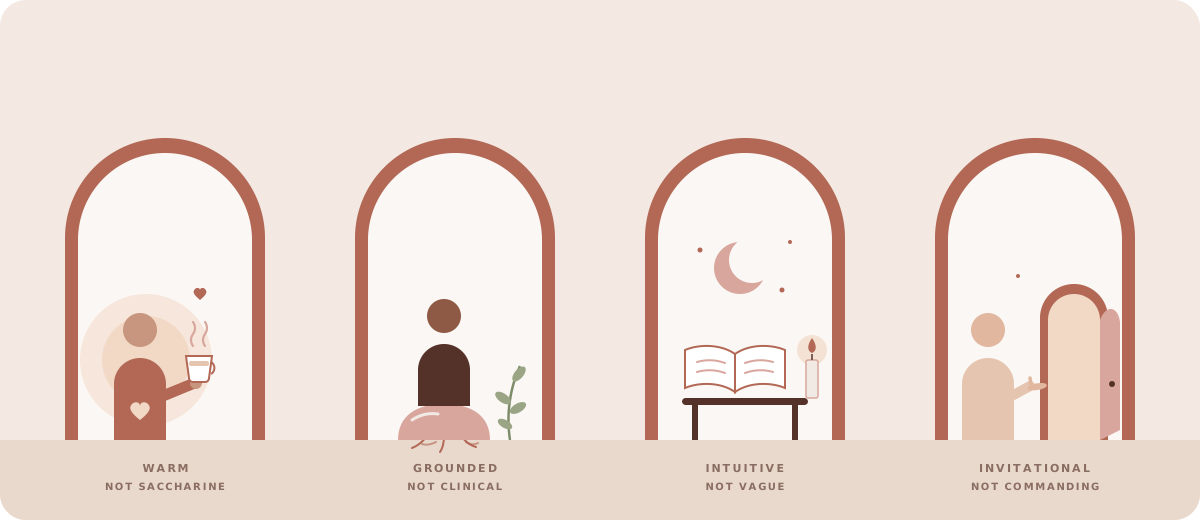
- Warm
- Not saccharine. Warmth is presence, not performance.
- Grounded
- Not clinical. Knowledge should create trust, not distance.
- Intuitive
- Not vague. Room for ritual and meaning, without pretending it is evidence.
- Invitational
- Not commanding. PALOMA guides. The guest decides.
Put together, they sound like a calm, grounded friend who happens to know a great deal. And because she knows a great deal, she doesn't need big words. We are confident enough to be simple.
Use the most human word
Every word on PALOMA's list is allowed. Strung together, they can be unbearable. Ask a guest what the Dome is and answer "our sacred space — a really intentional, elevated environment for holistic practices", and she still doesn't know what the room is. Say "it's the big domed room at the back. We use it for sound baths, ceremonies, sometimes private events. It's the quietest room in the building," and she does.
Use the most human word that still says what we mean.
A few words do carry a real distinction. Guest, not client: a client is someone you have a transaction with; a guest is someone in your home. Settle is often more human than regulate. And when a guest uses a word like detox, it is information, not necessarily PALOMA language. We don't police her words, and we don't build a promise on them either. We find out what she means.
“I really need to detox. I've been so bad lately.”
What do you do with her word?
Tap the answer you would give.
Accurate, and it corrects her in her first sentence.
Guest language is information, not necessarily PALOMA language. We don't police her words.
This adopts her word and then attaches a claim to it.
Using her language back is fine. Building a promise on it isn't.
Yes.
You used her word without correcting it or endorsing it, and you found out what she actually means.
Two people say “detox” and mean completely different afternoons.
Chapter two
Five laws, in one order
When PALOMA speaks, it is always doing five things, and they come in an order. The first one holds up the other four.
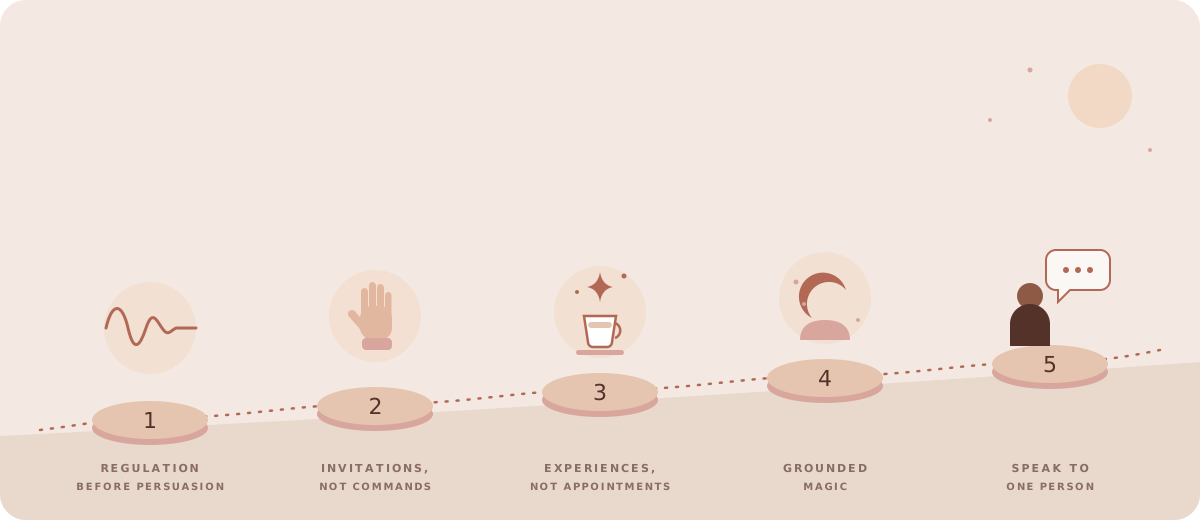
- 1 · Regulation before persuasion
- Calm first. Slow before adding information. Reassure before correcting. Connect before converting. Nothing gets sold to a nervous system that hasn't landed yet.
- 2 · Invitations, not commands
- Soft verbs: begin, reserve, explore. The choice stays hers. And no verb rescues manufactured urgency; if we genuinely are full, say so. Factual scarcity is fine. Inventing it is not.
- 3 · Experiences, not appointments
- Tell her what each option will feel like, not how many minutes it lasts. The sixty gives you enough time to actually stop thinking. The thirty is more of a reset.
- 4 · Grounded magic
- We don't use science to prove the magic, and we don't use magic to make scientific claims. Describe what happens and what people tend to find. Both true, neither overclaimed.
- 5 · Speak to one person
- One thoughtful human, not a segment. If you can come fifteen minutes early, you'll get the sauna before your massage is written to a person. Guests are encouraged to arrive fifteen minutes prior is addressed to nobody.
“I was going to book the facial but honestly I don't know if it's worth it.”
Under pressure, which one still holds?
Tap the answer you would give.
Fast, warm, and it answers a question she didn't quite ask.
She said she doesn't know. That's information, not an objection to overcome.
Yes — and it takes four seconds.
Regulation before persuasion holds even when you're busy. Especially then.
One question, and now you know whether this is about money, time, or whether her skin will react.
Kind, and it closes the door.
She told you something was unresolved. Letting it go isn't neutral; it's leaving her with it.
Sometimes necessary — and here it turns a half-open door into a closed one.
The question above is shorter than this sentence.
Say it in your own words
You will be asked what PALOMA is a thousand times. It should never sound like the thousandth. Recited correctly is still recited, and the guest hears the seams. So the rule is simple: understand the intention, and make the words your own. However you say it, three things have to survive:
Mental, physical and emotional. Not just the body on the table.
The clinical and the soulful, under one roof, without pretending they're the same thing.
She isn't expected to study a menu. That's our job, not hers.
Everything else is yours. And match the length of your answer to the question: a guest asking with one arm in her coat gets one sentence. Depth is the guest's choice, not ours.
“I've never done anything like the sound thing. Is that — I don't know. Is that for people like me?”
She's asking two questions. Answer the real one.
Tap the answer you would give.
Warm, and it answers the question she said out loud.
The one underneath was am I allowed to be curious about this. You sold the room instead of opening the door.
Yes.
PALOMA offers a world. The guest chooses how much of it to enter.
You took the entry requirement off the table and left the door open. She came for a facial and she is still, entirely, having a facial.
Honest, and it quietly sorts her into a type of person.
She asked whether she belongs. This answers maybe, depending.
PALOMA offers a world. The guest chooses how much of it to enter.
Chapter three
Before she arrives
Now the guest. Her visit begins before she walks in, because most of what a guest feels was decided in the hour before she arrived. The house is ready before anyone comes. So should you be: knowing the building not as where things are kept, but as what it is like to be inside it.
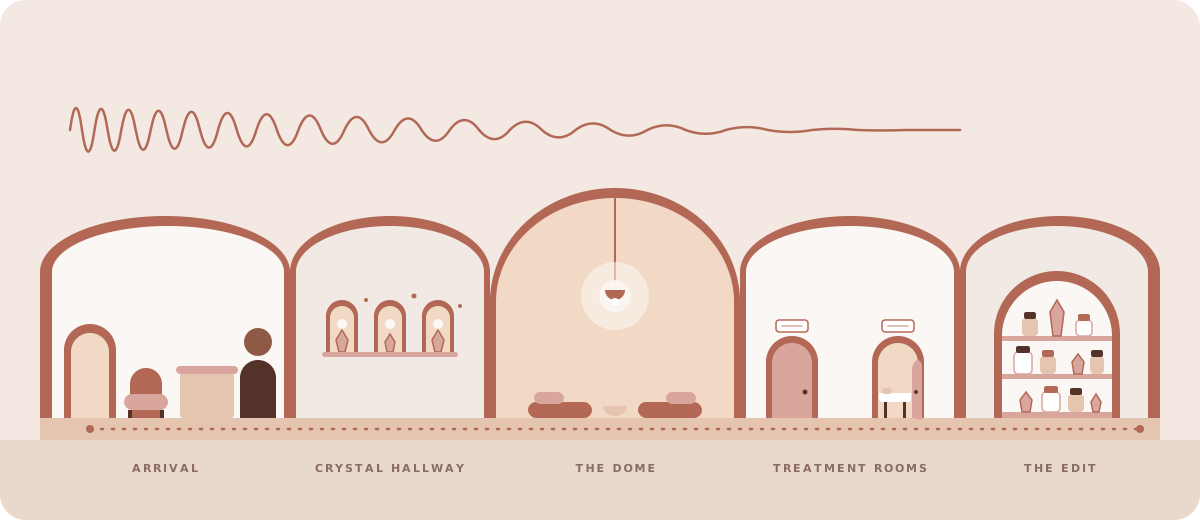
A guest moves from loudest to quietest as she goes in. The front of the house is the only place that is meant to feel lively. She arrives at a counter with nothing on it, because a counter with things on it is a place to be processed, and a counter with nothing on it is a place to be met. She passes the Crystal Hallway, seven arches of specimens that rotate with the seasons, where guests slow down without being asked. There is the Dome, the one space built for more than one person at a time, and where guests land when it isn't booked. There are the treatment rooms, each with a name rather than a number — Mindry, Higher Realm, Sanctuary, Bungalow, Hideaway, Refuge and Retreat — because "she's in the Hideaway" sounds like somewhere rather than a slot. And at the end, the Edit, the one she reaches for on her way out.
Where you stand
- Not behind the desk
- The desk is somewhere you go to do a thing, not somewhere you live. Get out from behind it.
- Walk the retail space
- Most retail conversations start because someone was already standing nearby.
- Keep an eye on her glass
- Notice it before she does. It is the smallest thing here, and it is the one guests remember.
- The desk is fine; distracted is not
- There is nothing wrong with being at the desk. There is something wrong with being absorbed in it while a guest is in the room.
And when she asks you something, you have a shelf. Reference holds what each service is, what is in it, who it is not for and what it costs. Looking something up in front of her is not a failure; it is what the shelf is for. A question about her own booking is answered where her booking lives. And the moment she mentions pregnancy, a medical condition, a medication or a recent surgery, the answer comes from a practitioner.
The shelf makes you useful. It does not make you qualified.
Chapter four
The door
Exceptional guest service is like welcoming guests into your home: the personal care, the attention to detail, the genuine hospitality you would give someone in your own home. We check every guest in and out the same way every time, because it gives us consistency, efficiency, safety, personal service, strong first and last impressions, a better experience, and what we need to keep improving.
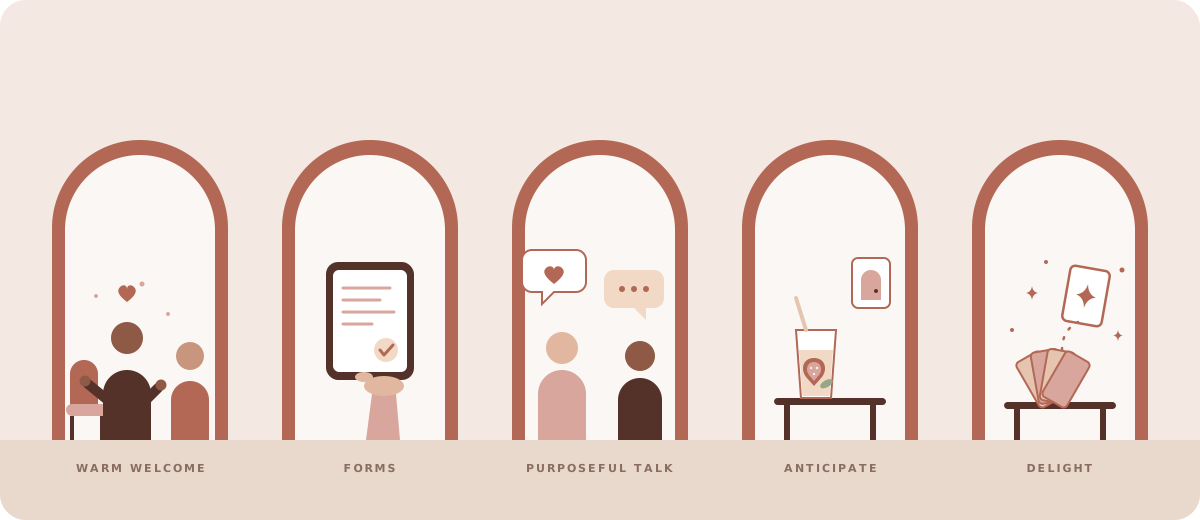
1 · Warm welcome
- 1Stand up from your chair and offer a warm, genuine welcome — a smile and open arms, as at home.
- 2If two associates are behind the desk, both stand.A simple gesture that shows we are all happy to see our guests.
Warm welcome script prompts
- “Welcome, what brings you in today?”
- “Hello. We are so happy you are here. May I have your name to get you checked in?”
- “Thank you for being here [Name]. Would you like to use the restroom?”
- “May I offer you a glass of our spa water infused with [Flavor]?”
- 1Bring appointment notes into your welcome. If notes are captured in the appointment, bring them into conversation naturally.“Welcome and HAPPY birthday; thank you for choosing to celebrate with us!”
2 · Efficiency and organization
A structured check-in streamlines guest flow and sets her experience up for success.
- 1Confirm all intake forms are completed.“I'm just going to confirm that we have all of your intake forms completed before I get you checked in.”Look at all forms for all services. If a guest has more than one service booked, check for forms attached to each one.
- 2If the guest needs to complete forms, tell them which ones and hand them the iPad.“Okay [Name], it looks like we have 2 intake forms that we need you to fill out. The first is your CBD consent form and the second is your massage intake form. Once you've completed both of these you can bring the iPad back up to the front desk and we will get you checked in!”
- 3If it is a specialty service, prepare the accoutrements while they fill out forms.“[Name], your Higher Realm massage comes with 2 CBD gummies, would you like both right now or 1 for now and 1 for later?”Or: “You are scheduled for The Alchemist facial today, which is our probiotic facial. Would you like your shot of kombucha before or after your facial?”
- 4Check the guest in once forms are complete.When they bring the iPad back, submit their intake forms and officially check them in to the system.
3 · Purposeful interaction
At PALOMA, small talk is done with intention and purpose. We actively engage with guests to understand their needs and preferences.
For new guests, ask
- “I see this is your first time at PALOMA. Welcome again. How did you hear about us?”
- “May I share a bit about the provider you are booked with?”
- “I see you are booked for the [Service Name]; this experience is thoughtfully curated with [high-level details].”
- “PALOMA offers a variety of experiences across our four pillars: Regulate, Connect, Beautify and Discover. Have you taken a peek at our Dome?”
For existing guests, ask
- “I see you typically book with [Provider], and today you are booked with [Provider]. May I share a bit about the provider you are booked with?”
- “I see you are booked for the [Service Name]; this experience is thoughtfully curated with [high-level details].”
- “I was reviewing your guest profile and would love to share some additional experiences PALOMA offers in our Dome.”
- “I was reviewing your guest profile and saw your purchase [Product Name]; how are you liking it?”
4 · Anticipating needs
- 1Offer water and a restroom reminder.“[Name], would you like a glass of strawberry lemon infused water? If you need to use the restroom before your service begins, it's the third door on the left down the main hallway.”
- 2Make genuine conversation. Make it fun and personable!Ask if it's their first time, how they heard about us, where they're from, what types of massages they normally get.
- 3If the therapist match feels off, privately coach the therapist — keep this conversation private from the guest.If you sense the guest might not be booked with the therapist who will best support them, encourage the guest to be detailed in their intake, then pop into the break room and share your conversation with the therapist before the appointment starts.
- 4If they're doing a spa journey, share how excited you are for them to be scheduled for two services.Then pop into the break room to make sure the Coordinator remembers the journey tote.
- 5If they mention a gift card, get that information before they go into their appointment.So there are no surprises at checkout.
5 · Delightful moments
Small moments create magic. Look for opportunities to delight.
- 1Card pull.“Would you like to pull a card? Pulling an Oracle card is a moment to pause and reflect. All you do is shuffle the deck, draw a card or spread, and interpret the message based on the card's imagery using this book or intuition.”
- 2Body care sampling: let the guest see you putting on your favorite body oil, and offer them some too!“Enjoying the products in our retail space is a job perk of mine. May I offer you a little to lather on?”
- 3Crystal hallway walk.“Did you have an opportunity to view our beautiful crystal hallway? We always say you don't pick crystals; crystals pick you. Feel free to take a walk and see which one pulls you in. We can talk about what each of those crystals is traditionally associated with.”
Chapter five
Reading the person
No two guests walk through that door the same way. One is here for her birthday and has been looking forward to it for a year. One puts her bag down and says, "it's been a week." The skill now is meeting each of them where she is.
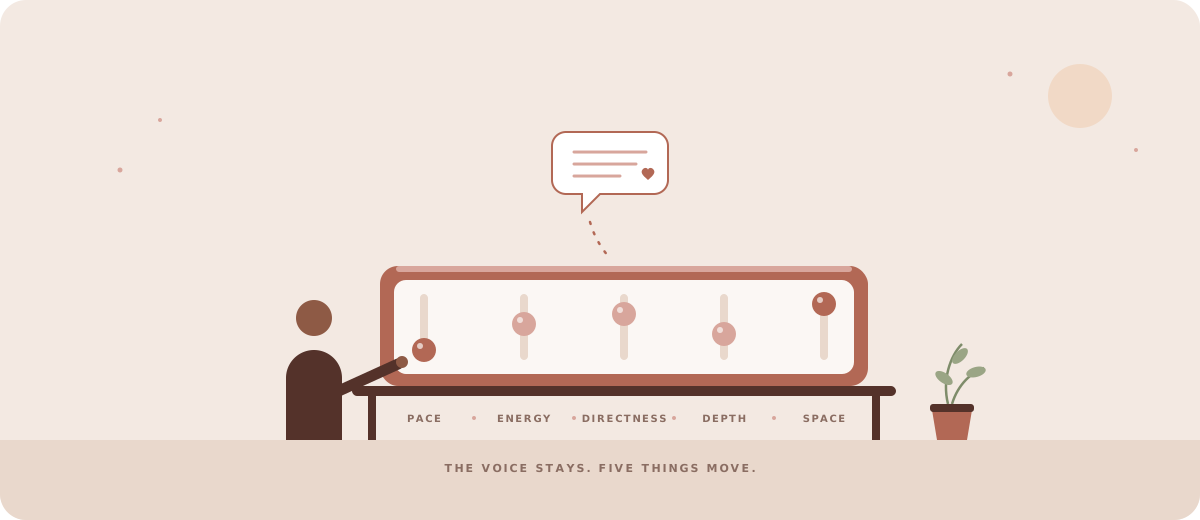
The voice never changes. Five things move. Pace: how fast you move her through the moment. Energy: how much you bring, and how much she has. Directness: whether she needs a clear answer, or room to arrive at one. Depth: how much you say, not how much you know. And space: what you leave unsaid. You will use all five; pace and space are the two to learn by name, because you will reach for them every day.
“I'll just do whatever's quickest. I don't really mind.”
Two associates hear this. Only one of them heard her.
Tap the answer you would give.
She said what she wanted and this gave it to her. Nothing about it is rude.
It also took “I don't really mind” at face value — and almost nobody who says that means it.
Look at B.
Yes.
Two very different people say that sentence. One is watching the clock. The other is tired of choosing things.
Listening is not waiting for her to finish. It's noticing that one sentence can mean two things, and asking which.
Listening is not waiting for her to finish. It is noticing that one sentence can mean two things, and asking which.
Tone flexes. Standards don't.
Calm is not PALOMA's only setting. Matching someone's excitement is warmth too; the levers move up as easily as down. And on tender moments, fewer words. Let the guest tell us what the moment means.
She's been at the desk a minute. Short answers. Hasn't looked up. What does she need?
Tap the answer you would give.
Kind — and it asks her to account for herself.
Yes.
Silence can be hospitality.
She isn't withholding. She's resting. You left the door open without asking her to walk through it.
Information she didn't ask for, into a quiet she chose.
Let the guest tell us what the moment means.
You just told her.
“I'll be honest, I think most of this stuff is nonsense. My wife made me come.”
What does he need?
Tap the answer you would give.
A gentle invitation to be converted. He didn't ask for one.
Yes.
PALOMA does not need agreement to remain confident.
Nothing there needed defending. You told him he belongs without asking him to believe anything — and you did it in a sentence.
This reaches for evidence to win a point.
It's also a claim you'd have to stand behind. More on that later.
Warm, and still a small challenge.
He isn't a project.
“This was the first time I've been out since my mom died.”
Set the moment.
“I'm really glad you came in.”
Yes — and so was one other.
You received it. You didn't decide what it meant to her.
“Thank you for telling me that.” (pause)
Yes — and so was one other.
Six words and a pause. The pause is the response.
The other answers, and why not
“I'm so sorry. Grief lives in the body — it makes sense you needed this. Massage can really help with that.”
Warm — and it does two things she didn't ask for.
It tells her what her grief is doing in her body, and it makes a claim.
“Oh, I'm so sorry to hear that. Would you like to book something for next month?”
Watch where the sentence goes.
It acknowledges, then turns to booking in the same breath.
Nothing here needs to be sold.
2 and 4 do the same thing.
They receive it without interpreting it. Neither one fills the silence.
Let the guest tell us what the moment means. On tender moments, fewer words.
Your pace and space matched.
Chapter six
What she came for
Somewhere in the first minutes, she will tell you why she is here. Usually in one sentence, and usually that sentence carries three things.
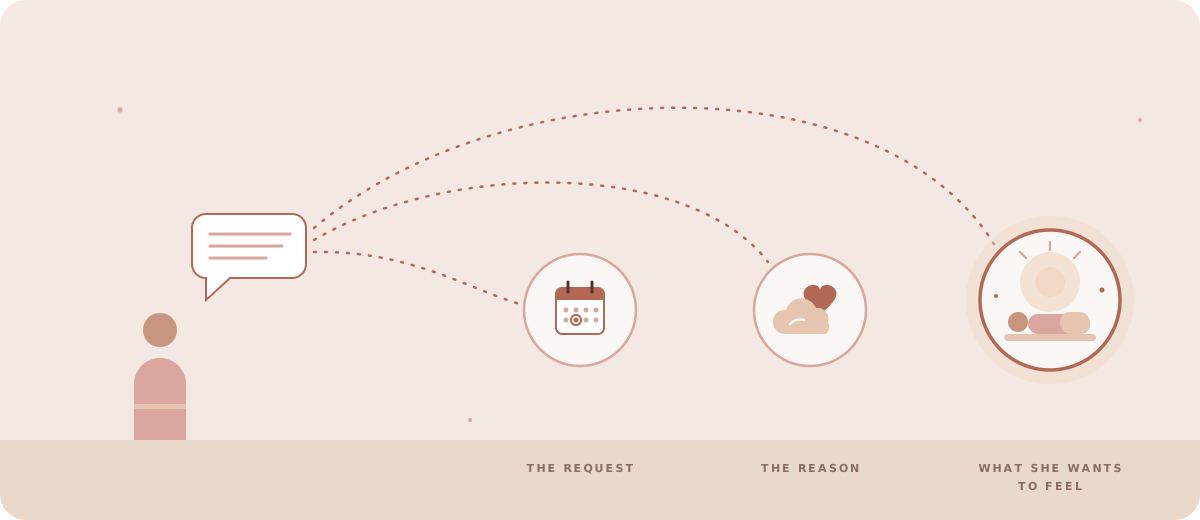
- The request
- What she asked for. Sometimes a service, sometimes just a time.
- The reason
- Why now. This is the part she'll tell you if you leave room.
- What she wants to feel
- Where she wants to be at the end of it. The one that actually decides.
You will get the request every time. The reason and the feeling arrive only if you are quiet long enough for them to. And one question does more work than any other: what are you hoping to feel when you leave? She may not know what she needs; she almost always knows how she wants to feel. Ask it in your own words, at the right moment, and then let the pause be. Silence can be hospitality.
“I've been so stressed. I think I just need to switch off for an hour.”
Two associates take that in. One of them added something.
Tap the answer you would give.
Warm, informed, and it named something she didn't.
She said stressed. She has just been told she has burnout and a nervous system running on empty — by someone at a front desk, in eleven seconds.
Look at B.
Yes.
Her words, her frame, and the only new thing added is a question that helps you choose.
Switch off was hers. Burnout was not. You can act on the first without ever reaching for the second — and she came here to stop being a problem to solve for an hour.
Her words are the ones you use back. Mirror before you translate. Listening ends where deciding would begin, and what her body means is never yours to decide.
Guide, don't prescribe
Once you know what she came for, you can guide her. Hold the shape of the menu, look up the rest, and give her one suggestion, one reason, and a door she can walk back through. The same recommendation can be handed over four ways:
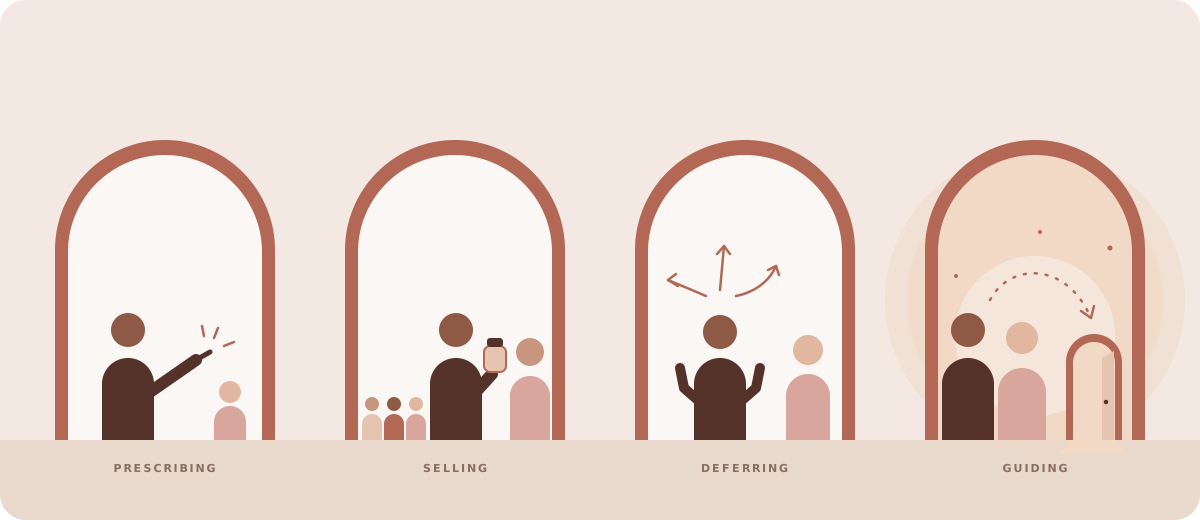
- Prescribing
- "You need the bodywork." She is now a case, and disagreeing with you is a correction.
- Selling
- "You should really try the bodywork — everyone loves it." The reason is about other people.
- Deferring
- "You could do bodywork, or the sound side, whatever appeals?" You did the listening and skipped the guiding.
- Guiding
- "I'd start you with the bodywork — you said you didn't want to have to think, and it asks the least of you. How does that sound?"
Only the fourth gives her both a recommendation and a way out of it: I heard you, here's what I'm thinking, here's why, how does that sound? And if she says no thank you, book what she asked for, warmly, as though the suggestion hadn't happened.
A declined invitation leaves no residue.
Chapter seven
The thread
She has had a lovely conversation at the desk. Now she goes in, and the question is whether that conversation goes with her. The recommendation is not finished when she agrees to it. It's finished when the person delivering it knows why she's there.
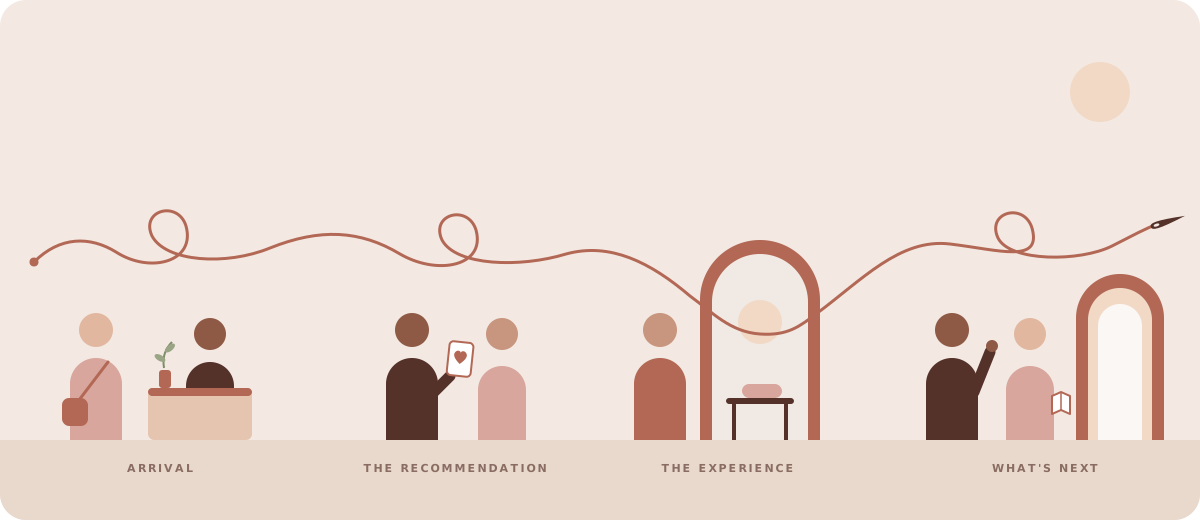
- Arrival
- What she told you, and how she wanted to feel.
- The recommendation
- What you suggested, and the reason you gave her.
- The experience
- Whoever is in the room, knowing both of the above before she walks in.
- What's next
- What would serve her after this — said once, lightly, at the end.
You usually have about eight seconds in a doorway, so pass the feeling, not the file. She wants to not think for an hour changes how a therapist opens more than any amount of detail about her week. A guest never sees the thread. She only ever notices it missing.
When a provider is running late
Delays happen: a service runs long, a room needs extra time, a provider is still wrapping up. When it happens, you are the guest's anchor. The guest should never feel forgotten, rushed or uncertain, and by the time she walks into her treatment room, the wait should already feel like part of the experience.
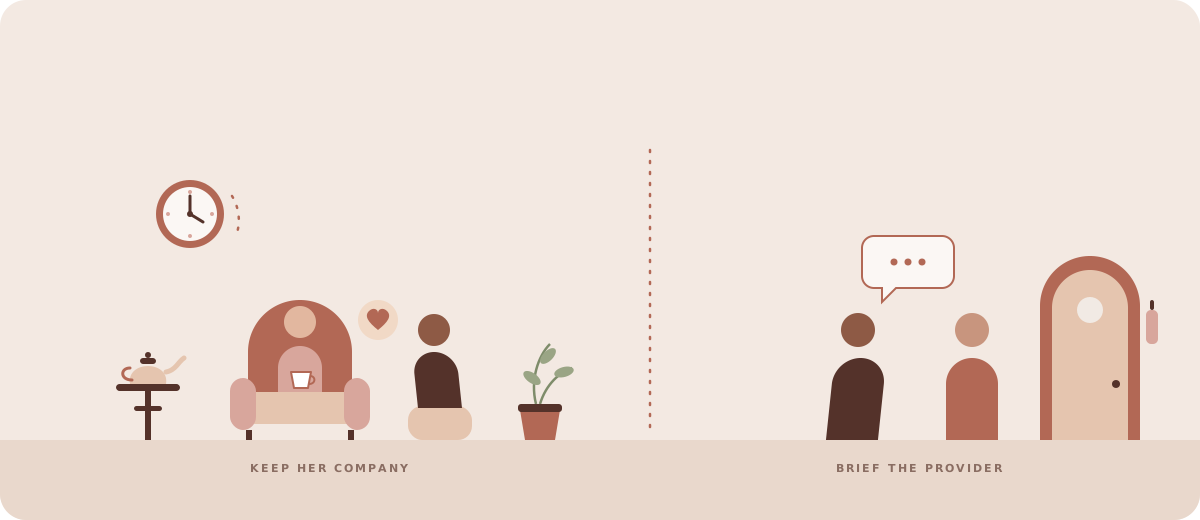
- 1Acknowledge the delay immediately and reassure the guest.Approach calmly as soon as you know there's a delay — don't wait for them to wonder what's happening. Be warm, direct and confident. The most important thing to convey: their service time will not be affected.
- 2Offer a beverage or CBD gummy.Once you've acknowledged the wait, offer something to make it feel intentional. This small gesture signals care and helps the guest settle in rather than feel inconvenienced.
- 3Stay with the guest and keep them company.Don't leave a waiting guest alone. Engage lightly — ask about their day, mention something about the space or a retail item nearby, or simply be a calm, pleasant presence. You're the host. Act like it.
- 4Watch for the provider to come out of their previous service.Keep one eye on the treatment hallway. The moment you see the provider emerge from their room, move quickly and discreetly.
- 5Go directly to the breakroom and brief the provider before they pick the guest up.Tell them you've been keeping the guest company, how long the guest has been waiting, and — most importantly — that you've assured the guest they will receive their full service time.
Never make the guest feel like the delay is a problem, because with you handling it, it isn't. A well-managed wait often leaves guests more impressed than if everything had gone perfectly on schedule. And if the lobby is busy, the Dome is a beautiful place to wait, once you have checked the day's schedule.
Chapter eight
The warm goodbye
She comes out softer than she went in. Now you honor what she has experienced and invite her to continue her journey with PALOMA, in that order.
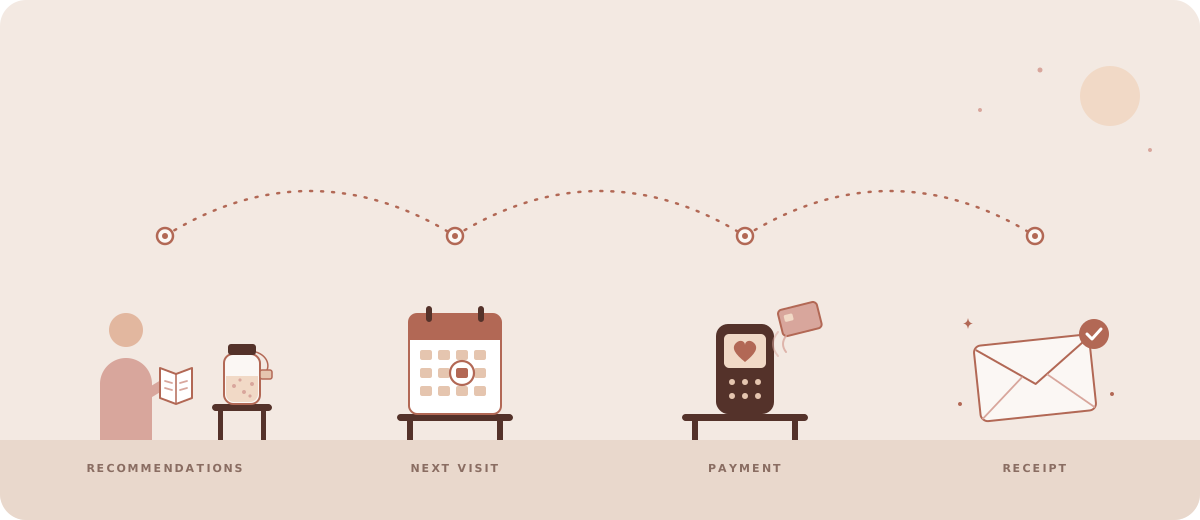
The sequence
- 1Confirm intake forms are complete and review the Service Provider's recommendations.“[Provider] mentioned that you might enjoy the Vertly CBD Epsom soak as a way to bring today's ritual home. Were you interested in checking that out today?”
- 2Share the Service Provider's recommendations for the next visit, and use them to lead into prebooking.“It looks like [Provider] would like to see you back in 4-6 weeks for a Higher Realm massage. Can I go ahead and get you set up for this?”
- 3Process payment and ask about gratuity.“Your total today is [amount]. Would you like to leave a gratuity for [Provider]?”
- 4Proceed with checkout: tell them we'll email their receipt and confirm we have an accurate email on file.
Check-out script prompts
- “How was your experience with us today? Is there anything specific that stood out to you?”
- “Did the service meet your expectations and address your needs and preferences?”
- “Can we do anything else to enhance your next visit?”
- “Are there any additional spa treatments or services you want to schedule for future visits?”
- “Would you like information about our retail products or recommendations for at-home care based on your treatment today?”
If she is holding a recommendation from her therapist, she is standing in front of you with a suggestion, at the one moment she could act on it. You are not selling. You are finishing what you started.
After a treatment, a therapist fills in a recommendation form and it goes home with the guest.
You're at the desk when she comes out holding it. What is it to you?
The end of the thread you started — and the easiest opening you'll get all day.
Yes.
She told you what she wanted at the start. Someone worked on her for an hour and wrote down what they think would help next. You are the person who can turn that into something real before she's back in her car.
I see she's suggested something for you — shall we look at when? You are not selling. You are finishing what you started.
The other answers, and why not
The therapist's document. Yours is the booking.
True about who wrote it and wrong about what happens next.
She is standing in front of you holding a suggestion, at the one moment she could act on it. Treating it as somebody else's paperwork is where the thread breaks last.
A prompt to rebook her — that's what it's for.
Half right, and the framing is the problem.
The form only has value because it isn't selling. Treat it as a rebooking tool and it becomes one — and she will feel the difference immediately.
What's next is said once, lightly, and then let be. Said once it's care; said twice it's a pitch. And on her next visit, the thing that should be true is that someone remembers why she came, so she doesn't start from the beginning. A regular is someone who no longer has to explain herself.
Chapter nine
When it gets complicated
Most days are the story above. Some days a conversation snags: a sentence lands oddly, a question isn't yours, a guest is unhappy or wants an exception. You will feel all of these the same way, as a small snag in the middle of a sentence. The skill is knowing which one it is.
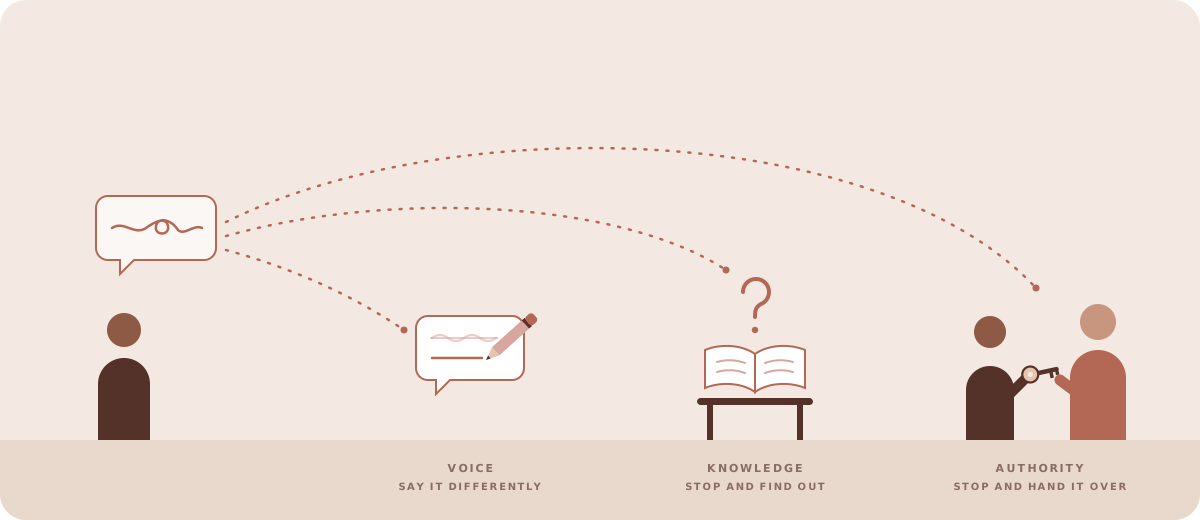
- Voice
- I know what I mean, but this doesn't sound like PALOMA. The information is fine; the way it is landing is not. Say it differently.
- Knowledge
- I don't have approved or adequate information to say this. Three colleagues saying the same thing is not a source. Stop, and find out.
- Authority
- The information may exist, and it still isn't mine to decide. Being right is not the same as being the one to decide. Stop, and hand it over.
One of them you repair by saying it differently. Two of them you repair by stopping, and handing over so that she still feels held: "That's one I want to get right rather than approximate. Let me grab someone who can give you a proper answer — two minutes."
You know the answer. You are certain of it, and you are right.
She asks you to make an exception. Which failure is in front of you?
Tap the answer you would give.
Yes, and this is the one that catches capable people.
Authority failures do not feel like ignorance. They feel like competence — you know the situation, you can see the reasonable outcome, and you are not the person who says so. Being right is not the same as being the one to decide.
No — and the premise is the trap.
You do know. That is what makes this an authority question rather than a knowledge one, and it is why certainty is no help at all here.
That matters, and it is the next step rather than this one.
How you hand it over is a voice question. Whether you may decide it at all is not.
When a guest is unhappy
When a guest shares feedback about a challenging experience, it's an opportunity to show our values. Remember that guests don't always expect compensation. Sometimes they just want to be heard.
- 1Listen actively. Let the guest fully express their feelings without interruption.Analyze the feedback and identify any areas for improvement in our services or procedures.
- 2Empathize and apologize. Show empathy for the guest's experience and offer a genuine apology for any inconvenience.Exception: if the guest is claiming harm or injury, see below.
- 3Gather details. Ask the guest for specific details so you fully understand the issues they encountered.Use the complaint scripts on this page to guide the conversation.
- 4Resolve the issue. Take immediate steps — rectify the service-related problem or find an alternative solution.Remember: guests don't always expect compensation. Sometimes they just want to be heard.
- 5Consider follow-up. Decide whether follow-up is needed to ensure the guest's satisfaction or provide additional support.
- 6Document the feedback in Zenoti's issue and resolution log, with the steps taken to address it.Capture any other pertinent information for future reference and improvement.
- 7Analyze and improve. Use the feedback to identify improvements, and post a recap on the Leadership Sling message board.
If a guest is claiming harm or injury, do NOT apologize or accept blame. Instead, listen, take detailed notes, escalate to a manager, and inform the guest that the GM will contact them within 48 hours.
Managers use a points system to decide the resolution. Points by issue — Unsatisfactory service: 10 (service didn't meet expectations regarding quality, technique or results). Service time shortage: 8 (massage or service cut short by a few minutes). Appointment delays: 5 (long waiting times or delays in scheduled appointments). Staff interaction: 8 (team perceived as unfriendly, unprofessional or unhelpful). Noise or disruptions: 5 (external noise or disruptions affecting the guest's experience). Billing or payment issues: 3 (discrepancies or errors in billing or gift certificate handling). Cleanliness concerns: 8 (environment or treatment rooms not maintained to a high standard). Resolution by total points — 18+: rebook for an appointment re-do and comp the follow-up service. 10–17: comp a 30-minute upgrade to a 60-minute massage (weekday bookings only). 6–9: comp a sauna session with the next massage booking. Under 5: thank them for the feedback, note it in their profile, and surprise them with gummies.
What you can offer, and what needs a manager
We want to give guests thoughtful moments of care, but discounts and fee waivers must be strategic and authorized. Some things you may offer yourself; managers have broader authorization.
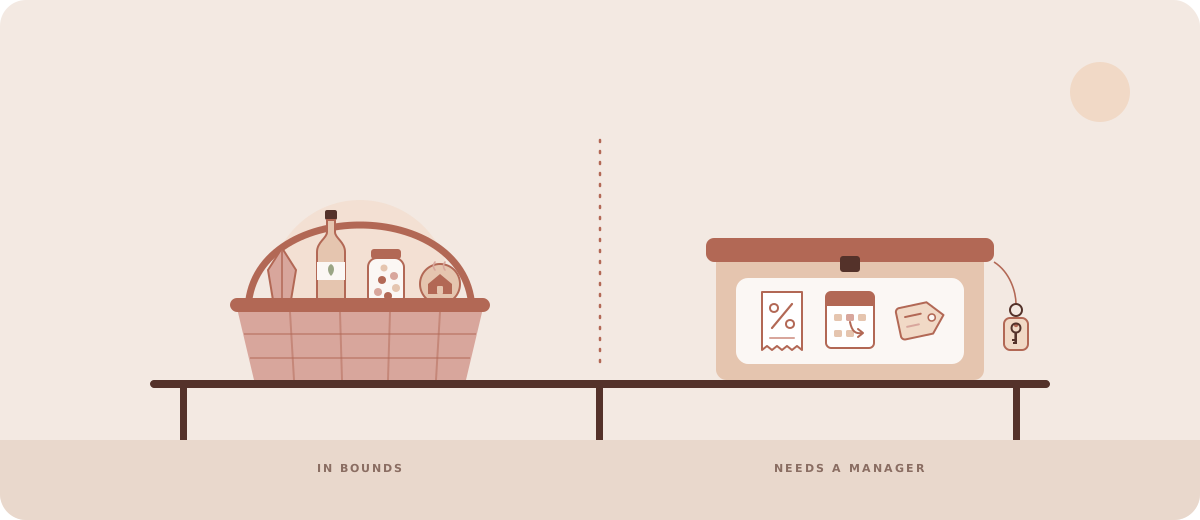
Only Managers are authorized to approve discounts on an invoice.
Excessive discounting devalues our offerings and erodes perceived quality. It affects our ability to maintain service excellence and invest in our team. So never offer a discount or waiver on the spot. Offer to connect her with a manager, and offer an in-bounds gesture, like a crystal or a complimentary tea, while she waits.
Voice. Knowledge. Authority. Name it before you fix it.
The last page
Before you move on
You have followed one guest from the hour before she arrived to the moment she walked back out. If you can answer these with confidence, you are ready for the floor.
For Experience Guides
- What are the steps for checking a guest in — from warm welcome through handing them off to their provider?
- How do you handle incomplete intake forms at check-in?
- What do you say to a guest when their service provider is running late, and what do you do the moment you see the provider come out?
- When is it appropriate to offer a guest the Dome, and what must you check before doing so?
- Walk through the check-out sequence — what happens at each step, from reviewing the provider's recommendations to closing the transaction?
- What are the seven steps for handling a guest complaint, and what does the points system determine?
- What is “in bounds” for Experience Guides to offer a guest without manager approval?
- When should you use the late cancellation script, and what do you say if a guest pushes back on the fee?
The Dome, spa journeys and retail each have their own module, and they build on everything here.
Guests are in our home.
Key takeaways
- 1A counter with nothing on it is a place to be met.
- 2You do not have to fill the time.
- 3Not room one and room two.
- 1Reading it off the shelf in front of her is not a failure.
- 2The shelf makes you useful. It does not make you qualified.
- 3Notice it before she does.
- 1Warm, grounded, intuitive, invitational. A calm, grounded friend who happens to know a great deal.
- 2We are confident enough to be simple. The reach for a bigger word is almost always the reach for cover.
- 3One test runs on any sentence. If it would not sound right said quietly to one person, it is not ours yet.
- 1Regulation before persuasion. Calm first. Everything else sits on top of it.
- 2Invitations, not commands. Experiences, not appointments. Soft verbs, and name what she will feel.
- 3Grounded magic, spoken to one person. The intuitive paired with the real, as a note rather than a broadcast.
- 1Use the most human word that still says what we mean. Both halves matter — human, and still accurate.
- 2The lexicon is something you look up. This is something you carry. One is a list; the other is a habit.
- 3A word that is trying too hard is doing it in front of her. She hears the effort before she hears the meaning.
- 1Understand the intention. Make the words your own. Reciting is the failure, not the wrong phrasing.
- 2You will say this a thousand times. It should never sound like the thousandth.
- 3PALOMA offers a world. The guest chooses how much of it to enter. Offer the whole of it; let her take what she wants.
- 1Listen. Discover. Guide. Once, and with confidence — not a questionnaire.
- 2Ask only what helps you care for her better, and stop when you could say why. If you cannot name the reason, you are collecting, not caring.
- 3PACE and SPACE are the two you will reach for every day. Learn them by name now.
- 1Tone flexes. Standards don't. The voice does not change; its volume does.
- 2On tender moments, fewer words. Hold space rather than fill it.
- 3Let the guest tell us what the moment means. Two guests in the same hour are not the same hour.
- 1Voice. Knowledge. Authority. Name which one it is before you try to fix it.
- 2One you repair by saying it differently. Two you repair by stopping.
- 3All three feel the same from the inside — a small snag in the middle of a sentence. Catching it while it happens is the work.
- 1The request, the reason, and how she wants to feel — all three are usually in one sentence.
- 2Her words are the ones you use back. Mirror before you translate.
- 3Listening ends where deciding would begin. What her body means is never yours to decide.
- 1Hold the shape. Look up the rest. Four doors is what you carry into a conversation.
- 2One recommendation with a reason. The others are what you reach for if it does not land.
- 3Getting it right in front of her is not a gap. It is the job.
- 1One suggestion. One reason. And a door she can walk back through.
- 2Prescribing decides for her. Selling is about other people. Deferring hands the work back.
- 3Choosing around a question you cannot answer is still answering it. A declined invitation leaves no residue.
- 1Arrival. Recommendation. The hour. What's next. You own your point and hand it forward.
- 2Pass the feeling, not the file. It is what the next room can act on.
- 3A guest never sees the thread. She only notices it missing.