Module 2 · Your Foundation
HR & Policies
What is expected of you, what happens in your first days, and the policies you work under.
About 30 min to read · then Check yourself
Chapter one
What PALOMA expects of you
Picture two Experience Guides. Both know the menu, both are kind, and both are good at the job. Yet guests ask for one of them by name. Why her?
Two Experience Guides. Both know the menu. Both are kind.
One of them a guest asks for by name. Why?
She answers every question correctly, works quickly, and never keeps anyone waiting.
This is a good associate, and a guest will not remember her.
Correct and quick is the floor, not the standard. Everything in this chapter is what sits above it.
She notices what a guest actually came in with, and adjusts — without being asked and without making a thing of it.
Yes.
The founders call this the thing that separates a good guide from an extraordinary one. It is also learnable, which is the point of the next five screens.
That is the whole of this chapter. PALOMA expects five things of everyone in the house. They are the standard, and they are not new: your colleagues were taught them in a room in April, in the founders' own words.

- How you look
- Your appearance is the first communication. Before you speak, a guest reads your grooming, your dress, and whether you look like you belong to this brand. You are the visual experience before the service begins.
- How you speak
- Language, tone and warmth, in equal measure. No rushing an explanation. No jargon a guest has to decode. No half-answer when she is genuinely trying to understand her options.
- The energy you give off
- Guests absorb your state before you say a word. Arrive regulated, grounded and present, and know that if you are scattered, they feel that too. Your internal state is part of the experience.
- Emotional intelligence
- Reading what a guest actually needs, not what you assume she needs, and adapting in the moment. The founders call this the one that separates a good guide from an extraordinary one.
- Wellness expertise
- You are not a host. You are a guide. Guests trust you to educate them, to recommend, to make things clearer than they were. That trust is why the knowledge matters.
Notice that only one of the five is about what you know. That is not an accident. PALOMA can teach you the menu in a fortnight. The rest is the part a guest actually feels, and it is the reason she asks for you by name. And unlike charm, it is learnable.
Three things a guest should never see, hear or feel
There is a second half to the standard, and it is about what stays out of sight. These are not small things. They are the difference between a guest feeling she is in a sanctuary and feeling she has walked into the back of a business.
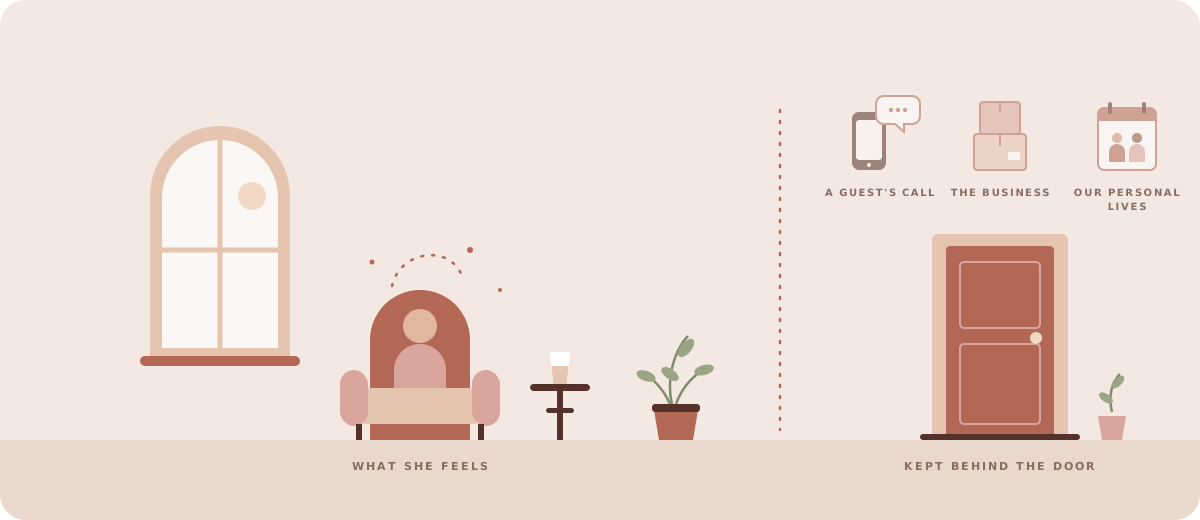
- Another guest's call
- A phone conversation about one guest does not happen within earshot of another. If she can hear how you talk about someone else, she now knows how you talk about her.
- The business running
- Ticketing, shipments, back-of-house: invisible. Doors that should be closed stay closed. None of it is shameful. It simply is not part of what she came for.
- Our personal lives
- Lunch, schedules, who is covering what, anything personal. Not in a guest-facing space. Ever. This is the one people slip on most, because it is so ordinary.
You and a colleague are at the desk. A guest is in the hallway looking at crystals, maybe four metres away.
Your colleague asks whether you can swap Saturday. What do you do?
Say you'll come and find her in a minute, and leave it there.
Yes, and notice how little it took.
Four metres is within earshot. A guest absorbed in a shelf of crystals is still hearing the room, and a rota conversation tells her the room is a workplace.
You did not have to refuse. You moved it.
The other answers, and why not
Answer quietly — it's two seconds and she's not listening.
This is the slip, and it is always reasonable in the moment.
The standard does not say unless it is quick. She is not listening until she is, and the thing she overhears is never the thing you would have chosen.
Answer, but step away from the desk first.
Better, and still inside the guest-facing space.
The line is not the desk. It is whether a guest can see or hear it.
Chapter two
Your first weeks
Nobody learns this in a day. You are not expected to finish this site today, or this week, or to remember all of it. A screen can teach you what PALOMA knows. It cannot teach you what PALOMA feels like, and it will not try. That half happens in the building, with people who have done this.
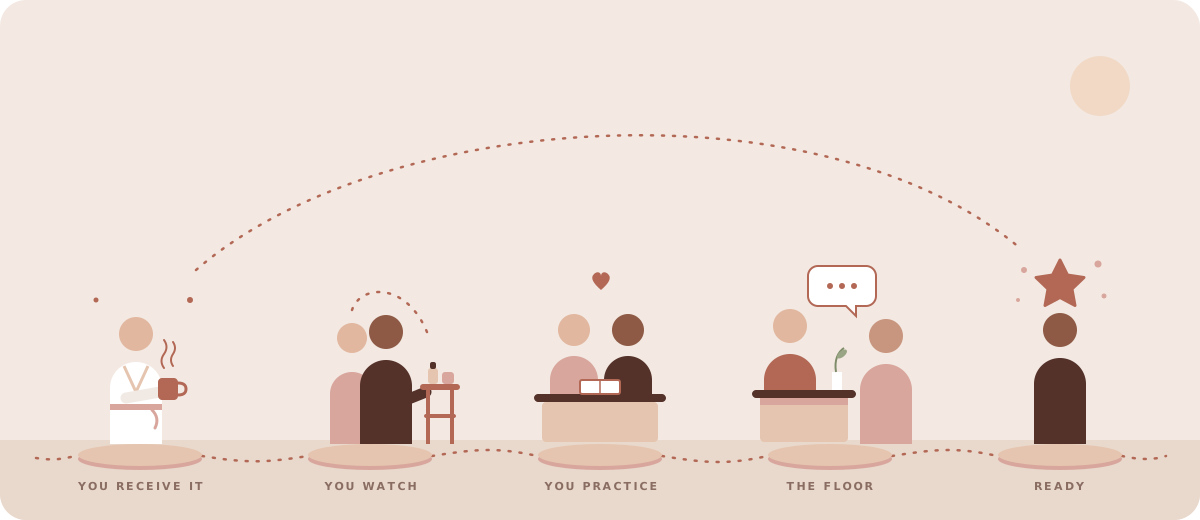
- You receive PALOMA as a guest
- Before you are asked to give any of this, you are given it. You come in and have an experience here, as a guest does. Most people say this is the part that makes the rest make sense.
- You watch someone do it
- You shadow someone good. Not to copy her, but to see what the standard looks like when it is running at full speed.
- You practice, with someone beside you
- Then you do it, with a trainer close enough to catch anything. Getting it wrong here is the entire point of here.
- You step onto the floor
- Real shifts, real guests, with someone who knows the answer within reach. Nobody is left to work it out alone.
- And then you are ready
- When it is yours, someone says so. There is a point where PALOMA confirms it rather than assumes it, and after that, the learning carries on anyway.
Your first weeks page lays this out day by day, shift by shift, so you always know what today is for.
Your path through this site
Everyone starts in the same place, and then the path depends on your role. An Experience Guide, an Experience Coordinator and a massage therapist each spend more time in some modules than others, and your trainer will tell you which come next for you.
Some of the day-to-day pieces, like opening the house or running the end of the day, you may walk through with your manager on the floor before you ever read about them here. That is by design. This site is somewhere to come back to, not something you have to finish first.
Your first day
Almost everyone's first day covers the first two modules, Brand Overview and HR & Policies. You will also need a few things ready before your first shift:
The Sling app and the Gusto app on your phone. Your Zenoti username and password, handy. The back door code and the alarm code, which your manager will give you in person.
The Sling app, the Zenoti app and the Gusto app on your phone.
Door and alarm codes are never written on this site or sent by message. Learn them from your manager, and keep them to yourself.
Then there is Reference, under Look it up. It is not a course; it is a shelf. Prices, durations, what is in which service, who each thing is not for. Nobody carries this in their head, and you will keep coming back to it long after training ends.
You are three chapters in and a guest asks you something about a service you have not reached yet.
What is the right move?
Say you'll find out, look it up, and come back to her.
Yes — and get used to this one, because it is the answer far more often than new people expect.
Looking something up in front of a guest is not a failure. Guessing in front of a guest is. There is a whole Reference shelf built on that principle.
The other answers, and why not
Give her your best understanding and flag that you're new.
Being new is not the problem here. A best understanding is a guess with a disclaimer on it, and she will act on it either way.
Saying you will find out costs you nothing and costs her nothing.
Pass her to someone who has been here longer.
Sometimes right, and not as a reflex.
Handing a guest off every time you do not know something teaches her that you are not the person to ask. Most things you can simply go and find.
Chapter three
Showing up
Everything so far has been about how PALOMA cares for its guests. The policies are how PALOMA cares for its team. PALOMA holds its team to the same standard of care we hold for our guests. These policies are there to protect the team, the guest experience and the business.
Whether you are an Experience Guide, a healer or on the leadership team, your presence, reliability and integrity matter. Read these as agreements you are making with your teammates and our guests. They start with the simplest one: being here, on time, ready.
Arriving
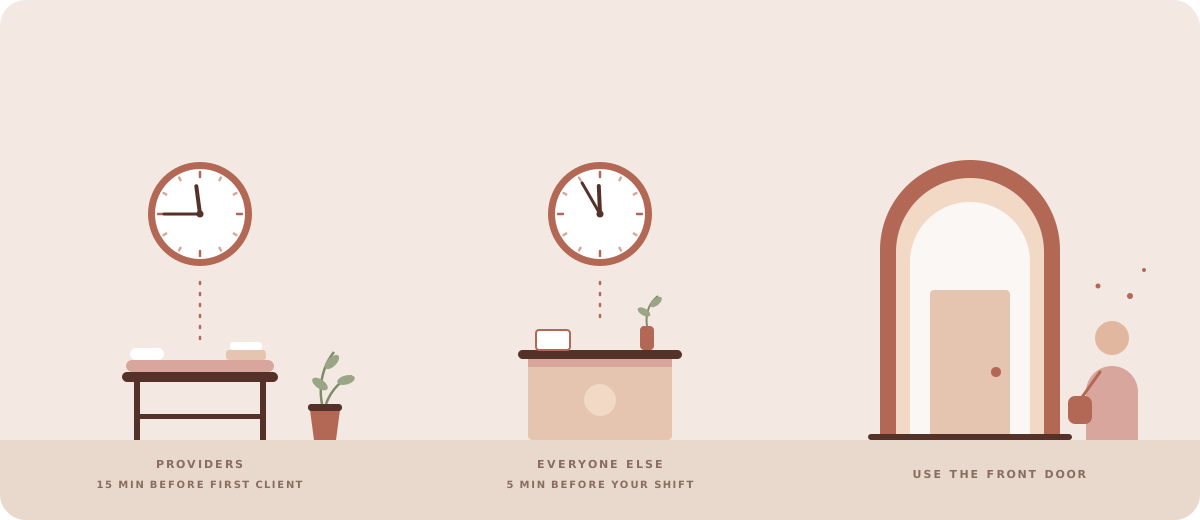
| Who | Arrive |
|---|---|
| Service providers | 15 minutes before your first scheduled client |
| All other associates | 5 minutes before your scheduled shift start |
Why the early start? Guests check in and out at the top and bottom of the hour. Arriving early lets you settle in and support the team, and it means you are regulated before the first guest is. When you arrive, find the manager on duty for anything that affects your day or the guest experience.
Unless you are opening or closing, enter and leave through the front of the building. The back door is not used during business hours unless a manager or key holder is with you.
You are late if you clock in 5 or more minutes after your scheduled start. Repeated lateness is handled step by step:
| Repeated lateness | What happens |
|---|---|
| First time | A conversation with your manager |
| Second time | A written warning |
| Third time | Could result in termination |
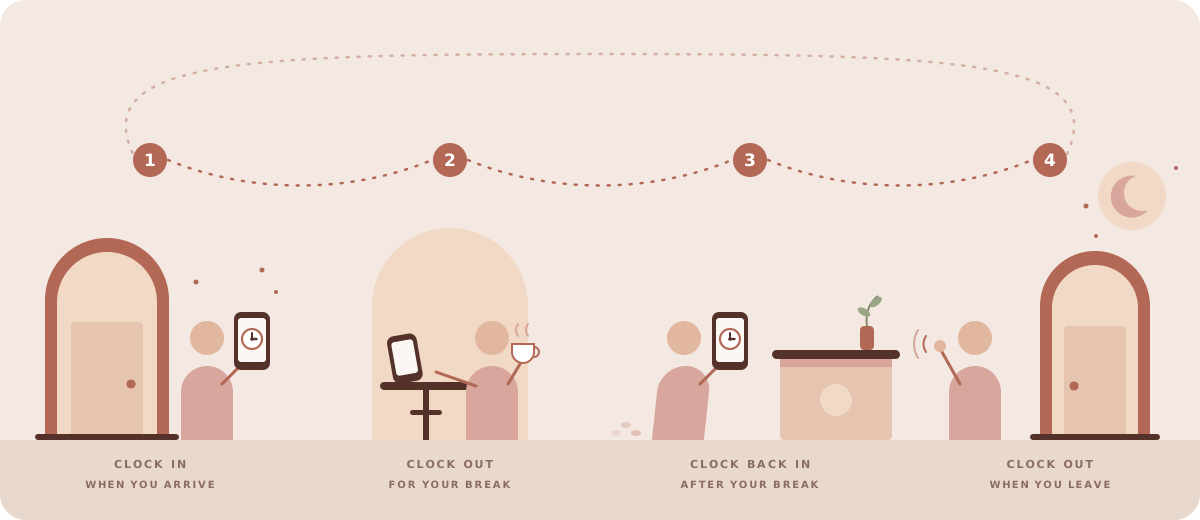
Clocking in and out in Sling
- 1Clock in when you arrive for your shift.
- 2Clock out for breaks.
- 3Clock back in after breaks.
- 4Clock out when your shift ends.
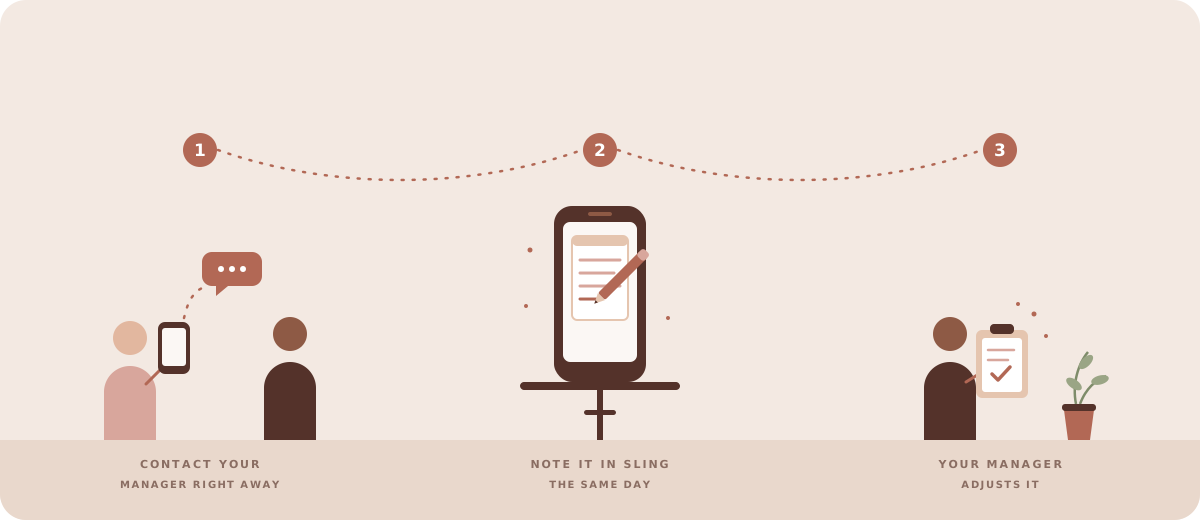
If you miss a clock in or out
- 1Contact your manager right away.
- 2Note the missed clock in or out in Sling the same day.
- 3Your manager will make any adjustments.A missed break punch is adjusted to your scheduled break unless you note otherwise.
Breaks
A break is part of staying regulated, which means it is part of the guest experience too.
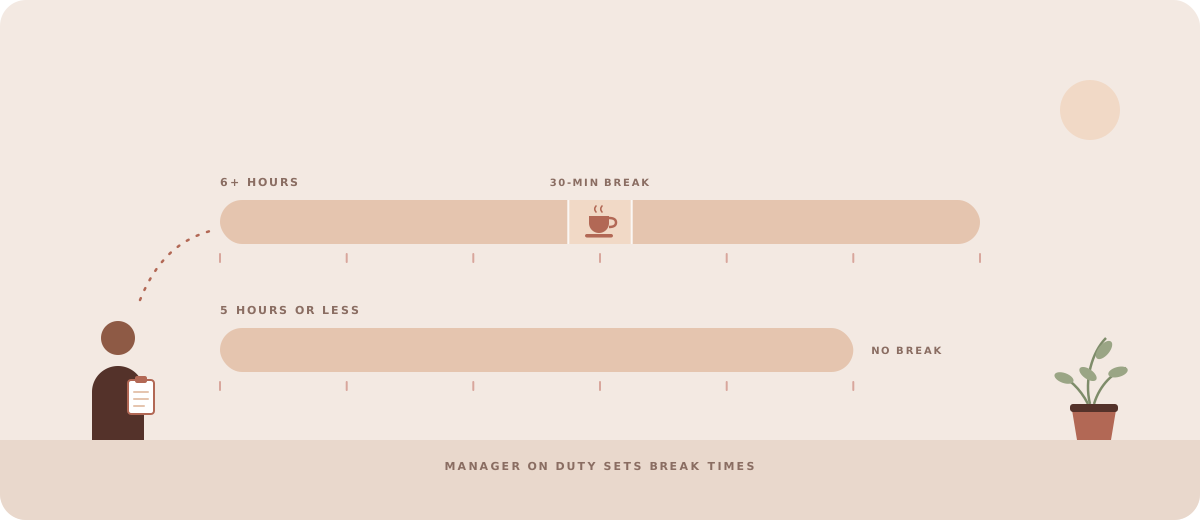
- A shift of 6 hours or more: a 30-minute break.
- A shift of 5 hours or less: no break.
- The manager on duty directs break times. Please do not choose your own.
- Any change to your break needs approval from a manager or key holder.
- Clock out and back in for your break in Sling.
Chapter four
Time away
Rest matters here as much as it does for any guest. There are two kinds of time off: planned time off (vacation, personal time, rest) and unplanned time off (illness, emergency, the unexpected). Both are fine. What makes them work is notice, so the team and the guests are never left short.
Planned time off
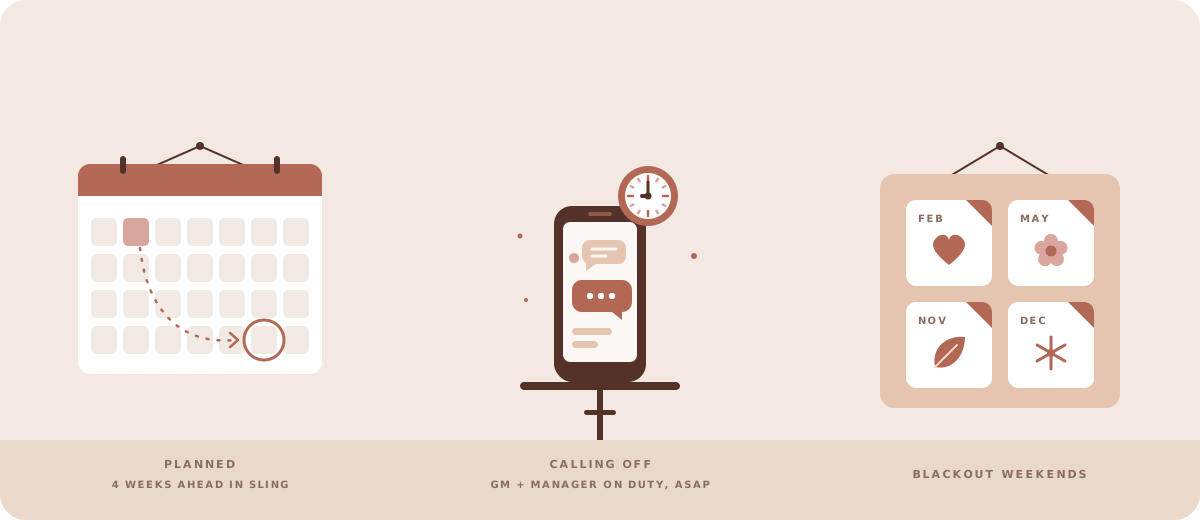
- Request it in Sling at least 4 weeks ahead.
- Only one associate's time off per day is approved without extra coverage, first come first served.
| Weekly hours | Planned days off per year |
|---|---|
| 40 | 20 |
| 30–39 | 16 |
| 25–29 | 13 |
| 20–24 | 10 |
| 15–19 | 8 |
| 10–14 | 5 |
| 9 or fewer | 2 |
PALOMA is confirming this. Ask your manager.
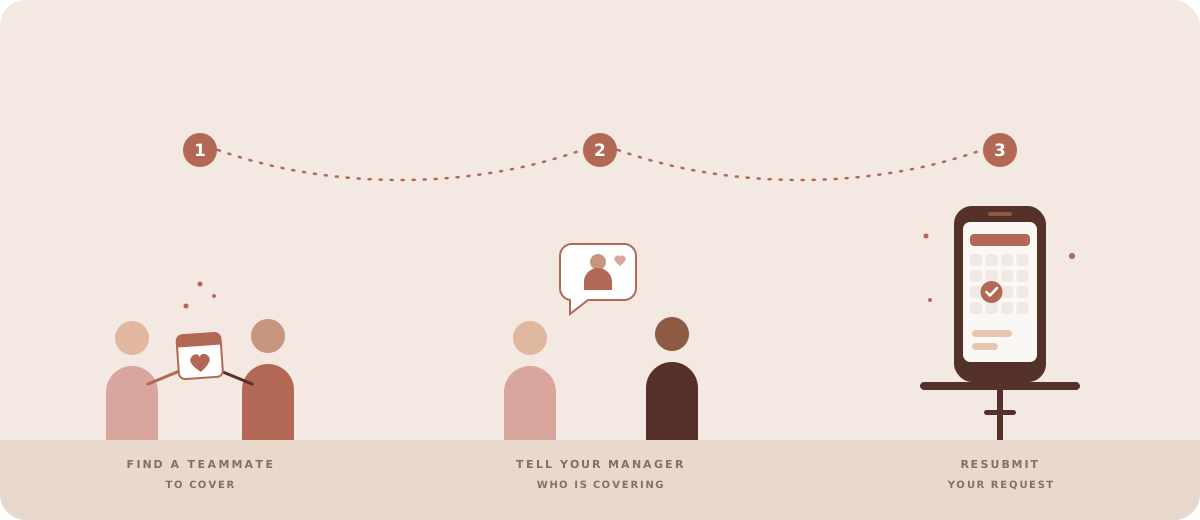
If your request is declined
- 1Find another associate who can cover your shift.
- 2Let your manager know who is covering.
- 3Resubmit your request.
Calling off
- 1Contact the GM and the manager on duty as soon as you can.
- 2Post a message in the "calling off" group in Sling.
- 3Try to find coverage if you can.
| Employment level | Weekly hours | Unplanned call-offs per year |
|---|---|---|
| Full time | 30+ | 8 |
| Part time | 20–29 | 6 |
| Part time | 10–19 | 4 |
| Part time | 9 or fewer | 2 |
The weekends we all hold
A few weekends are when guests need the house most, so everyone is on hand. These are blackout weekends (Friday, Saturday and Sunday):
- Valentine's Day weekend
- Mother's Day weekend
- Thanksgiving weekend
- Every weekend in December
PALOMA is confirming this. Ask your manager.
Longer leave
Maternity, paternity and personal leave
- Eligible after 1 year with PALOMA and 1,250 or more hours worked (about 24 hours a week on average).
- Covers the birth or adoption of a child, or a serious illness or medical injury.
- Up to 12 weeks of unpaid leave.
- Tell management ahead of time when you can, and provide a doctor's note where it applies.
When the house is closed
| PALOMA is closed | Modified hours |
|---|---|
| July 4th | Christmas Eve: close at 4:00 PM |
| Thanksgiving Day | New Year's Eve: close at 6:00 PM |
| Christmas Day | |
| New Year's Day | |
| Quarterly cleaning days: the 3rd Monday of January, April, July and October (subject to change) |
There are full Attendance and Time Off policy documents for hourly team members and for service providers. Ask your manager for the one that applies to you.
Chapter five
Pay, tips and perks
The practical part, kept simple. Your pay rate is in your offer letter, and everything else runs on a steady rhythm.
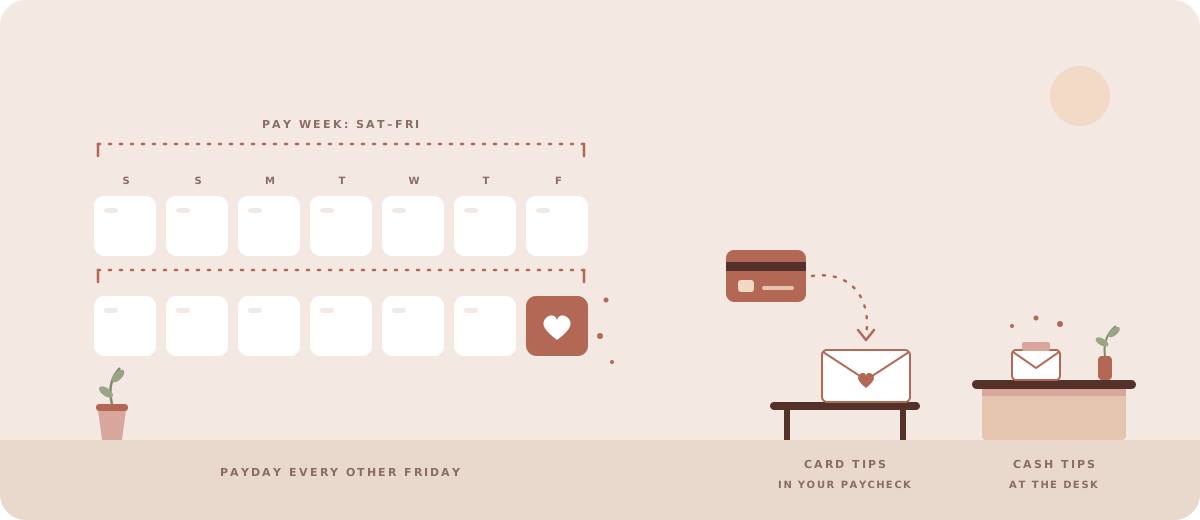
- Pay cycle: Saturday to Friday. Payday is every other Friday, through Gusto.
- Pay stubs: open the Gusto app, go to the More tab.
- W-2s are in the Gusto app too.
- Credit card tips are added to your paycheck automatically.
Cash tips (service providers)
- 1Pick up your cash tips at the front desk at the end of your shift.
- 2Initial the log to confirm you received them.
Your pay rate is confidential. Please don't discuss your salary with coworkers. This protects everyone's privacy and dignity.
And because the values we hold for guests are the values we hold for our team, you are cared for here too. Your PALOMA benefits and perks are set out in the Trade and Wellness Perk Policy. Ask your manager for the document and any questions about using your perks.
Chapter six
What to wear
Remember the first of the five expectations: you are the visual experience before the service begins. Experience Guides wear the PALOMA jumper, and wear it proudly. What follows is for service providers and Experience Coordinators, who dress from the house's own palette: whites, off-whites, tans, browns and black. The look is natural, bohemian and polished: holistic, warm and simple.
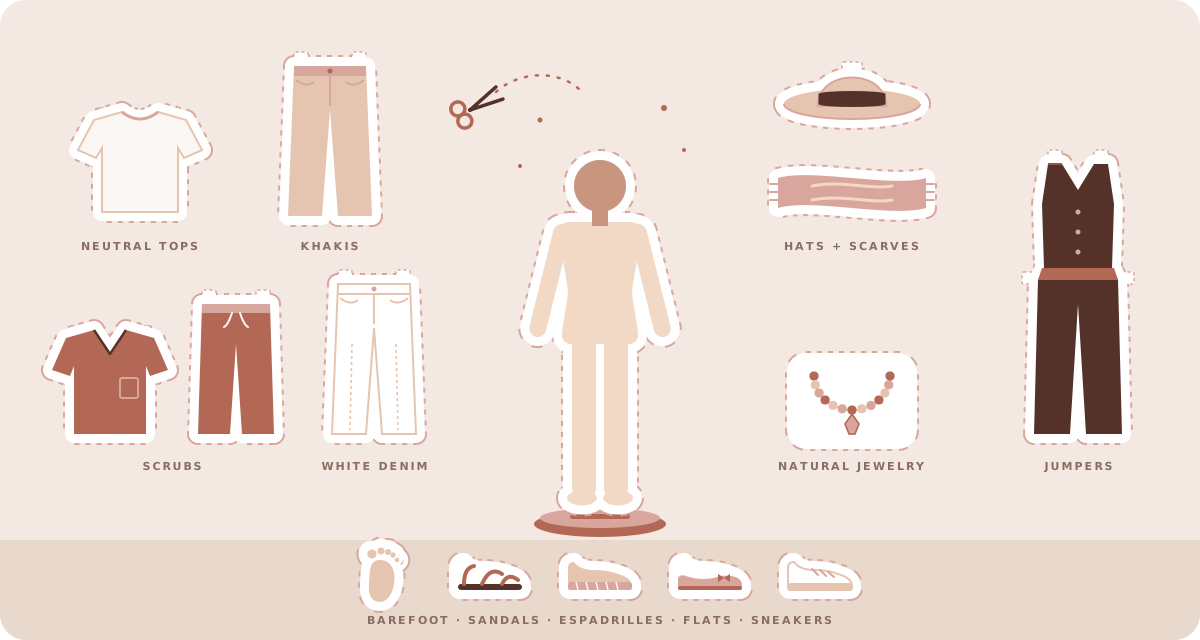
Yes, please
- Whites, off-whites, tans, browns and black
- Jumpers, khakis and neutral tops
- Scrubs (service providers)
- Natural fibers: cotton, linen, silk, wool, hemp, or quality synthetic blends
- Crochet, lace or embroidered details
- White or off-white denim
- Natural or bohemian jewelry, scarves and hats
- Clean, well-fitted clothing with no holes, tears or wear
Tops cover
- Your back
- The tops of your shoulders
- Your stomach
Footwear
- Barefoot, always allowed
- Sandals
- Espadrilles
- Natural material flats
- Sneakers
And the pieces that stay at home:
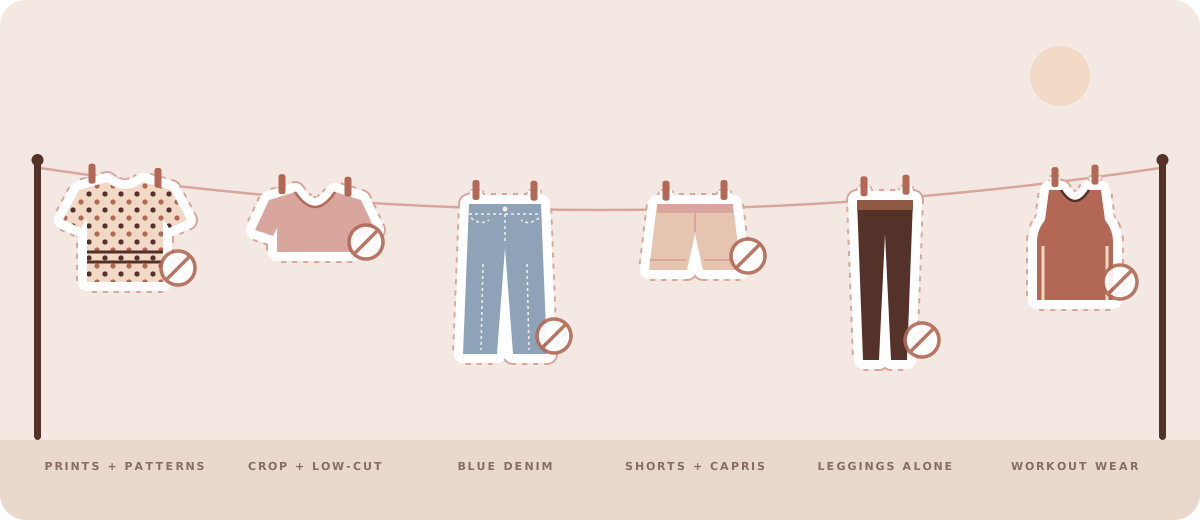
Not on shift
- Prints or patterns of any kind
- Denim, other than white or off-white
- Halter tops, spaghetti straps, low-cut or crop tops
- Shorts or capris
- Yoga pants or leggings, unless paired with a tunic
- Tank tops or workout attire
Clothing and grooming styles dictated by religion or ethnicity are always exempt from this dress code. Talk with your manager if you have any questions.
Service providers have a full style guide covering color, fabrics, silhouettes, layering, footwear and a capsule wardrobe. Ask your manager for it.
Chapter seven
Staying in touch
The last agreement is the one that keeps all the others alive: talking to each other. Safe + transparent communication is one of the six values, and these are the places it is built into the calendar.
| Team meetings | 1:1 with your manager | |
|---|---|---|
| How often | Every other month | Every other month, during your scheduled shift |
| Who | Everyone. Attendance is required. | You and your manager |
| Pay | Paid at your hourly rate | |
| Before | You get a short electronic questionnaire to reflect on your experience | |
| What it is for | Staying aligned, celebrating wins, working through challenges | Feedback, growth and career development, and your relationship with your manager |
Bring the real things. The questions you marked as unclear, the moments that did not sit right, the ideas you had on a slow afternoon. Remember the service that started with an Experience Guide being curious out loud. These conversations are where that happens on purpose.
PALOMA holds its team to the same standard of care we hold for our guests.
Key takeaways
- 1Five things: how you look, how you speak, the energy you give off, emotional intelligence, wellness expertise.
- 2Only one of the five is about what you know. PALOMA can teach you the menu in a fortnight; the rest is the part a guest actually feels.
- 3Three things a guest should never see, hear or feel — and the one that catches people out is a conversation between two associates held across her.
- 1Start at the top and go in order. It remembers where you stopped, and nothing here is timed.
- 2Reference is not a course, it is a shelf. Prices, durations and who a service is not for live there, and looking something up in front of a guest has never been a failure here.
- 3Mark anything that wasn't clear. There is a button at the bottom of every screen, and it is the fastest way to fix what this site gets wrong.