Module 1 · Your Foundation
Brand Overview
Why PALOMA exists, who we are, what we offer, the house itself, our values and the PALOMA Way.
About 39 min to read · then Check yourself
Chapter one
It began with a friendship
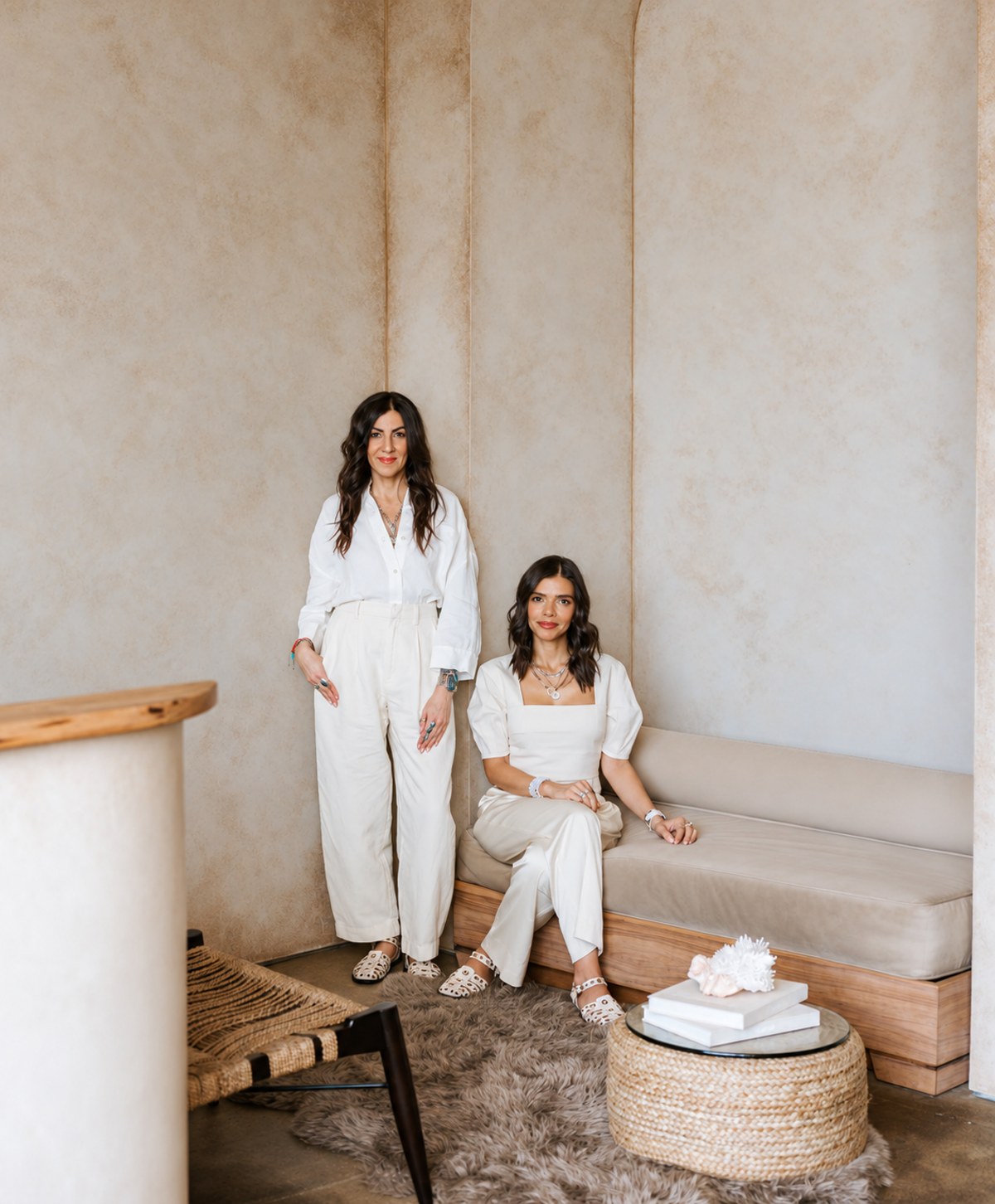
PALOMA began with two friends. Angela Gann and Stella Giometti met years ago inside a high-demand corporate world, as two retail executives, building careers and raising young families at the same time. Coworkers became friends, and friends became soul sisters.
They loved parts of that life. But as they grew, and especially as they became mothers, something stopped fitting. They watched burnout and chronic stress take a real toll on the people around them, and on themselves. These were highly successful people, and it was costing them more than anyone said out loud.
And a quiet, insistent voice kept saying the same thing:
This chapter is complete. You are meant to build something beautiful — a place that helps your community come home to themselves.
When they looked at what already existed, it did not hold up. The environments, the pricing and the experiences all seemed stuck in another time, just as wellness and self-care were starting to matter more than ever. What they did have was a career's worth of building and scaling brands, and two sets of skills that fit together rather than overlapped.
So they built it. In their own words: we concepted PALOMA because we had to.
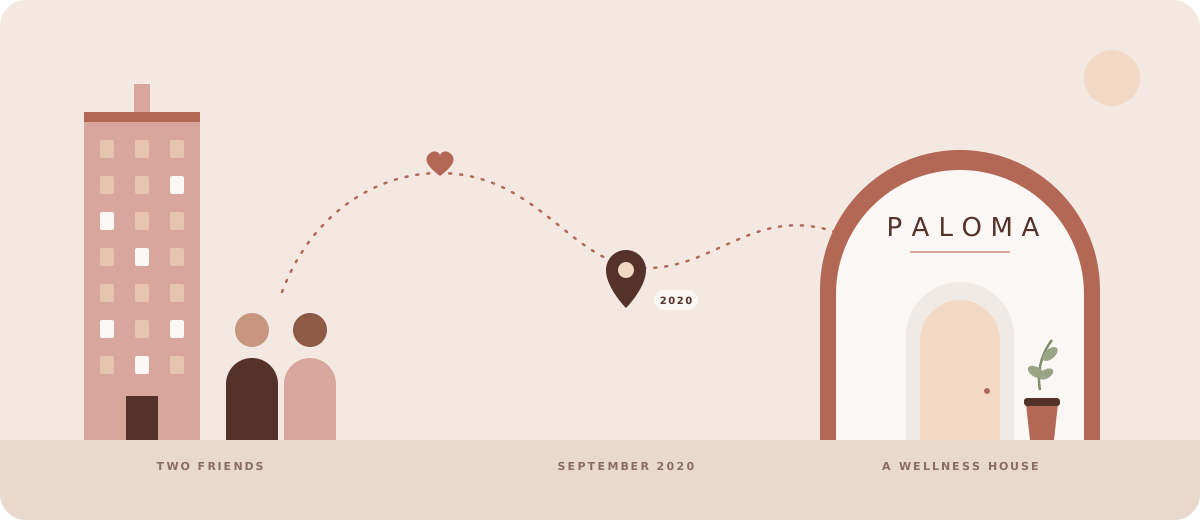
PALOMA opened in September 2020, in the middle of a pandemic, when the world was being told not to touch or breathe too close. They did both, gently and on purpose, because they knew it was exactly what people needed then and would keep needing.
That decision tells you most of what you need to know about the conviction behind this place. It comes down to one sentence, and everything else you will learn here follows from it.
Wellness is not a luxury. It is a necessity.
That is why PALOMA exists. It is not a nicer version of somewhere else. It is somewhere people can come for something they actually need. The founders put the mission even more simply: less stress, more peace.
They are both still in the business every day, and it helps to know who thinks about what. If it concerns how PALOMA looks, sounds or feels, it is likely Stella's. If it concerns what PALOMA sells, stocks or charges, it is likely Angela's. What PALOMA offers, and how it feels to receive it, they decide together.
Chapter two
What they built
Five years on, PALOMA has grown into a wellness house, a retreat and a brand. It reflects the founders' own lived experience and every guest who has walked through its doors. Ask anyone who works here what it is, and the honest answer starts with a phrase you will use often.
A wellness house for the whole human.
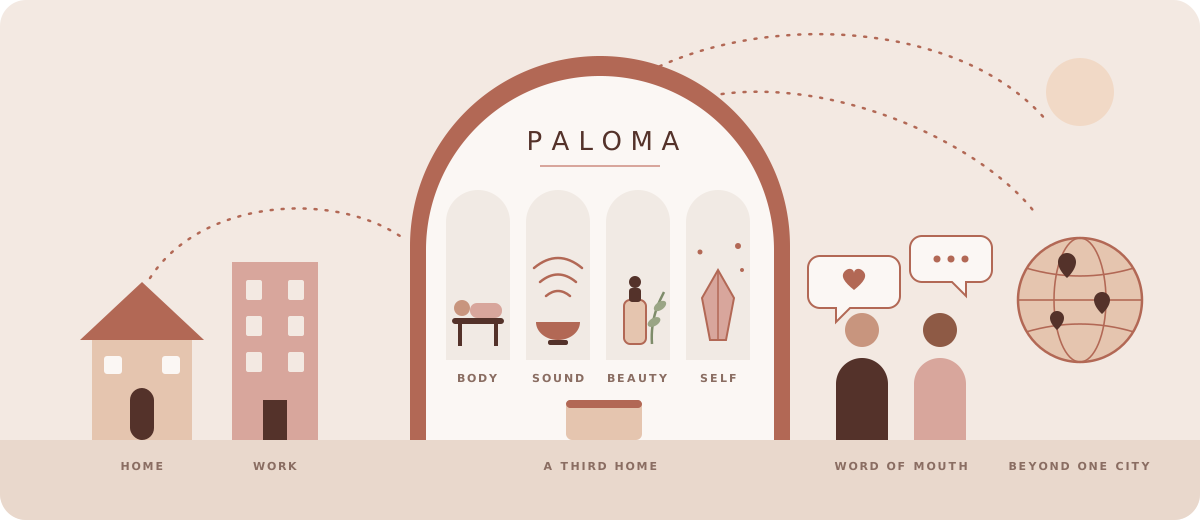
Bodywork, sound and energy healing, results-driven beauty and self-discovery, all under one roof. Most places do one of those. Doing them together is the point, not a coincidence.
It is also why the word spa never quite fits. There is home, there is work, and then there is somewhere else that is yours. That is the category PALOMA is in: a third home.
PALOMA grew through community and word of mouth, in one building, over years, because people kept telling each other about it. That history is why it feels the way it does, and it sets the standard for whatever comes next. PALOMA is now building something that reaches people who may never walk through the door. What cannot change on the way is the part that made it worth reaching for.
Four doors
From the inside, PALOMA can look like a lot. It is really four things, and once you can hold those four you can place almost any question a guest asks you. Each one has a line beneath it that the founders wrote. Those lines are the shortest honest answer to "what is that?"
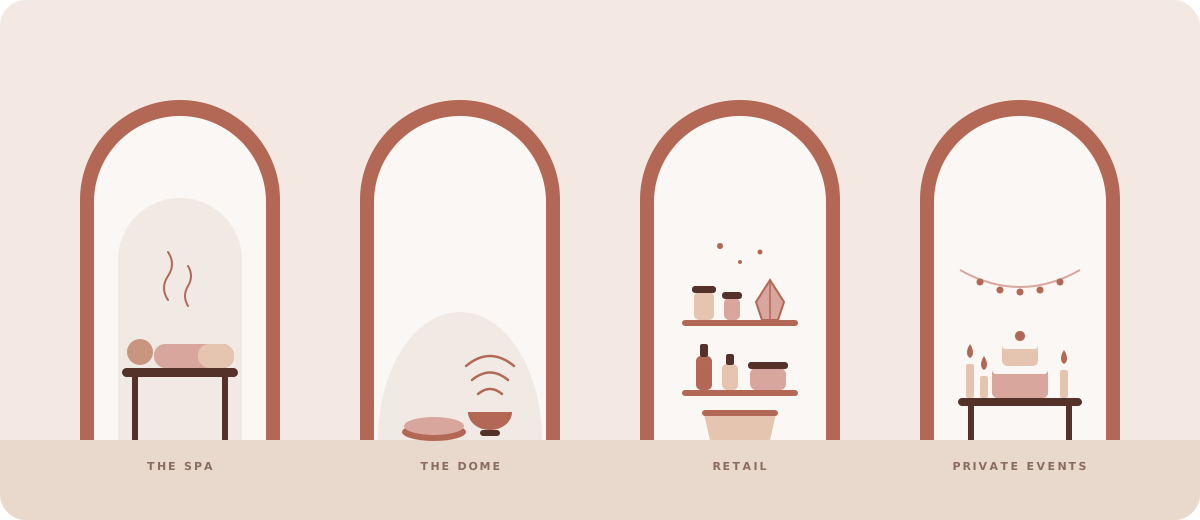
- The Spa
- Where ritual meets restoration.
- The heart of the house. Intuitive massage, lymphatic therapy, LED facials, fascia release and energetic alignment, with ancient healing practices alongside modern modalities. This is the largest part of what we do, and the part most guests arrive for.
- The Dome
- A modern temple for stillness.
- PALOMA's architectural centerpiece. Guided meditations, sound baths, breathwork and energy attunements, privately or in a small group, as well as workshops, aura photography and human design readings. Over 3,500 people have meditated in it since PALOMA opened.
- Retail
- Objects that anchor intention.
- Over fifty of the best wellness brands in the world, alongside PALOMA's own private label: body and skin care, crystal collections, self-care tools, fragrance, jewelry and wellness technology. It is designed as a living gallery rather than a shop floor.
- Private Events
- Ceremonies for every season of life.
- Intimate gatherings and bespoke rituals for the thresholds of being: birthdays, bridal blessings, corporate retreats, transitions of renewal. They range from private use of the Dome to renting the whole space.
You are not expected to carry the menu. Durations, prices and the detail of every service live on the Reference shelf, and looking something up in front of a guest has never been a failure here. For now you need the shape of the house, so the menu has somewhere to sit when it comes.
That shape is also what helps a guest who does not know what she wants yet.
A guest on the phone: "I don't really know what you do — is it like a spa, or a yoga place, or what?"
Two answers. Both are accurate.
Tap the answer you would give.
Everything here is true and she is no clearer than when she called.
A list is not an orientation. Four things offered as four options puts the sorting back on her, and she rang because she could not sort it.
Yes.
Same four things, but shaped: the big thing first, the common door named, and a question back. She told you she does not know what she wants, so the useful move is narrowing, not listing.
Asking what brought her in is not a technique. It is the shortest way to stop guessing — and she would far rather be asked than sold to.
Chapter three
What PALOMA believes
Beneath the four doors sit a handful of beliefs. They are short, and they explain almost every choice you will see the house make.
- The whole human
- Mental, physical and emotional wellbeing. Body, heart, senses.
- Wellbeing is a return
- A return to the body, to presence, to the version of yourself underneath the noise.
- You should not have to choose
- Bodywork, skin, sound and stillness usually live in four different places. Here they are one house, and one visit can hold more than one of them. Nobody should have to pick between feeling better and feeling whole.
- She is met, not sold to
- You do not have to know what you need to begin.
Then there is how we listen. However a guest arrives, she is usually asking for one of four things, even if she would never put it that way.
What her system needs. Grounding, settling, somewhere to put the week down.
What deserves to be held or shared. Relational, and often tender. This is where Private Events sit.
How she wants to feel in her skin and senses. Care and results, never fixing a flaw.
Curiosity. Open, never prescriptive. We do not tell someone who they are.
You will not hear a guest use these words, and you will not use them with her. They are how you place what she is actually asking for. Everything PALOMA offers sits under one of them, which is what makes an unfamiliar question answerable.
Notice which one comes first. Regulation comes first. Calm is not the reward at the end of the treatment. It is the condition everything else depends on. We will come back to that, because it may be the most important idea in this whole module.
A guest asks what PALOMA is.
Which answer is ours?
“It's a wellness house for the whole human — we bring together things that usually live in different places. Massage, skin, sound, stillness, and a shop at the end of it.”
This one. It says what PALOMA is and what makes it unusual, without selling anything.
It is also short enough to say while walking someone to a seat, which is when you will actually need it.
“We're a luxury spa and wellness destination — honestly the most beautiful space in the city, you have to see it.”
Warm, and it is a pitch.
PALOMA is not a spa, and the moment you reach for luxury and destination you are selling to someone who only asked a question.
Chapter four
Guests are in our home
If you remember one belief from your first week, make it this one. It is the oldest thing PALOMA believes, and it does the most work.
Guests are in our home.
They are not customers. A customer is someone a business is transacting with, and that is not the relationship we are in. They are not appointments either. An appointment is a slot in a day. A guest is a person who has arrived somewhere.
Think about what happens when someone comes into your home. You are not processing them. You are receiving them. You notice if they seem tired, or anxious, or like they have come from something hard. You are not diagnosing anything; it is what anyone does at their own front door. You offer them something. You make them feel that their being here is good, rather than scheduled.
Guests choose PALOMA over anywhere else because somewhere, they felt that. When it drifts, even slightly, they feel that too.
A guest arrives. Both of these associates are polite, competent and on time.
One of them is processing her. One of them is receiving her.
“Hi — name for the appointment? Great, you're all set, I've got you down for the sixty. If you want to take a seat we'll call you.”
Nothing here is rude and nothing here is wrong.
It is also the way you are spoken to at a counter. She has been located in a system, confirmed, and asked to wait — and none of that is being received.
“You're here — come in. Sit anywhere that looks good and I'll come and find you in a few minutes.”
Yes.
Same facts, and she has been let in rather than checked in. The test is simple: would you say it at your own front door?
Notice how little it cost. No extra time, no script, nothing added to the day.
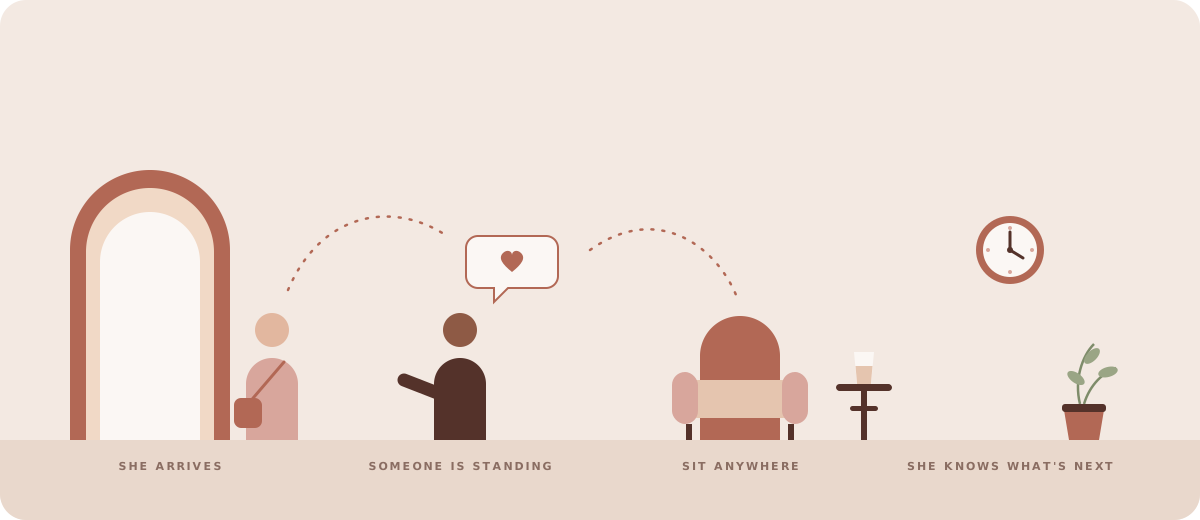
In practice, receiving her looks like a few ordinary things. Someone is standing, and she is greeted by name before she has had to decide where to go. Nobody sells her anything at the door: not an upgrade, not a product, not a membership. We do not take her coat or check her in. We welcome her in and get her comfortable, in the foyer at the front, or in the Dome if she would rather be somewhere quiet. Her glass does not sit empty. And she is never left working out what happens next: where to sit, who is coming, how long. If she has to wonder, something has been left undone.
None of this is a script. It is what you already do when someone you like comes over. The difference is doing it on a Tuesday, for the eleventh person, when the room is busy.
PALOMA has a name for this. It is the one standard of care that holds everywhere in the house:
PALOMA owns the experience around the guest, so the guest doesn't have to.
She should never have to wonder what's next, where to go, or who to ask. That holds even when the day is going badly, because the day you are having is ours to carry, not hers to absorb.
It is a Tuesday. You are behind, the phone is going, and a guest walks in.
What does “she is in our home” actually ask of you here?
That she doesn't find out any of that from you.
Yes — and this is the practical edge of the whole belief.
The day you are having is ours to carry, not hers to absorb. A phone going, a therapist running behind, a difficult morning: she should leave without having learned about any of it.
That is not pretending. It is the same thing you would do if someone knocked on your door mid-argument.
The other answers, and why not
That you apologise for the wait and explain what's going on.
Half right, and the half that's wrong matters.
Telling her what is happening to her visit is care. Telling her what is happening to us hands her something to manage. She did not come here to understand our afternoon.
That you move faster so she isn't kept waiting.
Speed is not the thing being asked for.
A guest can wait ten minutes and feel perfectly held, or wait two and feel like an interruption. It is not the length of the wait. It is whether she was received before it started.
Words to keepYou're here — come in. Sit anywhere that looks good and I'll come and find you in a few minutes.
Yours to say as written, or in your own words once it is.
Chapter five
The home itself
If guests are in our home, it's worth knowing the home. Walk in the front door and before anyone says a word, something has already happened. The light is warm. The walls are a soft peachy earth. It smells of something hand-poured. The space itself is the first thing that helps a guest exhale, which means the room is already doing part of your job before you have said a word.
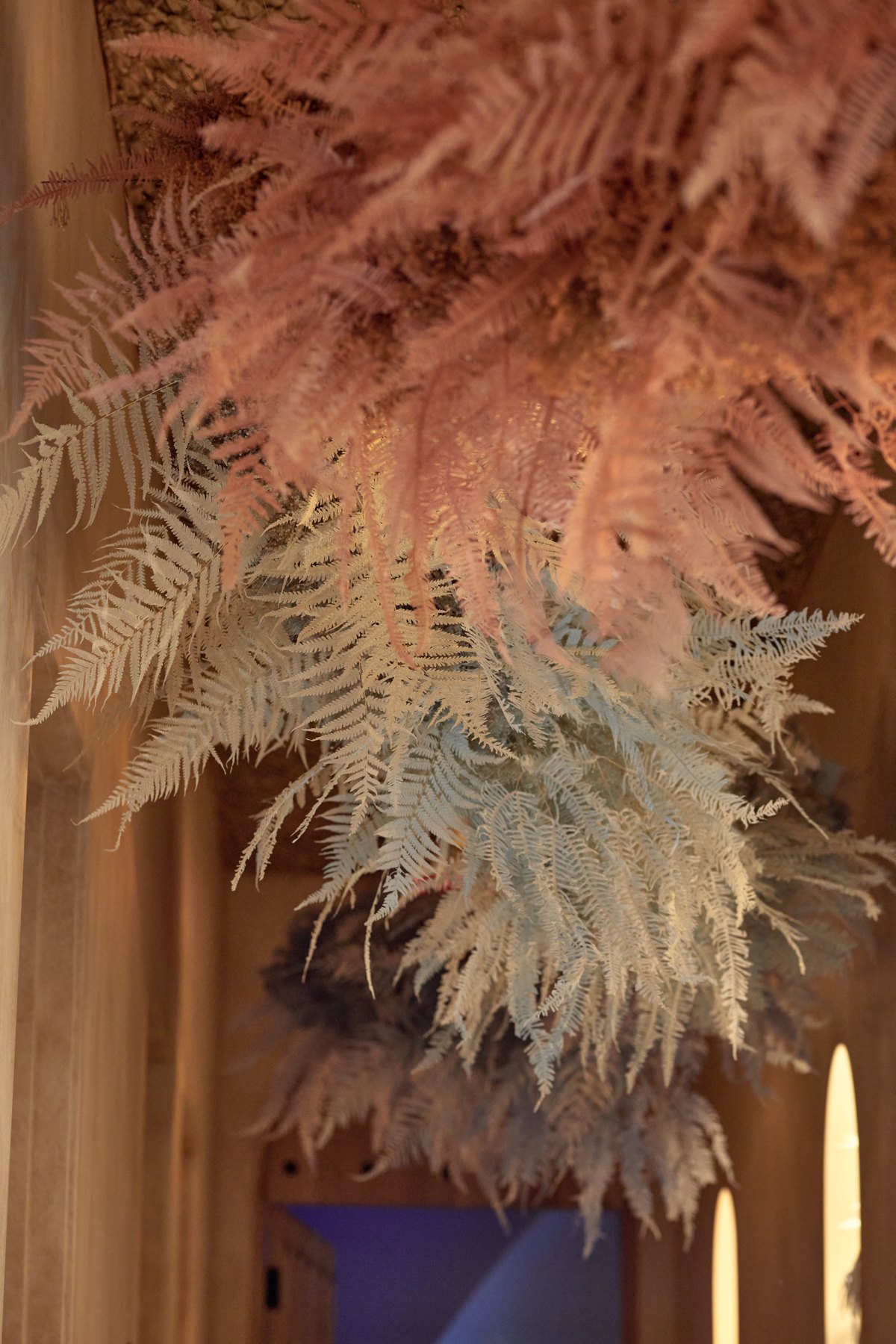
Even the walls carry a story. PALOMA's warm, limewashed tones were drawn from a hike through the Painted Desert: the peachy, earthen colour of the walls and the sand-soft floors echo the hues the founders ran their fingers through while dreaming this place into being.
And the design is only one expression of that intention. Anything that touches the body here is chosen with the same care: hand-crafted candles and incense, hand-made jewellery, and crystals the founders source themselves from Tucson, Brazil and Peru. Nothing here is accidental.
Where it all came from
Guests ask about the house constantly, and almost every answer is a small true story rather than a design term. There are six worth carrying with you.
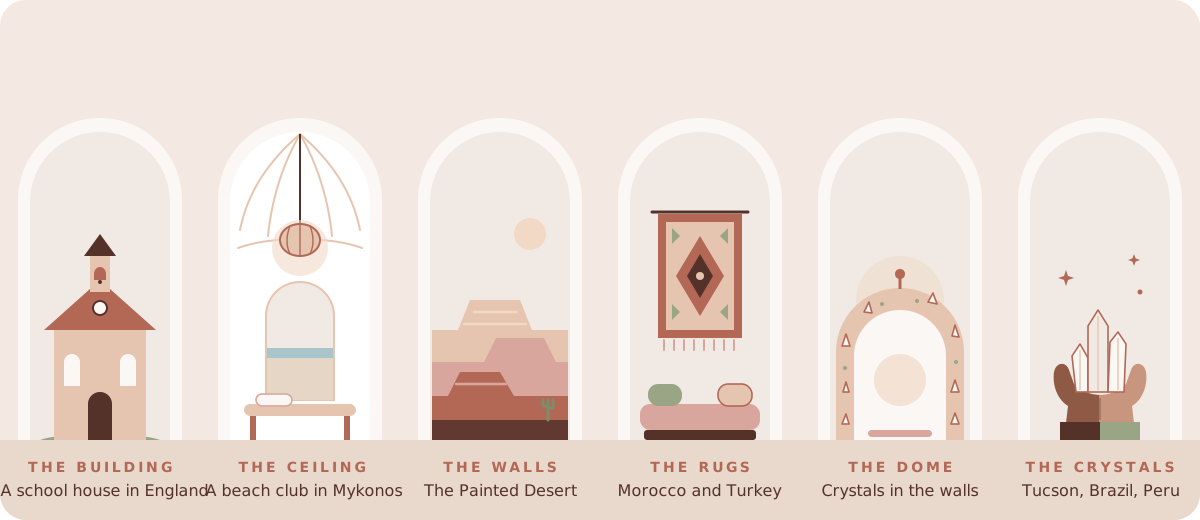
- The building
- The exterior is inspired by a school house in England. It's the reason PALOMA doesn't look like anything else on the street.
- The ceiling
- Inspired by a beach club in Mykonos. The single most photographed thing in the house.
- The walls and the paint
- Limewashed, and drawn from the Painted Desert; the custom art and paint came from travels through the desert too. If a guest says the colour reminds her of somewhere, she isn't imagining it.
- The rugs and the furniture
- Vintage rugs found in Morocco, Turkey and Azul. The furniture was designed to make people lounge and talk rather than perch. If a guest settles in and stays after her treatment, it's doing what it was chosen to do.
- The Dome
- A sacred space built for introspection, with state-of-the-art acoustics, lighting and furniture. There are crystals buried inside the walls, placed there for protection, clarity and peace.
- The crystals
- Hand-picked by the founders, sourced from Tucson, Brazil and Peru. Not bought from a catalogue. Chosen, one at a time.
These stories are short, they don't change, and they're the warmest thing you can hand someone for free. The skill is knowing how much to hand over.
A guest waiting in the vestibule looks up and says, "this ceiling is unreal — where is this from?"
What is the best thing to do with that question?
Tap the answer you would give.
Yes.
A true short story is worth more than a long one. She asked a light question while she waited; she did not ask for a tour.
This is also the easiest version of this job. You are not selling anything, you are not advising. You are telling someone something real about where she is sitting.
Generous, and it turns her quiet moment into an activity.
She is waiting, which at PALOMA is not dead time to be filled. If she wants more she will ask, and then you have plenty.
Honest, and this is one of the few things you genuinely should carry.
Prices and durations live on the shelf. The handful of stories about this building are small, they do not change, and they are the warmest thing you can hand someone for free.
From loudest to quietest
PALOMA is smaller than people expect, and it's arranged so a guest moves from loudest to quietest as she goes in.
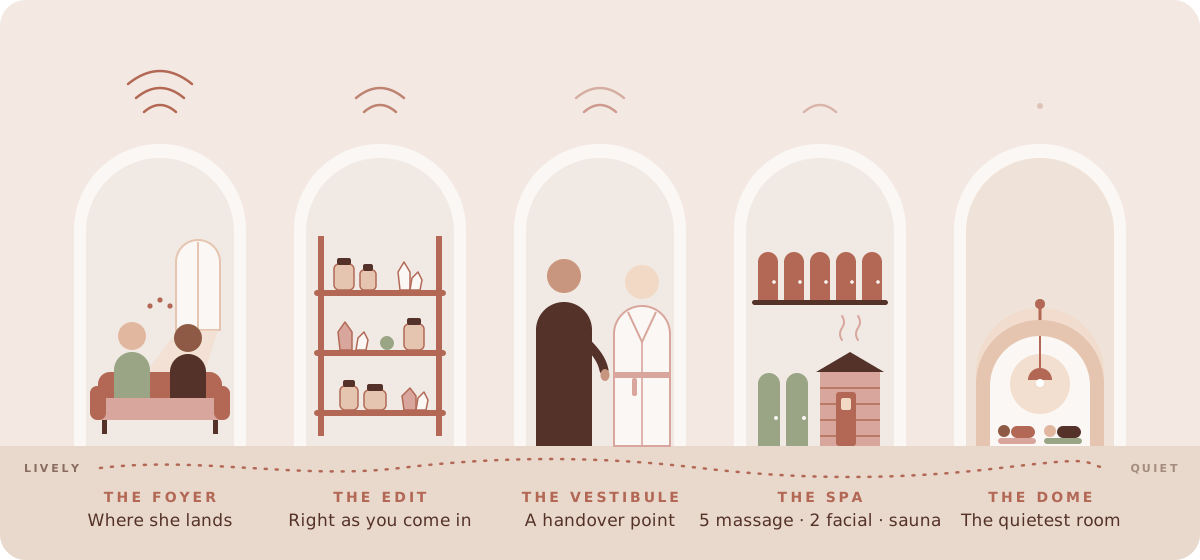
- The foyer
- The landing zone at the front, where most guests sit when they first arrive. Full of natural light, and a little more lively than the Dome. If she wants company and movement around her, this is where she waits.
- The Edit
- Our retail space, and you'll hear both names. It's immediately in, so it's part of the walk rather than a shop she has to decide to enter.
- The vestibule
- A transition space for a guest with more than one appointment. Her provider walks her here and a Guide takes her on from there. It's a handover point, which is why it's rarely empty and never somewhere she's left.
- The spa
- Five massage rooms, two facial rooms and the infrared sauna. The Ballancer Pro lives here too; it's a piece of equipment rather than a room. The rooms are deliberately cosy: custom decor, comfortable beds, soft linens.
- The Dome
- Meditation, sound baths, workshops, private events, aura photography and palmistry. One room doing six jobs, which is why its schedule matters.
There is no locker room. Worth knowing before a guest asks, because it changes what you say about arriving and changing.
That last idea, loud at the door and quiet at the heart, is not only an interior design choice. It is how PALOMA thinks about a guest's whole nervous system, and it is the next chapter.
Chapter six
Why calm comes first
Remember the pillar that comes first? Here is why. A guest is arriving, and there are two ways to greet her.
4:40pm. She has come straight from work and she is eleven minutes late.
Both of these are correct. Only one of them helps her arrive.
“Hi — you're here for the 4:30 with Monica, that's the Grounding Stone, sixty minutes. Have you filled in your intake? There's a form on the iPad. Did you want to add the CBD, it's seven dollars. Locker's through there, robes on the left.”
Everything in that is true, and she will retain almost none of it.
She has been handed six pieces of information and two decisions inside fifteen seconds, at the exact moment she is least able to hold them. She will ask about the locker again in four minutes, and she will feel slightly foolish for asking.
“You made it. Monica knows you're here — nothing's lost. Come and sit down for a moment, there's water just there. I'll come and get you in about five minutes and we'll go through the rest then.”
Yes.
The same facts are coming. They are simply arriving after she has landed rather than instead of it. Notice what has been handled without being mentioned: she is not late in any way that costs her, nothing is required of her right now, and she knows exactly what happens next and when.
Both of those greetings are correct, but only one of them helps her arrive. The reason is the part of PALOMA nobody has written down for you before.
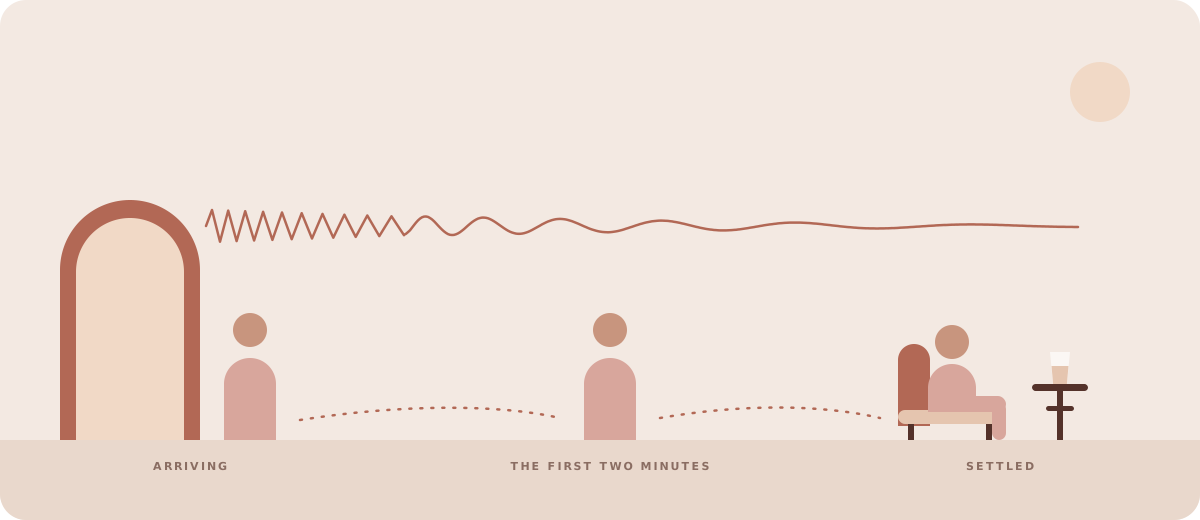
Under pressure, the body prioritizes. Her attention has narrowed to whatever seems most urgent, so she takes in less of what you say, remembers less of it, and finds small decisions harder than they should be. That is not her being vague or difficult. It is the most ordinary thing a body does.
And it does not stop at the door. The part of the nervous system that mobilizes her does not switch off because she has arrived somewhere pleasant. It settles over minutes, not seconds, and only as the signals around her start saying it can. So the first few minutes are not a formality before the experience. They decide what the rest of it can be.
The signals that help are mostly boring: knowing what happens next, not being asked to decide anything right away, fewer things asking for a response. Predictability does more work than atmosphere. A beautiful room she cannot read is still a room she has to work out.
Regulation before transformation.
That is PALOMA's philosophy in three words: calm first, and clarity and choice follow from a settled nervous system. It is also why a home fits better than a spa: a home is somewhere you arrive and stop managing yourself. And it is why we don't sell at the door. A decision asked of someone whose attention has narrowed is one she makes badly and may quietly regret. Holding the offer is not lost revenue. It is the offer arriving when she can actually hear it.
The first two minutes are yours
Almost everything in that window is in your control, and almost none of it is treatment. You are not doing anything to her. You are removing the things she would otherwise have to manage.
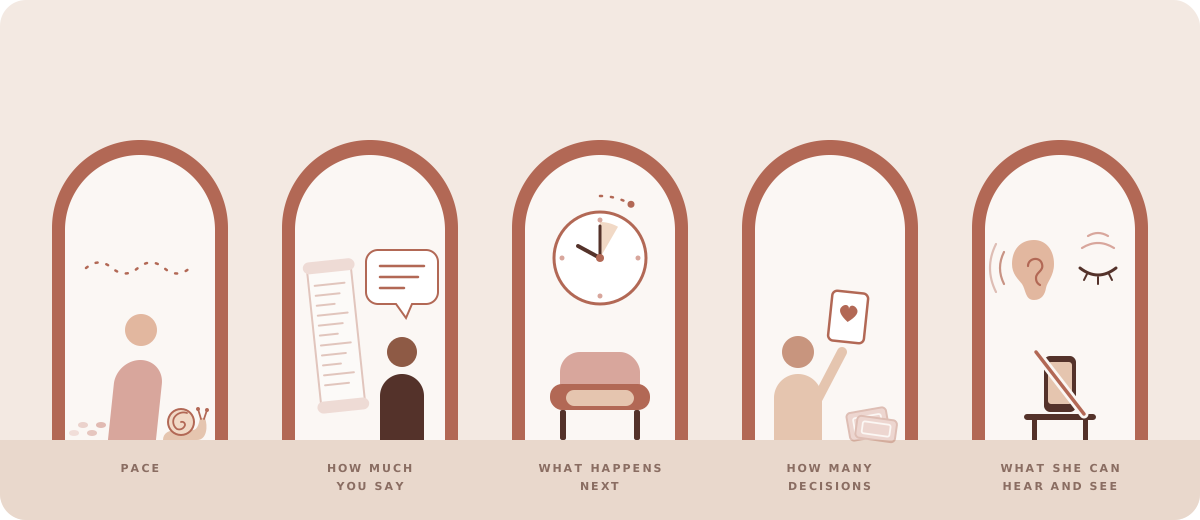
- Pace
- How fast the first exchange moves. You set it, and she will match you almost every time. It costs nothing and changes the most.
- How much you say
- Everything true is not everything now. Most arrivals need three facts, and the rest can wait four minutes.
- What happens next
- The single highest-value sentence at the door is some version of I'll come and get you in about five minutes. It removes the one job she would otherwise be doing while she sits: watching for someone.
- How many decisions
- Every question you ask is a small task. None of them are wrong. The question is whether they are wanted now, or in ten minutes when she is settled.
- What she can hear and see
- Voices carrying from the desk. A phone ringing out. Something half-tidied in her eyeline. You notice these less than she does, because you are not the one arriving.
It starts with you. Regulation begins with the person delivering the experience. That means noticing your own state before it becomes hers, keeping your footing inside a hard day, and coming back after something goes wrong. Nobody stays regulated all day. Your state is part of the experience, and that is a responsibility, not a demand to be permanently calm.
Nor is the philosophy a slower script. A first-time guest standing with her bag still on needs the shape of the visit made visible, and then to be left alone in it. A regular already halfway to the locker room needs her name, the one thing that has changed, and to be let go. Some people arrive by talking, and that is fine: calm is not quiet. What settles a person depends entirely on the person.
There is one more thing to know, now that you know a little about nervous systems.
She sits down heavily and says: “God, I have had the worst week.”
You now know something about nervous systems. Which of these may you say?
“That sounds like a lot. You're in the right place to put it down for an hour — come through whenever you're ready.”
Yes.
It meets her, it does not diagnose her, and it hands her something to do. You have used what you know without saying what you know.
That is the whole shape of it: the knowledge changes what you do, not what you announce.
The other answers, and why not
“Your nervous system is probably completely fried — this will help reset it.”
This is the line this chapter is most trying to prevent.
Two separate problems in one sentence. You have told her what is happening inside her body, which you cannot know, and you have promised what an experience will do to it, which is not yours to promise.
Knowing more is not permission to say more.
“A lot of people find the sauna really helps with stress — the infrared brings your cortisol down.”
The first half is fine. The second half is a claim.
A lot of people find it helps is honest. Naming a mechanism turns an experience into a treatment, and nobody has approved that sentence. The more you learn about the body, the easier this one gets to trip over.
What you know now changes what you do, not what you say. You will not explain any of this to a guest. She will simply find that arriving here is easier than arriving most places, and she will not be able to tell you why.
Chapter seven
The people in the house
A house cannot regulate a guest's nervous system while grating on its own people. That is why the founders call PALOMA's team culture one of the most distinct things about the brand. Inclusion, diversity and accessibility are valued and respected, and everyone in PALOMA's house is treated warmly, with transparency, dignity and respect.
The values we embody for our clients are the same values we covet for our associates.
The founders
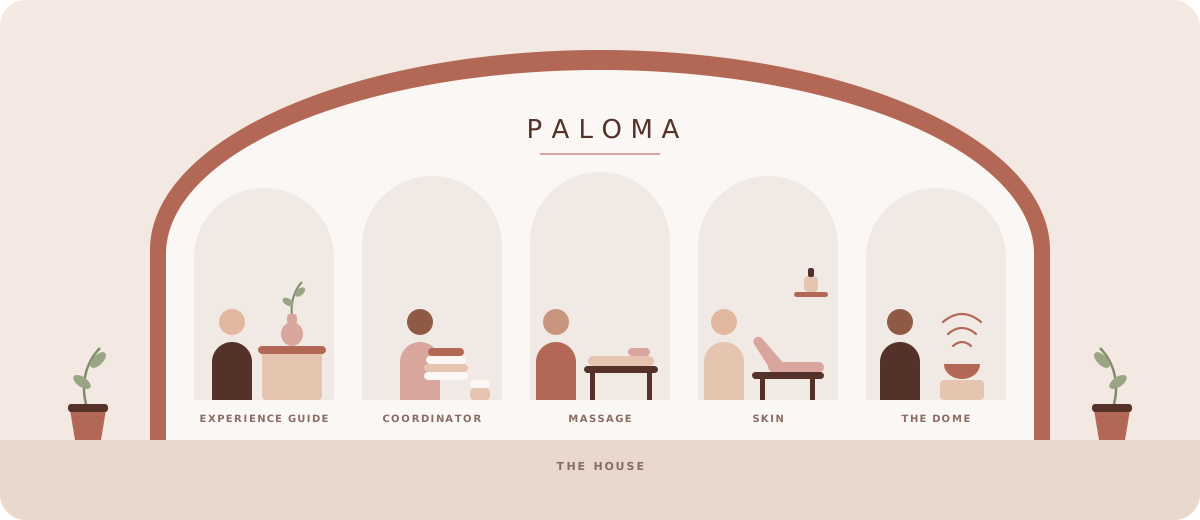
Every role in the house carries something the others do not.
- Experience Guide
- Accountable for the guest's journey: booking and rebooking, curating gifts, educating guests on everything wellness. The first and last face a guest sees at PALOMA.
- Experience Coordinator
- The Healer's protector and the Experience Guide's right hand. Leads the effort to keep the house running on time between appointments, and preps the space. If the day stays smooth, this is usually why.
- Healer — Licensed Massage Therapist
- Most have at least five years of experience and are among the best in the industry. Which modality a Healer practices matters when you are matching a guest.
- Healer — Skin Therapist
- Also at least five years, and also among the best. They perform facials, and they are personal shoppers for guests on everything skincare.
- The Dome's practitioners
- The people who hold the Dome: guided meditation, sound, breathwork, energy work and readings. You are not expected to explain what they do, only to know that the Dome has its own practitioners and that what happens there is as considered as anything in a treatment room.
PALOMA calls its therapists Healers, and you will hear the word constantly. It is deliberate, and so is the point beneath it: they are not interchangeable. Which one a guest needs is a real question with a real answer.
A guest finishes a facial and asks you, at the desk, which of two serums she should actually be using.
Who is best placed to answer her?
The skin therapist who just treated her.
Yes, and this is the half of the role most people miss.
Skin therapists at PALOMA are personal shoppers for skincare, not only providers of facials. She has just had her face read by someone with at least five years of looking at skin.
Taking the question back to her is not passing the buck. It is routing it to the best answer in the building.
The other answers, and why not
You can — the Edit is the Guide's floor and you know the products.
Product knowledge, yes. This question, no.
She is not asking which serum is popular. She is asking what her skin needs, and that is a read somebody has just done.
Whoever is free — anyone who knows the range can help.
This treats the roles as interchangeable, and they are not.
The reason PALOMA names the roles at all is that each carries something the others do not.
Chapter eight
Six values, and an ordinary Tuesday
The culture has a vocabulary. PALOMA has six values, and they are the same six whether you are a founder, a Guide or a Healer.
- Openness + Flexibility
- Welcoming opportunities as they come and not being afraid to walk down unexpected paths. Adapting to strategies as they change, and being a cooperative team player.
- Ownership + Discretion
- Acting with courage, challenging the status quo, and finding new ways to grow our company and each other. Feeling empowered to make the call and execute.
- Safe + Transparent Communication
- Speaking up with no fear that our words will be shut down, dismissed, or judged unfairly. We don't beat around the bush or passive-aggressively communicate to make a point.
- Creative Collaboration
- Passionately working together to discover, strategize, communicate and deliver results in a unified effort. Championing big ideas and leaning on each other's strengths.
- Curiosity + Exploration
- The learning should never stop. Curious minds, questions that lead to solutions, listening before we act. Stopping half way is not an option.
- No Toxicity + Egoless Intention
- No tolerance for toxic behavior. We actively discourage a blaming culture, shameful language and unfair comparison, which all stem from fear and insecurity.


Values like these are easy to agree with and easy to hang on a wall. At PALOMA they are not on the wall. They are in the shift, and they are tested quietly far more often than they are tested loudly. Here is one ordinary Tuesday, written up the way an associate might keep it in her journal.
An ordinary Tuesday
I came in expecting the front desk, and fifteen minutes before open I was asked to set the Dome for a workshop. I have never set the Dome. Openness + Flexibility is saying yes to the change. It is not pretending you already know how. So: yes, I haven't done it, who can show me once?
A treatment is running fifteen minutes over and the next guest has looked at the clock twice. Nothing I do shortens the fifteen minutes. The only thing I control is who speaks first, so I went to her before she came to me. Nobody needed to hand me that call.
Her dishes in the break-room sink again, and I keep washing them. Four times is a pattern, and she almost certainly does not know it is one. Tell her directly, once, in private.
Someone in the back said a therapist has been off all week. If there is a real concern, it goes to a manager, not around the room. Egoless does not mean silent. It means the concern travels to where it can be acted on.
A note in Sling, and I cannot tell whether it is meant for me. Ask what it means for my shift, then tell whoever else it might land on. Stopping half way is not an option.
A group of friends in the Dome for the first time, and one of them mentioned that it is her birthday. Ten minutes, and a colleague on shift who plays the sound bowls. I don't have the skill. I had the idea, and I knew who did.
Some moments ask for two values at once, and the order matters.
A massage room has not been flipped and the guest for it arrives in ten minutes. The laundry has not been moved. There are dishes in the sink. The Experience Coordinator is in the break room on her phone.
Two things to do, and the order is most of the answer.
Flip the room. Then say it to her, plainly, before the shift ends.
Yes, and the order is the whole answer.
The room has a clock on it.
So the room first, every time, regardless of whose it was.
Then the part most people skip. If something bothers us, we know we can bring it up and be heard — and that means to her, not about her. You do not need to be anyone’s manager to say “the room had not been flipped and she was ten minutes out.”
You also do not know what you walked in on. That is a reason to ask, not a reason to go quiet.
The other answers, and why not
Flip the room, move the laundry, do the dishes, and say nothing.
The first half is right and the second half is the one the values name specifically.
It is how a one-off becomes a pattern nobody has ever said out loud.
Doing all of it silently feels like the generous option. You will still be carrying it in six weeks.
Leave it and tell a manager what you walked in on.
Two problems, and the first one is the guest.
She still walks into a room that is not ready.
And that was the only thing in the list with a clock on it.
The second is the shape. We actively discourage a blaming culture — going to a manager before going to her is that shape, whatever the intention. This is not a safety question and it is not outside what you are allowed to decide; those are the things that escalate. This is a conversation.
Where a service comes from
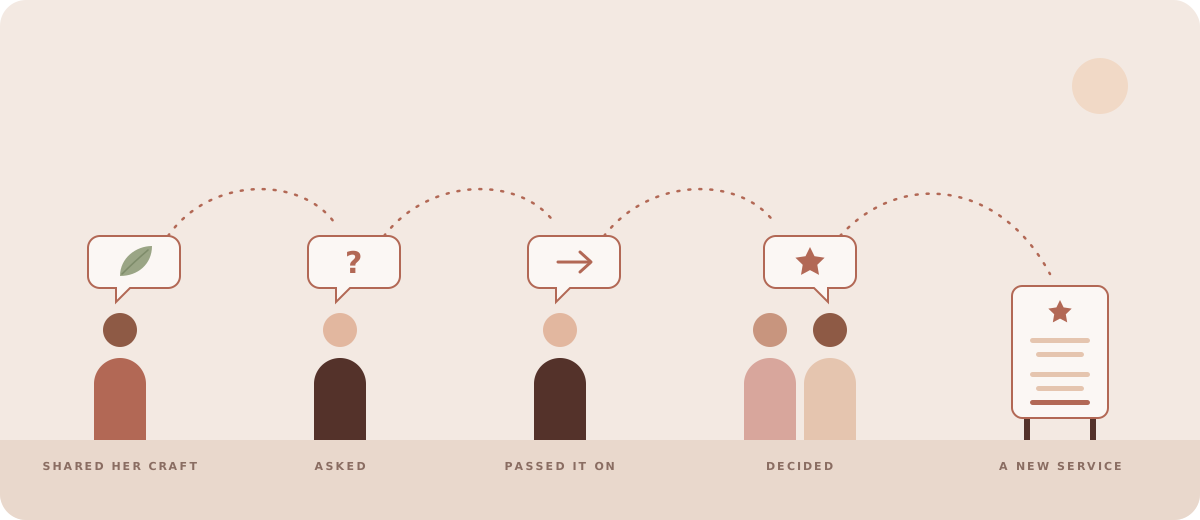
This happened here. One of our therapists was talking about facial massage: why it matters, and what it actually involves. An Experience Guide heard it and started asking questions. Then she didn't keep the answer to herself. She passed it on. A manager took it to the founders, where it stopped being a conversation and became a decision. And now there is a service on the menu because of it.
Every link in that chain was somebody's ordinary shift. Two of the links were an Experience Guide being curious out loud and then not keeping the answer to herself, which is exactly the part of the story that could be yours.
Your part of the story
The founders built PALOMA because they had to, and they built it for the people who walk through its doors. It grew because those people felt something here and told each other. Everything you have just read, from the house to the beliefs, the calm and the values, only becomes real in the way it is lived on an ordinary day, by the people working that day. Starting now, that includes you.
You are not being asked to be different. You are being asked to be fully yourself, here.
Key takeaways
- 1PALOMA was founded by Angela Gann and Stella Giometti, who built it because they had seen what burnout does — in the people around them, and in themselves.
- 2Five roles in the house: Experience Guide, Experience Coordinator, and three kinds of Healer — massage, skin, and the Intuitive Guides who hold the Dome.
- 3PALOMA calls its therapists Healers, and they are not interchangeable. Which one a guest needs is a real question with a real answer.
- 1Wellness is not a luxury. It is a necessity. That is why PALOMA exists, and it is the shortest answer you can give.
- 2Guests are in our home. Not customers in a business. Everything else in this Academy is that belief worked out in detail.
- 3You are not being asked to be different. You are being asked to be fully yourself, here.
- 1PALOMA is a wellness house, not a spa — the difference is what we are for.
- 2Four pillars: Regulate, Connect, Beautify, Discover. You will not say them to a guest; you use them to place what she is asking for.
- 3Regulation comes first. Calm is not the reward at the end of the treatment. It is the condition everything else depends on.
- 1Four doors: the Spa, the Dome, the Retail Space, Private Events. Almost every question a guest asks comes through one of them.
- 2The Spa is the largest part of what we do, and the part most guests arrive for.
- 3You are not expected to carry the menu. Durations, prices and who a service is not for live on the Reference shelf.
- 1Nothing here is accidental. The walls came from the Painted Desert, the ceiling from a beach club in Mykonos, the crystals from Tucson, Brazil and Peru.
- 2The handful of stories about this building are short, they do not change, and they are the warmest thing you can hand someone for free.
- 3The space is doing part of your job before you speak — and it will steady you on a hard shift the same way it steadies a guest.
- 1Philosophy, voice, standards of care, behaviours. Four parts, and they are not interchangeable.
- 2Regulation before transformation. Calm first; clarity and choice follow a settled nervous system.
- 3A standard is what a guest can count on. A preference is how you happen to do it. Telling them apart is the whole of this chapter.
- 1Settle her first. Everything else works better after.
- 2What you know now changes what you do, not what you say. None of this is explained to a guest.
- 3She will simply find that arriving here is easier than arriving most places — and she will not know why.
- 1Six values: Openness + Flexibility · Ownership + Discretion · Safe + Transparent Communication · Creative Collaboration · Curiosity + Exploration · No Toxicity + Egoless Intention.
- 2They are the same six whether you are a founder, a Guide or a Healer. That is deliberate.
- 3The founders' own examples are all company decisions. What they ask of you on an ordinary Tuesday is the next two chapters.
- 1Say yes, say you haven't done it, and ask who can show you once.
- 2Go to her before she comes to you.
- 3Tell her directly, once, in private.
- 1Saying yes and asking how.
- 2Telling someone once, in private.
- 3Not carrying a thing on in the back.