Module 5 · Your Day
Operations & Daily Procedures
Daily rhythms, shift procedures and the systems that keep the day running from opening to close.
About 40 min to read · then Check yourself
Chapter one
The day nobody sees
A guest arrives at ten. Her robe is warm, her therapist has already read her notes, the Dome is set for the sound bath she booked for noon, and when she moves from her massage to her facial she never has to get fully dressed in between. She doesn't see how any of it happened. That is the point.
PALOMA runs like a well-choreographed experience. Every team member, from Experience Guides to service providers to Coordinators, has a specific part in making the day flow. When operations run smoothly, guests feel the care and attention to detail that PALOMA is known for. When they break down, the whole experience falters.
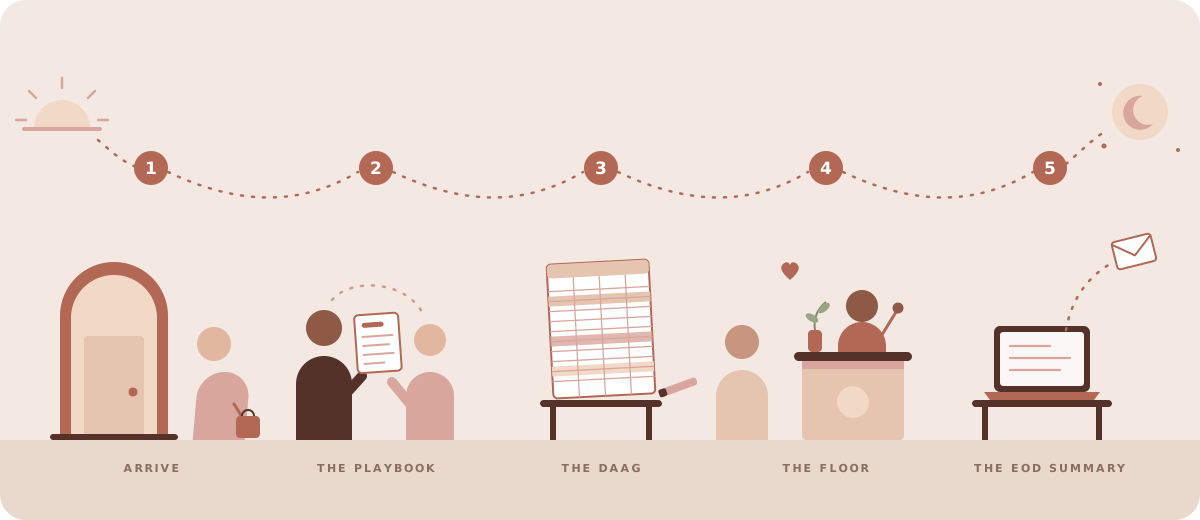
This module follows one day from the front door to the alarm: how you arrive, the two documents that hold the day together, the checklists, and the summary that closes it. Then it turns to the harder moments: what is yours to decide, what goes to a manager, and what to do when something happens.
Flawless operations are invisible to guests. They never see the Daily Playbook or the Day At A Glance. What they feel is the ease, the timing and the thoughtfulness. Your job is to make that feeling possible.
Chapter two
Arriving
Your first moments of the day set the tone for everything that follows, so the day starts before your shift does.
| Your role | When to arrive |
|---|---|
| Service providers (massage therapists, estheticians) | 15 minutes before your first guest. This gives you time to center yourself, prepare your room and read your guest notes. |
| Everyone else | 5 minutes before your scheduled start time. This is non-negotiable: on time is late. |
When you arrive
- 1Find the manager on duty as soon as you arrive.Ask for anything about today that may affect your work or the guest experience.
- 2Clock in for your shift on the Sling app.If you miss a clock-in, note it in Sling the same day.
- 3Always use the front entrance to arrive and leave.The back door is off-limits during business hours unless a manager is with you.
Breaks are built into the day the same way, planned in advance rather than taken when it's quiet, because the front of the house must never empty.
How breaks work
- Breaks are unpaid.
- The manager on duty assigns break times, using the Daily Playbook.
- Any change to your scheduled break needs a manager's approval.
- The goal: 2 Experience Guides at the front and 1 Coordinator on at all times, even during breaks.
- Clock out and back in for your break on Sling. If you miss a break clock-out or clock-in, your timesheet adjusts automatically.
The break lengths themselves, and what to do if you're running late or calling off, are in HR & Policies.
Being early is a gift you give the day and your team.
Chapter three
The Daily Playbook
Two documents hold the day together. The first is the Daily Playbook: the plan for the day's people. It must be ready 15 minutes before opening.
| The Playbook sets | What that means |
|---|---|
| Team and breaks | Who is working and when each person's break is, keeping 2 Experience Guides at the front and 1 Coordinator on at all times. |
| Secondary roles | Which Experience Guides take on a second role today (below). |
| Peak times | When 4 or more rooms need flipping at once, and where extra help goes. |
| Dome setup | What gets set up in the Dome at opening, mid-day and close. |
| Unusual tasks | Anything outside the daily checklists that needs doing. |
| Morning cover | Which Experience Guide does the morning Coordinator tasks when 2 Experience Guides open and the Coordinator arrives at 9am. |
Every shift starts with the manager on duty going over it with you, out loud. You'll hear your role and any secondary role, your break and who covers you, peak times when you may help flip rooms, any Dome setup you're part of, and anything special about the day. Your trainer will show you a real one.
It's 8:45am and you see 5 room flips at 9:15 that nobody has flagged. Five at once is a peak time. Tell your manager now, so support and breaks can be arranged before the rush.
The hats a guide wears
Experience Guides wear many hats. Depending on the day and the Playbook, you may take on one of six secondary roles. Knowing each one keeps you flexible.
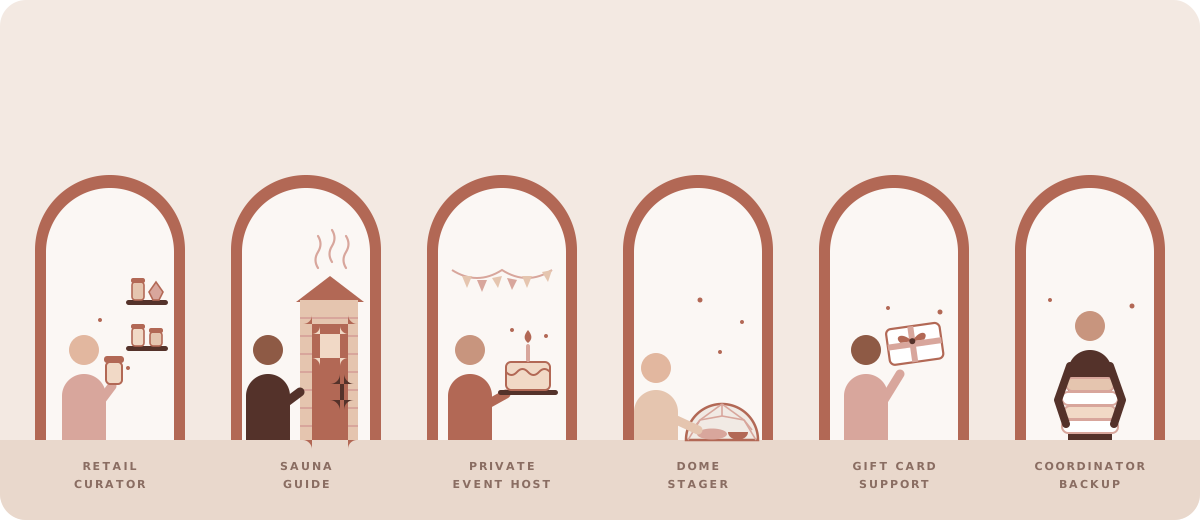
- Retail Curator
- You love recommending products and connecting guests with at-home self-care rituals. You care about the why behind what PALOMA sells and how it carries the PALOMA experience into guests' homes. Your curiosity helps guests find products that actually suit their lives.
- Sauna Guide
- You know how the Sunlighten infrared sauna works. You walk guests to the sauna, explain the experience, answer questions about temperature and session length, and flip the sauna at peak times to keep the day moving. Your knowledge makes guests feel cared for.
- Private Event Host
- You greet private event guests warmly as they arrive, keep the move between the Dome and the spa seamless throughout their visit, check in mid-event and give the final thank-you. You are the warm, attentive face of every celebration.
- Dome Stager
- You bring close attention to detail to the Dome. You set up for meditation, sound baths and workshops precisely, with every pillow, blanket, crystal and speaker in its place. Your setup is the space the guest's experience happens in.
- Gift Card Support
- You are the holiday point person for gift card sales. You become the expert on amounts and options and on making gift-giving easy, which frees other Experience Guides to stay with spa guests during the busiest season.
- Coordinator Backup
- You support the Experience Coordinator at peak times. You jump in to flip rooms, prepare treatment spaces, manage guest transitions and keep things calm when the day gets hectic. Your backup is what lets everything flow.
Chapter four
The Day At A Glance
The second document is the DAAG, the Day At A Glance: the real-time page for providers and the team. It brings room assignments, guest transitions, group appointments and guest notes into one place, and like the Playbook it must be complete 15 minutes before opening.
The five things the DAAG does
- Assigns a treatment room to each provider, planned so no two providers with overlapping shifts share a room. A provider working 10am–2pm and one working 3pm–8pm can share; 10am–4pm and 3pm–8pm cannot.
- Captures guest transitions: when a guest is having 2 or more spa services in treatment rooms, so providers can prepare transition bags and keep the visit continuous.
- Shows group appointments: 2 or more guests booked together, so the team can prepare kombucha, champagne or a mindful gift for the occasion.
- Keeps guest notes and service enhancements in one place: appointment and profile notes, booked enhancements, transition services and group details, all visible at a glance.
- Notes Dome setup through the day and at closing, so everyone knows what is set up now and what will be set up next.
Some visits ask more of us than a standard appointment, and the DAAG is where you see them coming. When one appears, treat it as your cue to go above and beyond.
| Visit | What it is |
|---|---|
| Transition service | A guest having 2 or more spa services in treatment rooms, such as a massage and a facial. A transition lets the guest move between treatments without getting fully dressed in between, so the visit stays unbroken. |
| Group appointment | 2 or more guests booked for spa services together. Groups need coordination before, during and after the visit. The aim is for everyone to feel equally celebrated and cared for throughout. |
| Spa Journey | An immersive, multi-service visit that takes the guest through a set sequence of treatments, rituals and sensory moments. Each journey has its own flow, beverage and parting gift. |
Each of those is marked on the printed DAAG with a highlight colour, and each colour is an action.
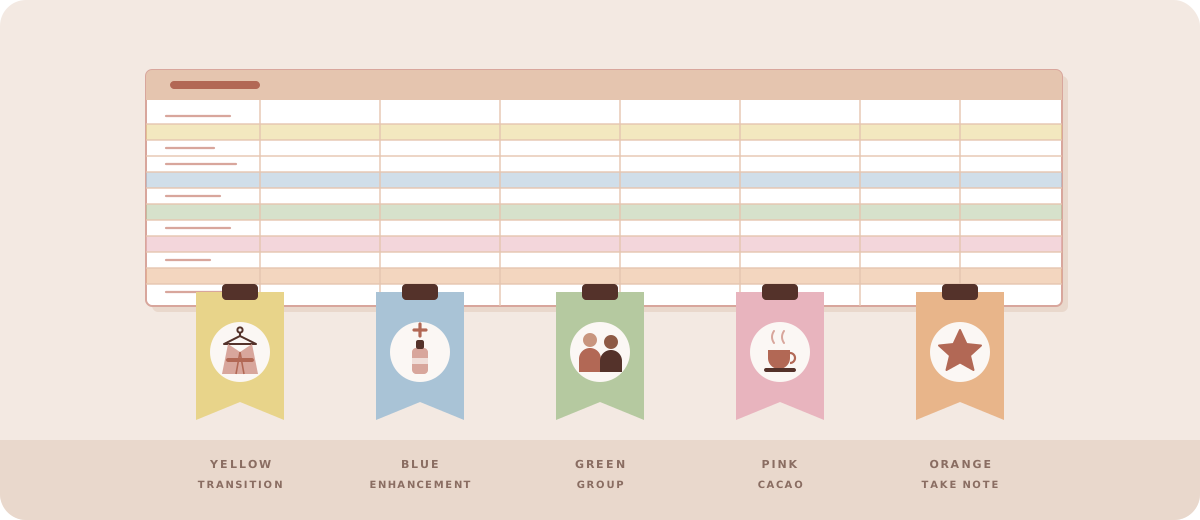
| Highlight | Means | What happens |
|---|---|---|
| Yellow | Transition robe and bag | The guest has more than one service and will move between treatment rooms. Coordinators prepare; Experience Guides confirm. |
| Blue | Enhancement add-on | The guest has an enhancement already booked. Some preparation may be needed; ask a Coordinator if you need help. |
| Green | Group appointment | Two or more guests booked together. Collect them from the lobby at the same time and coordinate so everyone feels equally celebrated. |
| Pink | Cacao needed | Coordinators prepare and serve warm cacao at the right time, for Fire Within Journeys, public Sound Baths and private Meditation experiences. |
| Orange | Take note | The guest may have a special request, a pop-up note on their profile, or be celebrating something. Give extra attention. |
Pay close attention to
- Room assignments, especially where an evening provider is in the same room as a morning provider. Flipping that room is the first priority.
- Transition bags. They must be in the correct treatment room before you bring the guest back. This is the Experience Coordinator's responsibility; Experience Guides confirm it.
- Dome setups. Check and confirm the Dome configuration throughout the day.
- Sauna transitions. Sanitize and reset the sauna after each session to keep the day on time.
- Closing Dome setup. If you are the closing Experience Coordinator, this is a key part of your closing duties.
Building the DAAG
Whoever builds tomorrow's DAAG follows the same steps every time. Your trainer will walk you through a completed one from a real day.
Creating the DAAG, step by step
- 1Open the Zenoti appointment book and the DAAG spreadsheet in Excel. Use Tile windows to see both side by side.
- 2Right-click yesterday's date sheet at the bottom of the DAAG file.
- 3Select Move or Copy.
- 4Select yesterday's date and tick the Create A Copy checkbox.
- 5Rename the new sheet with today's date.
- 6Check Sling for each massage therapist and esthetician to see who is working.For anyone not scheduled, shade their cell grey and type OFF TODAY.
- 7Assign treatment rooms to every provider who is working.Two providers can share a room only if their shifts do not overlap.
- 8Starting with the first provider's column, go guest by guest through the day and fill in GUEST NOTES.Capture appointment notes, profile notes, booked enhancements, transition services (2 or more treatments) and group appointments.
- 9Turn to the Dome section and check three places in the appointment books for Dome activity.Meditation Guide books (Sound Journeys, Private Meditations, Private Sound Baths), the Public Classes list, and Aura Photography appointments.
- 10List all Dome activity in time order.For each one, note the seats or beds needed, the beverage (Moodbelli, for example) and what time to serve it.
- 11Fill in the CLOSING DOME SETUP row from tomorrow's appointment book.Note the first Dome activity and how many chairs or beds it needs, for example: Private Sound Bath – 5 people.
- 12Go through the infrared sauna books.For each session, note the time, guest name, guest notes (group size, enhancements, transitions) and how long they booked.
- 13Save the file and print 2 copies.
How each treatment room is set up is in Visual & Space Standards.
Chapter five
Opening, mid-day and close
These tasks should never get in the way of serving the guest.
Every role has its tasks: opening the studio, keeping rooms flipped and stocked through the day, closing it down, and a few weekly jobs in quiet moments. They are part of the job, and you don't learn them from this page. Your trainer walks you through them on the floor, in real time, starting as early as your second shift, and they become second nature over your shadow days.
Lights, music and the drink station, the rooms, the sauna and the Dome, and the day's paperwork.
Flipping rooms, hot towels and laundry, guest texts and confirmations, keeping everything tidy.
Closing the register, cleaning and resetting every space, tomorrow's DAAG, and locking up.
Deeper cleaning and restocking, done in downtime through the week.
Two are always mandatory: the rugs in the main hallway and retail space vacuumed before opening, and lights off, lock up, set the alarm and clock out at the end. Codes are never written down; your manager gives them to you in person.
Service provider checklists (lymphatic specialist, esthetician and others) are specific to each role and are covered separately with your trainer and team lead. If you are a service provider, ask your manager for your onboarding checklist.
Curious before then? Here is the full list. You don't need to learn it here.
Experience Guide, before the doors open.
- Studio setup
- Turn on lights and music · Prepare the drink station · Unload the dishwasher · Restock retail shelves · Wipe the window sill, benches and side tables · Stock the bathroom with soap and toilet paper · Make sure the main hallway and retail space rugs are vacuumed before opening. This is mandatory. · Refill the CBD gummies at the front desk, and check them out by bag in the system · Sweep outside by the windows and door and cut back wild weeds; salt the sidewalk if it is icy or snowy · Make sure the Experience Coordinator has cleaned the glass table tops in the vestibule and the Dome
- Front desk and admin
- Check the provider books for male clients, as your trainer shows you · Pull the Center Summary Target Report and update the Sales Log in the EOD document (instructions for the log are in the file) · Review and confirm the DAAG: print it and highlight today's transitions, group appointments, add-ons and enhancements, cacao beverages and important notes · Fill in the EOD with today's staff and opening service sales · Print today's Playbook · Print the forms for the day · Count the cash drawer in Zenoti. Your trainer will show you how. · Light incense in the bathroom, vestibule and front desk
- Morning manager on duty only
- Fill out the pre-shift
Experience Guide, through the day.
- Guest scheduling and communication
- Check the Zenoti waitlist, move guests into open appointment slots, and call same-day bookings. Confirm provider availability and deep tissue maximums. · Send 24-hour form reminder texts · Check same-day cancellations with an outstanding balance, and charge or discount accordingly · Check the previous day's SOAP notes and confirm guest information is updated · Mid-day form check for same-day or online bookings · Call all unconfirmed appointments 48 hours out · Send the day's upgrade and add-on texts to guests: meditation, sauna, 60/90-minute upgrade and similar · Send the 24-hour lymphatic drainage information text to any lymph guests booked for tomorrow · Send the 24-hour same-day facial promotion texts for the next day (Monday to Friday only) · Check the info email account for gift requests; put together 3 gift options and send photos and descriptions to the guest. Check this several times a day.
- Admin and reporting
- Mid-day retail summary check · Fill in the Deep Tissue Tracker using the massage therapist deep tissue maximum chart. Flag any overbooked provider shifts in the EOD under Follow Up Action Items, Employee Follow Up. · Complete the Book Scrub tasks for the day and the next early morning; follow up on appointment holds · Build tomorrow's DAAG, if you can during downtime
- Studio maintenance
- Run a Swiffer duster along the sides of the hallway to pick up mid-day dust
Experience Guide downtime tasks, done through the week.
- tasks (completed weekly)
- Re-stick candle labels and fill candle boxes · Barbicide all door handles, phones and high-touch surfaces · Deep clean the bathroom: pull all baskets and items from the wall to sweep and Swiffer, clean behind the toilet, and so on · Wipe the bathroom walls with a wet rag to remove dust and candle soot · Vacuum, sweep and Swiffer the Dome with the small vacuum, only when the Sanctuary is empty and with all doors to the Dome closed · Organize and clean the AV closet · Dust vents, ceilings and other high places to clear dust and cobwebs · Check the Cancellation List: clear out old entries and call any guests about openings that have come up · Clean the front door glass · Restock from the storage unit: retail bags, tissue paper, gift boxes, gift card boxes, suede pouches, gift cards, QR codes, PALOMA tape and similar · Pull weeds at the front and back of the building and spray with weed killer · Check the printed intake form stock in the binder (ear seeding, minor, chemical peel) and print more if needed · Check the product order form and inventory; call any guests waiting on a restock and set their product aside in the retail bag cabinet · Label sample jars with brown kraft labels · Fill and label 7-day and 60-day CBD gummy jars
Experience Guide, at the end of the day.
- Front desk
- Give cash tip-outs to service providers, only once their treatment rooms are fully cleaned and reset. Your trainer will show you how. · Build tomorrow's DAAG · Make sure all invoices are closed, including cancelled and no-show appointments: Reports icon, Today's Sales, Status: Open, Cancelled, No Show. Charge any invoice with a balance due. · Count the cash drawer and close the register in Zenoti. Your trainer will show you how to record and complete the deposit. · Check the Zenoti waitlist, move guests into open slots, and use the text scripts to confirm appointments · Pull today's sales summary figures into the EOD: Reports icon, Summary, Daily Financial Summary (the EOD numbers guide in the SOP binder helps if needed) · Complete the EOD Sales Summary email and send it to the leadership team · Close all apps and clean the tablet screens with Windex and a paper towel · Charge the iPods, iPads and computer mice · Empty and clean up the drink station · Send the remaining Google Review text prompts to the guests highlighted in the EOD · Check notes for the following day and add anything the opening team needs to know · Check tomorrow's provider books for male clients, as your trainer shows you · Make sure the heater is unplugged and the tablets are charging
- Bathroom
- Wipe the hand dryer, soap dispenser, railing and back of the toilet · Clean the toilet with a disposable bowl-cleaner head and brush · Clean the sink with bathroom cleaner and a cleaning towel · Windex the mirrors · Dust the walls · Take out the bathroom trash · Sweep and Swiffer
- Studio
- Restock the boutique shelves · Restock the boutique drawers · Windex the front door and the mini fridge door · Restock the mini fridge: 2 champagnes, 3 kombucha, 3 cans of each RECESS flavor · Empty the trash cans · Dust all retail shelves · Sweep and Swiffer · Help the Coordinator with vacuuming and the Berkey refill · Make sure all treatment rooms are shut down properly · Disinfect all touched surfaces, doorknobs, computers and phones · Plug in the Dome iPod with the Dome charger · Pause music on the iPods and turn music off in the AV closet (the big red button and the Dome power button) · Turn off the lights, lock up, set the alarm and clock out. This is mandatory.
Experience Coordinator, before the doors open. Top priority first.
- Top priority, do these first
- Turn on the power strip for the hot stone warmer · Plug in all treatment rooms and turn on the table warmers and the sauna (see the sauna steps below) · Sanitize the sink before making hot towels: spray with Barbicide, leave 10 minutes, wipe down and rinse · Make 3 hot towels for each massage room in use · Make 12 hot towels for each facial room (this is for a fully booked 8-hour shift) · Vacuum the main hallway rugs and the retail space rugs. This is mandatory. · Start a load of laundry · Review the DAAG and prepare for the day · Set up the Coordinator Board · Make Barbicide · Put away clean laundry from the linen drop-off · Vacuum the Dome
- Dome
- Check the DAAG and the Playbook for Dome events, and make sure the Dome is set up to match · Make sure the LED lights are on · Compare the credenza to the photo reference · Replace tea lights as needed
- Lymphatic suit
- Check that the lymphatic suit presentation is set
- Sauna
- Turn the sauna on: tablet power button (lower right), select PALOMA Giometti, then Power On. (Never step into the sauna with shoes on.) · Select the maximum duration of 480 minutes, then click Start 480-minute session now. · Turn on the exterior lighting: Sauna Settings, Lighting, slide to On. (The exterior lights illuminate the word PALOMA.) · Turn on the sauna LEDs with the LED remote on the glass and wicker table next to the Berkey. (If they don't come on, open the sauna door and point the remote straight at the bulbs.) · Turn on the sound machine in the sauna room. · Set out face and body wipe sets on the shelf for the first sauna session. (One set per guest: 2 sets for 2 guests, 3 for 3, 4 for 4.)
- Miscellaneous
- Check hand sanitizer dispenser stock in the lobby, vestibule and locker room · Check hand soap dispenser and toilet paper stock in the bathroom
Experience Coordinator, all day long and at mid-day.
- daily responsibilities (throughout the day)
- Keep up with laundry; when flipping facial rooms, rinse product-stained towels in the sink before laundering · Flip treatment rooms between appointments · Sweep as needed · Help keep the breakroom clean: dishes out of the sink, Barbicide tub clear · Disinfect and set up the Dome after every class · Help providers prepare treatment rooms and products for treatments · Unpack and put away general supplies (laundry detergent, paper towels, toilet paper, soap and similar) · Keep up continuous communication with Experience Guides, providers and management · Sauna preparation, sanitation and session setup for guests · Fill the Berkey water filter · Stock rolled towels and towel wraps in the sauna room · Make the cacao beverage for private meditations · Set up the Dome for seated classes, lay-down classes, sound journeys, workshops and aura · Check the locker room after any class, sound journey or workshop · Add any product needs to the ordering chat · Hang all clean, dry transition robes, making sure each has its tie attached
- Consumables and change run
- Check consumables stock and list what is needed. Review the list with a manager or key holder, then shop at a non-disruptive time on Monday and Thursday. Make sure the front desk and the manager on duty know when you will be out of the building. · Ask the manager on duty whether a change run is needed (from the register and the petty cash envelope)
- Treatment rooms and hallway
- Confirm the hallway and rooms look tidy · Check in with massage therapists and estheticians about hot towels · Double-check that each room has been either shut down or set up properly for the next provider · Disinfect all light switches and door handles throughout the day · Replenish esthetician hot towels: count the remaining appointments and allow 4 towels per appointment
- Breakroom
- Cup check: keep an eye on the glass stock up front; run the dishwasher or hand wash as needed · Make sure the space is organized: cabinets, bins, treatment and breakroom counters · Sweep and Swiffer thoroughly, moving chairs, trash cans, laundry bags and so on
- Periodic tasks
- Every Wednesday: replace and wash the eye pillow covers · Every Monday: check that slippers are clean; wipe with a disinfectant wipe if needed · Last Monday of every month: remove the weighted inserts and bag the covers of the weighted blankets
- Dome
- Support setups as needed · Check the tealight candles and replace as needed
- Sauna
- Remove the floor grate inside the sauna and wipe down or vacuum underneath. Only vacuum when no guests are in treatments and no meditation is in session. · Move all items off the table and Windex the glass shelves
Experience Coordinator, at the end of the day.
- Sauna
- Wipe down the entire sauna, benches and floors, with the sauna cleaning solution · Wipe down the sauna glass door with the sauna glass cleaner · Sweep the floor inside the sauna · Mondays only: vacuum under the sauna floorboard · Sweep and Swiffer the room · Turn off the sauna's exterior light (Sauna Settings, Lighting, Off) · Turn the sauna off by pressing and holding the button at the lower right of the tablet · Turn the LEDs off with the LED remote · Reset the sauna with clean towels, checking the books for the following morning · Wipe down the table with glass cleaner · Mondays only: empty and clean the Berkey water filter · Refill the Berkey
- The Dome
- Blow out or turn off any candles · Sweep and Swiffer the Dome · Vacuum the Dome rugs · Dust and wipe down the credenza · Turn off the LED lights · Set the Dome up again for tomorrow, using the closing setup on the DAAG · Check the AV closet and the credenza in the Dome are organized and easy to reach
- Treatment rooms
- Check that all treatment rooms are unplugged and the hot towels have been emptied from the warmer, with the caddy door left open · Turn off all lights in the treatment rooms and hallway · Vacuum the treatment hallway rugs and the treatment rooms
- Breakroom, before close
- Make sure the dishwasher is loaded and running · Clean out the sink and wipe it down with Barbicide · Turn off the supply shelf power strip · Refill all massage topicals from the backbar cabinet in the office · Flip and fold laundry
- Breakroom, at close
- Start a load of wet towels in the washing machine (the bin is left empty, with the lid propped open overnight) · On Sundays, Tuesdays and Thursdays, bag all flat and fitted sheets for the linen service and place them at the front desk · Empty the Barbicide and put away all implements · Wipe down all surfaces with a Barbicide wipe: countertops, tables, the outside of the fridge and so on · Sweep and Swiffer the breakroom · Take out all trash
- Refuge (lymph and esthetics)
- Check that the Refuge is set up correctly for the following day: lymph setup Sunday to Friday, esthetician setup on Saturday
- Before you leave
- Vacuum the rugs in the main hallway and the retail space. This is mandatory. · Look at tomorrow's books and leave notes for the opening Experience Coordinator: low product, guest issues, anything to anticipate, laundry priority, and anything else they need for the day to run smoothly
Experience Coordinator deep cleaning, through the week.
- Treatment rooms and hallway
- Dust the bases of the beds and wipe down the hot towel warmer · Trim the rugs · Move the vestibule rugs and table, then sweep and Swiffer underneath · Barbicide all light switches · Windex the treatment room mirrors · Dust the light fixtures in the treatment rooms and hallway
- Breakroom
- Clean out the fridge: throw away old or expired items, wipe down the shelves, organize the freezer tools · Wipe down all countertops, including underneath appliances and other items · Organize the under-sink cabinets · Sweep and Swiffer thoroughly, moving chairs, trash cans and laundry bags · Clean the microwave inside and out · Clean out the implement sink and drying rack: spray with Barbicide, leave 10 minutes, then wipe clean · Last Monday of every month: remove the weighted inserts and bag the covers of the weighted blankets
- Dome
- Organize the credenza cabinets · Wipe down the candle holders · Check that tea candles are not stacked in the holders · Wash and change out the Dome blankets · Wash and change out the weighted eye covers · Clean the smudge bowls
- Sauna
- Remove the floor grate inside the sauna and wipe down or vacuum underneath · Move all items off the table and Windex the glass shelves · Sand and clean the wood in the sauna
Chapter six
The End of Day Summary
When the last guest leaves, the day still has one job left. The End of Day Summary is PALOMA's daily record of what happened, how the team performed, and what leadership needs to know before the next shift begins. The manager on duty or an Experience Guide fills it in throughout the shift, and it is emailed to leadership before the closer leaves for the night.
Why the EOD matters
- It keeps the founders and the General Manager connected to the day-to-day. They cannot be on the floor every day; the EOD is how they stay informed, catch patterns early and lead with full context.
- It drives real conversation about continuous improvement. Every guest issue, operational friction and win written here becomes the basis for coaching, team discussions and better decisions.
- It makes sure nothing falls through the cracks. Guest follow-ups, private event inquiries and unresolved concerns are tracked here, so the next team member picks up exactly where you left off and every guest feels the continuity.
It has twelve sections. Every one has a purpose:
Total Sales: the day's total revenue from services and retail.
Use this to track any guest who needs a callback, rebooking or follow-up.
List each manager on duty who worked during the day.
Celebrate the wins. Note anything that helped the day reach its targets, such as:
Be honest and constructive. Note anything that created friction or got in the way of the day, such as:
Log every guest concern, complaint or unhappy interaction from the day. For each one, include:
Give leadership a clear picture of how the appointment book looked and performed:
Log any staffing changes during the shift:
List any guests who were genuinely delighted, paid a compliment or had a standout visit. They are the guests to send a Google Review text.
Flag anything that affected how the building ran, and highlight what went especially well:
A catch-all for anything that does not fit elsewhere: guest notes, retail observations, team dynamics, unusual situations, or anything else you want leadership to know.
Log anything about upcoming or completed private events:
Two of them deserve a second look. Falling short is not about blame; it is about spotting patterns. And exceptional experiences are the guests to send a Google Review text, which is one of the most valuable things you can do for PALOMA's visibility. Private event inquiries go to events@experiencepaloma.com.
The EOD must be emailed to leadership before the closer leaves for the night. Fill in each section as the shift goes, rather than all at once at close. A strong EOD is one of the most valuable things you give the team.
Chapter seven
Stop, confirm, escalate
Now the harder part of the day: the moments the checklists can't plan for. It starts small. Her second week, a guest asks something she half-knows the answer to.
Her second week. A guest asks something she half-knows the answer to.
Both answers are polite. Only one of them is safe.
“I think it's usually fine, but let me double-check for you.”
The intention is good and the first six words already landed.
She has heard “usually fine.” Whatever comes after it is a correction, and corrections travel more slowly than first answers.
Look at B.
“That's a good question and I want to get it right rather than guess. Give me a moment.”
Yes.
Nothing has been promised, nothing has been withheld, and she has been told something true: you would rather be right than quick.
A guest almost never minds waiting sixty seconds. What she minds is being told two different things.
A guest almost never minds waiting sixty seconds. What she minds is being told two different things. So PALOMA has three words, and they are the whole of this part of the module.
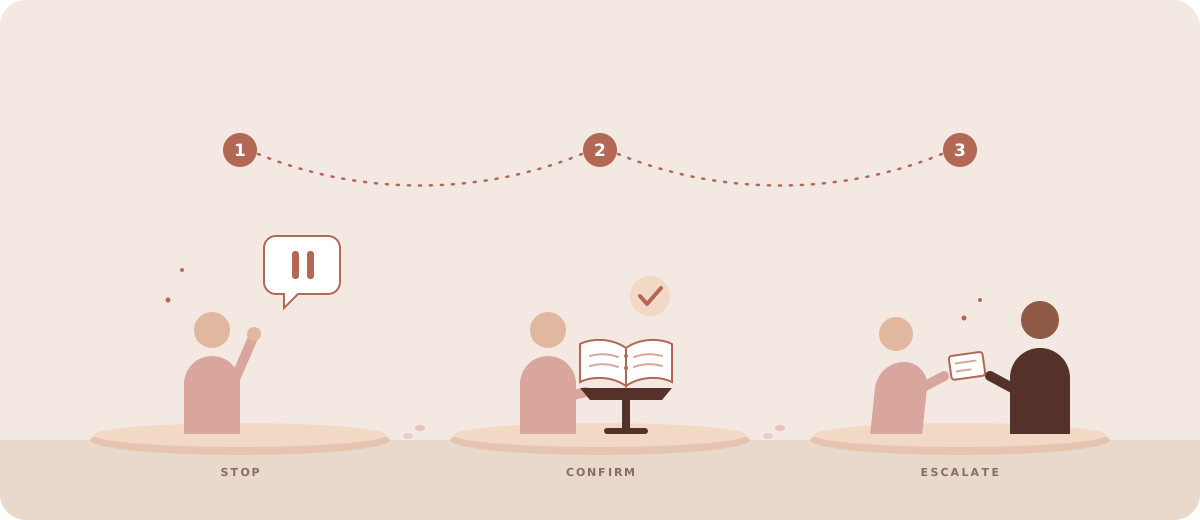
- Stop
- The moment you notice you are not sure. Not after you answer: at the noticing.
- Confirm
- Find out, from the person or the source that actually holds the answer.
- Escalate
- When it is bigger than a question, hand it to the Manager on Duty.
You will use stop a hundred times more often than escalate. That is not a failure rate. It is the system working. And the first skill is knowing which questions are yours at all.
Four questions arrive in one shift.
Which of these is yours to answer?
Tap the answer you would give.
Yes. You know it because it is written down and you have checked it, not because you remember it.
That distinction is the whole chapter. Something you can look at is yours. Something you can only recall is a guess wearing a confident voice.
No, and this one is not close.
Health questions are not yours, however many times you have heard them answered. Having heard an answer is not the same as being the person who may give it.
Reasonable is not the test. Authority is.
An exception outside your authority goes to the Manager on Duty — not because the guest is wrong, but because it is not yours to grant.
What you have read is not what PALOMA claims.
You can say what something is. What it does to a person is a different kind of sentence — and that is its own chapter.
Something you can look at is yours. Something you can only recall is a guess wearing a confident voice. Confirming means going to where the answer actually lives, and for one kind of question that is nobody in the building.
A question about whether a guest should have a service at all, given something she has mentioned about her health.
Who at PALOMA can answer that?
Tap the answer you would give.
She holds a great deal, and not this.
Operational authority is not clinical authority. The Manager on Duty is exactly who you tell — and telling her is not the same as her being able to answer it.
Yes, and this is the one people find surprising.
Not the manager. Not a founder. Not the most experienced therapist on the floor. For clinical, licensure, contraindication or scope questions, a consensus of confident people is still not clinical authority.
You escalate it. Someone qualified answers it. That is not slowness — it is the only honest route.
She has licensure, and her licensure has its own boundaries which are not PALOMA's to move.
She may well decline the service. That is her professional judgment, not a PALOMA ruling — and the two get confused constantly.
And when you do have to say you don't know, there is a sentence that costs you nothing. Have it ready before you need it.
You have to tell a guest you don't know.
Four ways to say it. One of them costs you nothing.
Tap the answer you would give.
Honest, warm, and it hands her your inexperience to hold.
She did not ask how long you have worked here. Apologising for being new invites her to wonder whether anyone here knows.
Yes. Seven words of it, and none of them are an apology.
Not knowing is ordinary. Guessing is the thing PALOMA does not do — and saying so plainly reads as standards, not as a gap.
This is the sentence to have ready before you need it.
Perfectly fine and slightly smaller than it needs to be.
It tells her where you are going rather than why. “I'd rather be right” is a better reason than “someone else decides.”
Charming, and it makes her question the outlier rather than answering it.
The question is not unusual to her. It is the reason she came to the desk.
Stop. Confirm. Escalate. In that order, every time.
Chapter eight
When it goes to a manager
Escalating is a judgment, and timing is most of it.
A guest is unhappy. It has already been going on a while.
Two associates reach the same decision. One of them arrives late.
She keeps trying — three more attempts, warmer each time — and escalates when nothing works.
Everything she did was kind, and the guest spent the whole of it getting less happy.
Escalating after you have exhausted yourself is not escalating. It is surrendering. By then the guest has repeated herself four times.
Look at B.
She offers what is hers to offer, sees it isn't landing, and brings a manager in while the guest is still being reasonable.
Yes.
The moment to escalate is while you still have something to hand over — a guest who is disappointed rather than furious, a situation with room in it.
Escalating early is a judgment. Escalating last is a collapse. They look identical on paper and land completely differently in the room.
Escalate while you still have something to hand over. And you don't have to decide what kind of thing it is. Four families go to a manager; you only have to recognize that it belongs to one of them.
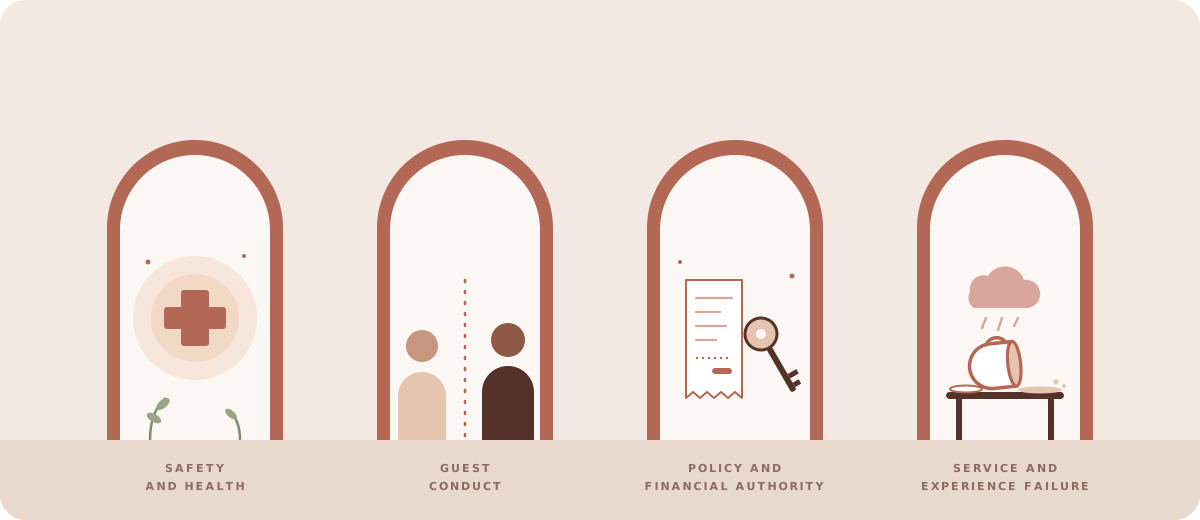
A medical emergency. An injury. A possible contraindication outside your authority. A safety threat. Anything needing clinical or professional judgment outside your role.
Harassment. Discrimination. Threatening behaviour. Significant disrespect. Intoxication or impairment creating a safety concern.
An exception outside your authority. A significant refund or compensation dispute. A chargeback threat. A repeated policy dispute. A waiver or override outside your authority.
A serious complaint. An injury or adverse reaction. An allegation of inappropriate provider conduct. A privacy or boundary concern. A guest still significantly dissatisfied after appropriate first-level support.
A guest is speaking to you in a way you would not accept from anyone.
You are calm, you are capable, and you could address it. Do you?
Tap the answer you would give.
You may well be right that you could do it beautifully. It is still not yours.
Having a conversation with a guest about how she is speaking to us is a manager's conversation, every time, regardless of how well you would handle it.
Yes.
The explicit respectful-conversation boundary with a disrespectful guest is manager-only. It is one of the few places PALOMA draws a hard line around who speaks.
That is not because you couldn't. It is so that you are never standing alone in it — and so that what gets said is consistent.
Waiting for it to get worse is a plan that only works if it gets worse slowly.
Significant disrespect is already in the guest-conduct family. You are not deciding whether it has become serious enough — you are recognising where it belongs.
Then the handover itself. The guest is watching you decide, and how you say it decides whether she hears a wall or a better outcome.
You have decided this goes to the Manager on Duty. The guest is watching you decide it.
How do you hand it over without it feeling like a rejection?
Tap the answer you would give.
True, and it puts a rule between you and her.
“Not allowed” makes PALOMA sound like a place with a lot of rules and not much judgment. She hears a wall.
Yes.
You have described a better outcome, not a limit on you. Same handover, entirely different feeling — and it is also simply what is happening.
Notice what it does not do: it does not apologise, and it does not explain the org chart.
Warm, and it leaves her expecting you back with a yes.
Disappearing and returning with someone else is a small surprise at exactly the wrong moment. Say who is coming.
Self-deprecating, and it tells her she is now dealing with someone junior.
Nothing about escalating is about your seniority. It is about whose decision it is.
You escalated something and it turned out to be nothing. How should that feel?
Tap the answer you would give.
That instinct is the one that gets people hurt.
An associate who has been made to feel foolish once escalates later the next time, and later is where the harm is.
Yes.
Escalation is not failure. The cost of escalating something ordinary is a short conversation. The cost of absorbing something serious is not comparable, and it is not yours to carry.
If you are ever unsure whether it is worth it: it is worth it.
Close, and the second half quietly undoes the first.
Checking more first is exactly the hesitation the rule removes. STOP is at the noticing, not after a private investigation.
Escalation is not failure. It is the part of the job that protects the guest and you.
Chapter nine
When something happens
Rarely, something happens that doesn't wait: a guest becomes unwell, a fire alarm sounds, the power goes out. PALOMA has the same five steps whatever it is, and one principle above them.
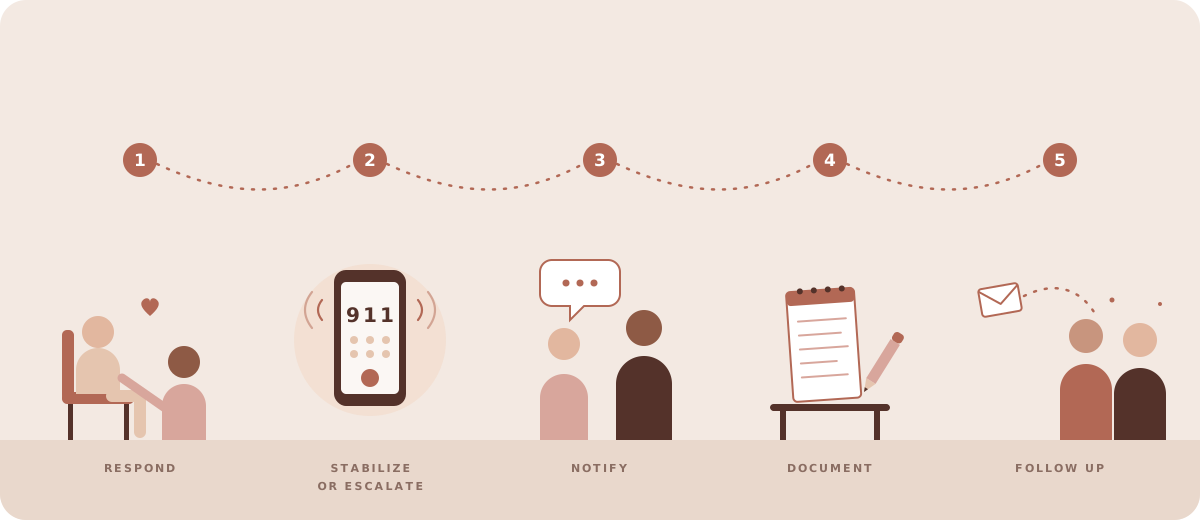
Five steps, whatever has happened
- 1RespondTo the person in front of you, first and immediately.
- 2Stabilize or escalateCall 911 where emergency medical attention is indicated. Stay with her.
- 3NotifyThe Manager on Duty immediately. The founders by phone once the response is underway.
- 4DocumentThe facts, promptly, while they are still exact.
- 5Follow upThrough leadership. Not by you, alone, later.
PALOMA responds first to the person, then to the process.
A guest in the lobby becomes unwell. It looks serious.
There are three of you nearby. What is the first thing that happens?
Tap the answer you would give.
The Manager on Duty absolutely leads this — and finding her is not the first move.
Where emergency medical attention is indicated, 911 is called and someone stays with the guest. The manager is notified immediately, in parallel, not first in sequence.
Yes. All three, and the staying matters as much as the calling.
A guest who is unwell is never left alone while someone goes to ask.
Then: the founders by phone as soon as the immediate response is underway, and a second associate goes to bring the responders in and hold the space and privacy around her.
The kit is in the Breakroom and it is not the first move.
Assessing is the word to look at. Associates do not diagnose, speculate about what is happening, or provide treatment outside their training — and that holds most firmly at the moment it feels most useful to try.
The immediate response is underway. A colleague asks what she should do.
There is a job here people forget. What is it?
Tap the answer you would give.
Worth doing, and it is not the named job.
Something specific is missing from this list and it is the thing that goes wrong most often.
Yes — and it is a named role, not an improvisation.
A second associate directs responders in and protects the space and privacy around the guest. Minutes are lost at the door of a building nobody has been shown into.
The privacy half matters just as much. Something is happening to a person in a place she came to feel safe.
That comes, and it comes after.
Documentation is step four for a reason. Nobody should be writing while the response is still happening.
Some incidents arrive days later, on the phone. Two sentences PALOMA never says: that the service caused it, and that it couldn't have.
A guest calls two days after her visit. She says she has been in pain since.
Three sentences you might say. Two of them PALOMA does not say.
Tap the answer you would give.
Kind, and it has just told her the service caused it.
Do not tell a guest the service caused her condition. You do not know that, and saying it warmly does not make it known.
Yes.
Received warmly and seriously, and captured in her own words. You are not diagnosing, not defending, and not deciding anything.
Three timestamps matter and will be asked for: when the service was, when the symptoms started, when she got in touch. Then the Manager on Duty and the founders, promptly.
Reassuring, and it is the mirror image of the first one.
Do not tell a guest the service could not have caused it either. Both sentences decide something that is not yours to decide, and one of them will be quoted back.
After the call. You are the one who took it.
One of these is expressly not done. Which?
Tap the answer you would give.
Done, and important. Preserve all of it.
Yes — and this is the one that is done with good intentions.
Do not alter historical documentation after receiving a complaint. Not to clarify it, not to complete it, not to make it more readable.
A record changed after the fact stops being a record. Leave it exactly as it was written.
Correct and prompt. Both.
Correct. The conversation does not continue with you, however reasonable it is being.
And three facts about the building itself, each with an instinct to unlearn.
The fire alarm sounds. You have guests in treatment rooms.
What is true, and what is instinct?
Tap the answer you would give.
Yes. Front and back are the designated exits, the Manager on Duty leads and coordinates the sweep where it is safe to do so, and associates assist guests out.
And the part that is hardest in practice: do not delay evacuation to retrieve personal belongings. Not hers, not yours. A guest will ask for her bag. The answer is that we will get it back to her.
The instinct is real and the rule is explicit.
Do not delay evacuation to retrieve personal belongings. Priority is safe, efficient evacuation. Dignity is handled by how you help, not by waiting.
No. You do not have the information required to make that a safe decision, and the time spent finding out is the only time that matters.
The power goes out mid-afternoon. Three treatments are in progress.
Someone says “let them finish, it's dark but it's fine.” Is it?
Tap the answer you would give.
This is the exact assumption PALOMA has corrected.
“Allow massages to complete” is not an automatic rule. A decision comes first, and it is not a decision about disruption.
Yes, and the Manager on Duty makes it.
Against real things: emergency lighting · fire and life-safety functionality · safe visibility and egress · building-management instructions · water and restrooms · temperature · communications · how long the outage is expected to last.
If continued occupancy or service is not clearly safe or permitted, services stop and guests are safely assisted out. Comfort is what you do inside that answer, not instead of it.
Too fast in the other direction, and it is still not your call.
There is a decision to be made and a Manager on Duty who makes it. The rule is that it gets made, not what it concludes.
Two facts about first aid at PALOMA. One of them surprises people.
Tap the answer you would give.
The first half is right. The second half is the thing to know.
PALOMA does not currently have an AED. Assuming one exists is worse than knowing there isn't one, because it costs seconds at the only moment they count.
Yes. Both, and the second is the one to carry.
Knowing what we do not have is part of knowing the building. In a cardiac emergency the answer is 911, immediately, and staying with her.
The kit is checked and restocked quarterly, so if you use something from it, say so.
Neither half holds. The kit is in the Breakroom, and there is no AED.
You never tell a guest the service caused it, and you never tell her it could not have.
Chapter ten
What we don't claim
Most of what goes wrong at a wellness desk isn't an emergency. It's a sentence: kind, well meant, and claiming something PALOMA doesn't claim.
“I swear this one found me.”
Two replies. Neither is dishonest.
“They really can feel that way. There's some interesting research on how touch and texture affect the nervous system, actually.”
Warm, well-meant, and it has quietly swapped her sentence for a different kind of sentence.
She said something spiritual. It came back as science, and slightly invented science at that.
Look at B.
“That's usually how it goes. You don't pick crystals — crystals pick you.”
Yes.
Avoiding fake science is not the same as being scientifically sterile. You met her exactly where she was, in PALOMA's own language, and claimed nothing.
The trap in A is the one worth naming: reaching for evidence to make a spiritual moment respectable. It makes it less true, not more.
Avoiding fake science is not the same as being scientifically sterile. Here are six questions to ask of your own sentence before it leaves your mouth:
Am I describing something, or naming what is wrong with her?
Am I suggesting, or instructing?
Have I said what may happen, or what will?
Do I know this, or does it merely sound like something known?
Am I naming a tradition, or presenting a belief as fact?
Is this actually mine?
A guest asks whether the sauna will help her inflammation.
Four answers. One of them is inside your scope.
Tap the answer you would give.
It sounds modest and it is doing more work than it looks.
“A lot of people find” attached to a named medical condition is still a claim about that condition. The softness of the phrasing is not the test.
Yes, and notice how much you still said.
You described the thing. You declined the claim. You pointed at who could actually answer. None of that is a refusal.
That last question is the whole move: not a wall, a direction.
Correct, and it lands like a form letter.
The boundary is right and it has been delivered without any warmth at all. She asked a real question and got a policy.
Same boundary, different sentence — see option 2.
The first half is a disclaimer and the second half is the claim it was disclaiming.
A caveat in front of a claim does not neutralise the claim. She will remember the second half.
A guest describes her service as “so detoxing.”
Do you correct her?
Tap the answer you would give.
Understandable, and it misreads whose sentence it was.
Guest language is information, not necessarily PALOMA language. She is telling you how it felt. Correcting her turns a lovely moment into a lesson she didn't book.
Yes.
Do not police guest words. Listen for meaning. “Detoxing” from a guest usually means lighter, clearer, less heavy — which is worth knowing and worth asking about.
The rule cuts one way only: her words are hers. You still don't say it back as a PALOMA claim.
Half right, and the half that's wrong is the important half.
Not correcting her is not the same as adopting her word. The moment you say it, it is PALOMA saying it.
Four sentences an associate might say in one afternoon.
Three are fine. One has crossed something.
Tap the answer you would give.
Fine. A tradition named as a tradition is an honest sentence — it says where the idea comes from without claiming it as fact.
Fine. It reports experience as experience and promises nothing.
Yes — and it is the clearest crossing on the page.
A promise, about a body, in a domain that requires evidence PALOMA does not have. Three of the six scope questions fail at once: promise not possibility, borrowed authority not evidence, and not within what you know.
This is not a phrasing problem. There is no warmer way to say it that makes it sayable.
Fine. “Designed to support” is a statement about intent, not about outcome — and that difference is doing all the work.
Say what a thing is. Be careful about what it does.
Chapter eleven
PALOMA AI: it guides, it doesn't decide
There is a tool for the moments in this module. PALOMA AI is an internal tool for the floor: when a guest asks something you can't answer, or something has gone wrong and you aren't sure what happens next, it is where you reach. It will give you the words. What it will not do is decide anything on PALOMA's behalf. You will be given the link and a code; both stay inside the team.
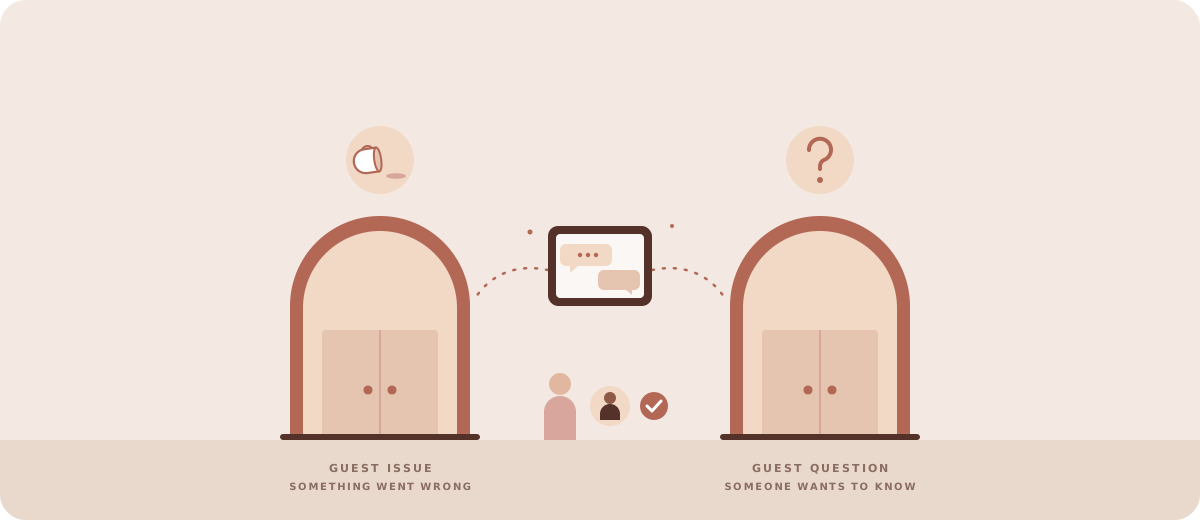
- Guest Issue
- When something has gone wrong
- Pick the category (the experience, a reaction to a service, booking and scheduling, or an emotional response) and say what happened. It gives back the steps, a word-for-word script, which resolution fits, and whether you need a manager. That line you cannot overrule.
- Guest Question
- When someone wants to know
- A service, a price, a wellness benefit, a policy. Type the question and you get words you can say to her right away.
A guest finished a facial twenty minutes ago and has come back to the desk. She says the room was too cold and she could not settle.
Which way in?
Tap the answer you would give.
Yes. Something went wrong with the experience, and that is one of its categories.
The useful part is not the script. It is the line telling you whether this one needs a manager — because "too cold" sounds small, and what she might be offered for it may not be yours to decide.
She is not asking a question. She is telling you something went wrong.
Guest Question is for what is this, what does it cost, what does it do, what is the policy. This is the other door, and taking the wrong one gives you a tidy answer to a question nobody asked.
Kind, and it skips the part that protects you both.
A tea is not a resolution, and choosing one yourself is how two guests with the same complaint get two different afternoons. The tool exists so the answer is the same whoever is on the desk.
A guest arrived twenty-five minutes late and the fee applies. She is upset. PALOMA AI has given you the steps and a script, and you have read them.
She asks you to waive it. What now?
Tap the answer you would give.
Yes, and this is the line the whole chapter is about.
It guides you. It cannot approve anything. Waived fees, discounts, moving an appointment, late cancellations and no-shows all still need a manager — however clear the answer on your screen looks.
Use the script. Then go and get someone.
This is the mistake worth naming out loud, because in the moment it will feel reasonable.
A tool that hands you confident words reads like permission. It is not permission. It cannot spend PALOMA's money and it does not know what else has happened today.
It is not the system, and she will know it is not the system.
This is a decision somebody is allowed to make — just not you, on your own, standing there. Saying that plainly costs less than hiding behind software.
A guest comes out of a massage and tells you her shoulder is worse than when she arrived, and that it hurt while it was happening.
The tool has a category for a reaction to a service. Do you use it?
Tap the answer you would give.
No. This is the one situation where you close the tool and go.
Take notes while it is fresh and get a manager straight away. What happens after that is taught in When Something Happens, and none of it starts on a screen.
The part people get wrong under pressure is the apology. Do not say sorry in a way that accepts blame, and do not accept blame. That is not coldness — it is that nobody yet knows what happened, and working it out is not yours to do standing at the desk.
The category exists, and this is still not the moment for it.
Anything a guest describes as pain or injury stops being a guest-experience problem. It goes to a person, immediately — not because the tool is bad at it, but because the clock and the written record both matter now, and a manager owns both.
The first half is slow and the second half is the half that costs.
An apology here sounds like agreement about what caused it. You can be warm without being sorry: stay with her, take notes, and get a manager now.
You are filling in a Guest Issue. The box asks what happened.
What belongs in it?
Tap the answer you would give.
Yes. Leave out guest names and personal details.
It needs the shape of what happened, not who it happened to. The steps it gives you back are the same either way, and nothing you type needs to carry her name around with it.
The link and the code stay inside the team, for the same reason.
More is not better here.
Names, numbers and personal details are hers. They belong in the systems PALOMA already keeps them in, not typed into a box to get a script back.
Too little, and the answer gets vaguer along with it.
What happened, what she said, what you have already tried — that is the detail that changes the steps you get back. Specific about the situation, blank about the person.
If it gets something wrong, say so. There is a feedback survey and it reaches the founders. And for anything you want to be certain about (what is in a service, how long it runs, who it is not for), the Reference shelf is still the shelf.
It guides you. It does not decide.
Key takeaways
- 1Stop. Confirm. Escalate. In that order, every time.
- 2Something you can look at is yours. Something you can only remember is a guess.
- 3For anything clinical, no amount of confidence in the room is authority.
- 1Safety. Conduct. Authority. Failure. Four families, and you only have to notice.
- 2Escalate while you still have something to hand over, not once you have run out.
- 3Escalation is not failure. It is the part of the job that protects the guest and you.
- 1Respond. Stabilise or escalate. Notify. Document. Follow up. The person first, then the process.
- 2You do not diagnose, speculate or treat outside your training — least of all when it would feel most helpful.
- 3You never tell a guest the service caused it, and you never tell her it could not have. Nothing written down gets tidied up afterwards.
- 1Say what a thing is. Be careful about what it does.
- 2Knowing the boundary of your knowledge is part of expertise.
- 3“I don't know, and here's who does” is a complete answer. Her words are hers — listen for the meaning, and do not adopt the claim.
- 1It guides you. It does not decide.
- 2Two ways in — something went wrong, or somebody wants to know something. One line in every answer you cannot overrule: whether it is yours to handle.
- 3If it gets something wrong, say so. And for anything you want to be certain about, the Reference shelf is still the place.