Module 8 · What We Offer
Wellness Education
The wellness world in plain words: what you can know, and what is yours to say.
About 35 min to read · then Check yourself
Chapter one
A map, not a menu
It is your first week. A guest at the desk asks about something you have never heard of. You don't know it, and that is fine. Nobody knows everything on day one. But notice what happens next, because there are two ways this goes.
Her first week. A guest asks about something she has never heard of.
Two associates, same gap in their knowledge.
“I'm not sure about that one, sorry — let me find someone who knows.”
Honest, and she had more than that.
Blank is rarely the true answer.
She didn't know the specific thing and she did know what family it was in — which would have given the guest something real.
“That's on the energy side rather than the hands-on side — so no oils, no table, you stay clothed. The detail I'd get from the practitioner. Shall I?”
Yes. She placed it, described the shape of it, and routed the rest — in three clauses, about something she has never seen.
That is what a map does. It is not a substitute for knowing the detail. It is the difference between I don't know and here is what kind of thing that is.
This chapter is the map.
Blank is rarely the true answer. The second associate didn't know the detail either. What she knew was which kind of thing it was, and that gave the guest something real: no oils, no table, you stay clothed, and the detail from the practitioner. That is what this module gives you. Not every service. A map, so that nothing a guest mentions is ever a blank.
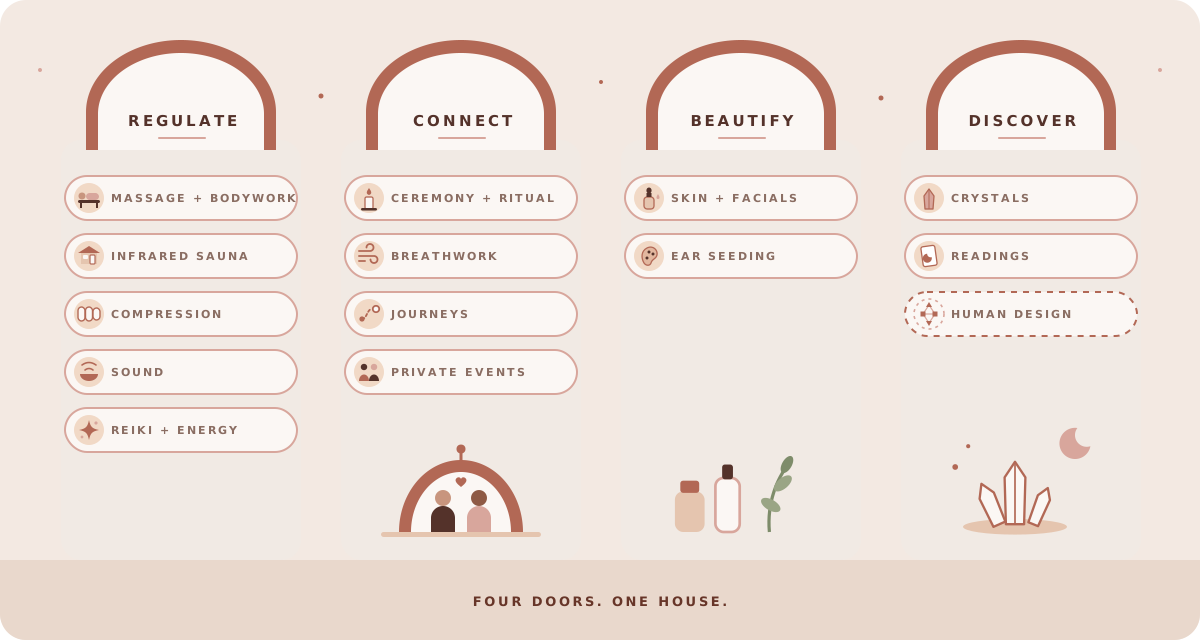
Four doors, and every kind of thing PALOMA offers behind one of them. You met the doors in The Menu as a way to lay out the menu. Here they hold a different kind of knowledge: what each family is like to receive, so you can describe something you have never seen.
Tap a door to walk through its families.
Settling the body and the nervous system. The largest door by far.
- Massage + bodywork
- Hands-on work on muscle and soft tissue, on a table, with oil. She undresses to her comfort and gets under the drape. Unhurried: the opening is slow and the close is never rushed. It splits two ways: relaxing, about how she leaves, and restorative, about what she came in with.
- Infrared sauna
- A private cabin using infrared light rather than heated air. It runs cooler than a traditional sauna and she stays in longer, with coloured light (chromotherapy) if she likes. A heat you sit inside rather than endure.
- Compression
- The Ballancer Pro, a medical-grade pneumatic system worn over the lower body. She lies down fully clothed and twenty-four chambers inflate in a slow rolling wave from the feet up. She does nothing at all.
- Sound
- Live crystal singing bowls in the Dome. Shoes off, a mat, a warm dim room. Completely passive: nothing to do, no experience needed. Most people go somewhere quite far away in the first ten minutes.
- Reiki + energy work
- A practitioner works with her energy without manipulating the body. She lies down and stays fully clothed. People commonly describe warmth, tingling, or a sense of something moving. Some feel very little and still leave settled.
Taking part, with other people or properly with yourself.
- Ceremony + ritual
- Group gatherings in the Dome marking something: a full moon, a new moon, a solstice. A circle, breathwork to open, guided reflection, sound, and shared silence to close. More participatory than a sound bath, and less demanding than it sounds.
- Breathwork
- Guided breathing, used deliberately. PALOMA offers it as a private session called Basics of Meditation, breathwork and grounding, and it also opens the ceremonies. A starting point, not an advanced practice.
- Journeys
- Two or more experiences made into one visit, hosted start to finish by one person. The connection is in the flow: she is looked after from the moment she arrives to the parting gift.
- Private Events
- Birthdays, bridal blessings, team gatherings, and groups who want the Dome to themselves. Ceremony, not a party: the same experiences, shared with the people she chose.
Skin and results, and never separate from how it feels to receive it.
- Skin + facials
- Face up on a table, with a facialist working on the skin, and usually something restful in the middle. Three tiers: HydraFacials, speciality facials, and foundational facials. Chapter three walks through all of them.
- Ear seeding
- Tiny 24k gold or Swarovski seeds placed on points of the ear. PALOMA calls it acupuncture without the needles, which is safe as framing, not as a claim. She leaves with extra seeds and a personal ear map to continue at home.
Learning something about yourself you didn't arrive knowing.
- Crystals
- Stones, held and chosen. The only family that continues at her house, and the one where touching is the point. Chapter seven.
- Readings + self-discovery
- One-to-one in the Dome: palmistry, intuitive readings, and aura photography with a reading. Use PALOMA's own ritual names, such as Path of the Spirit or Journey of Your Soul. The content of a reading is the reader's, entirely.
- Human Design
- A self-discovery system that uses birth information to produce a personal blueprint. It is on the map with a dashed outline: real, and not yet established as something PALOMA offers. If asked, say what it is and don't extend it.
Some of the map is drawn with a dashed line on purpose. A map missing a family would read as complete. And notice what the doors are for: they are your map, not hers. A guest asked to pick a pillar is being handed our internal architecture. Use it to think; don't hand it over.
Using the map
The map earns its keep when a guest says something that doesn't name anything. Read her sentence, not her keywords.
A guest says she wants “something that isn't massage but isn't weird.”
The map earns its keep here. What does she actually mean?
Tap the answer you would give.
She said two things and you answered one.
Possibly, and you jumped to a service instead of reading the sentence.
Isn't weird is doing more work than isn't massage.
Yes.
She drew a line across the map and told you which side she is on. That leaves heat and compression — and the honest pitch for both is that she lies down and nothing is asked of her.
Not hands-on, and not the part that sounds spiritual to someone who hasn't tried it.
You got there without knowing a single price.
You already know what she means.
Careful, and it makes her explain a word she chose precisely so she wouldn't have to.
Asking her to define it is a small embarrassment for no new information.
And it earns it again with the guest who has done the obvious thing for years and wants to know what else there is. Asking what else is not asking for the opposite.
She has had massages for years and asks what else she should try.
How does a landscape help you answer a question with no wrong answer?
Tap the answer you would give.
Asking what else is not the same as asking for the opposite.
A reasonable instinct that skips a step.
Sending a lifelong massage guest straight to a psychic reading is a guess dressed as boldness.
Yes, and the map is what makes it possible.
Naming two distances rather than two services lets her choose how adventurous she is feeling, which is the actual question underneath hers.
Sideways keeps her in REGULATE — heat, or compression. Further moves her into CONNECT — a sound bath, where she is one of a group.
No. The pillars are your map, not hers.
A guest asked to pick a pillar is being handed our internal architecture. Use it to think; don't hand it over.
There is one question you will hear more than any other: what's the difference? There is one answer that is always safe, works for every pair on the map, and is also exactly what she is picturing when she asks.
Two families, one question: “what's the difference?”
Which difference is always safe to give?
Tap the answer you would give.
Yes, and it works for every pair on the map.
Observable, honest, and it never becomes a claim.
One of them you lie there and someone works on you. The other you lie there and a machine does. The third you sit up and talk.
It is also what she is picturing when she asks.
Best for is an efficacy comparison.
The most natural answer and the one that keeps getting people into trouble.
People often describe feeling lighter is a report. You'll feel lighter is a promise.
Close, and it depends entirely on how you say it.
Same sentence, one word apart — and under pressure the second is what comes out.
Then the families, one at a time: massage, skin, sound, the body's quiet systems, the aura camera and the stones. You will learn a great deal, and each chapter draws the same line: what is yours to say, what is yours to know, and what belongs to her practitioner. Near the end, we put that line in one place.
You are not expected to know every experience. You are expected never to be blank.
Chapter two
Massage, and the ways of working
Massage is PALOMA's foundation and its largest family, so it is the one you will be asked about most. Each massage on the menu is built on one or two modalities: industry names for a way of working with the hands. Know the modalities and you can describe any massage, including one you have never had.
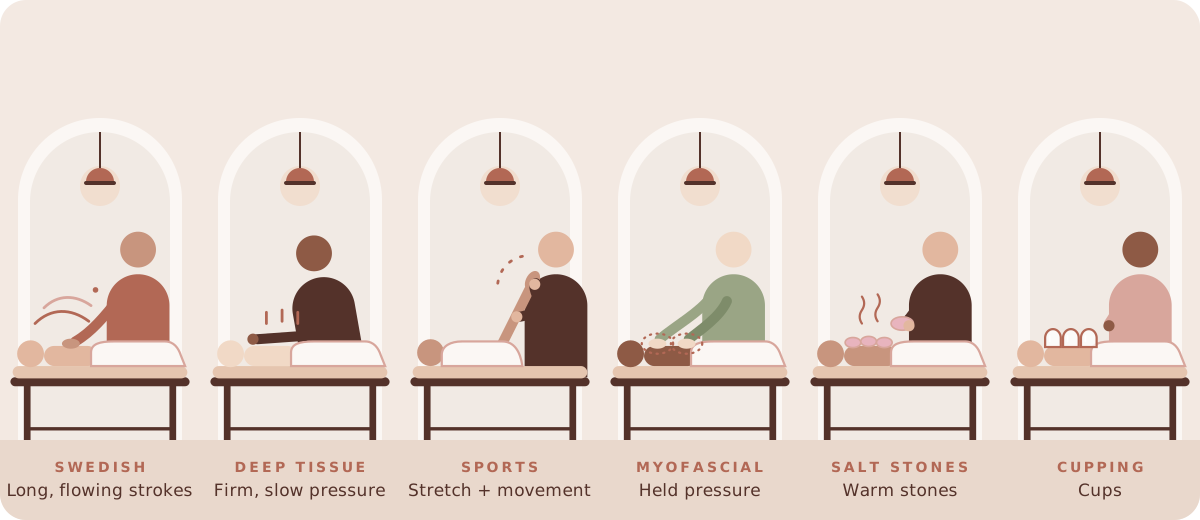
Massage, in plain words, is pressure and movement on skin and muscle, by a pair of hands. Muscle sits under the skin, wrapped in a thin layer of connective tissue called fascia. Pressure runs from light to firm. Most strokes have plain names, too: effleurage is long and gliding, kneading lifts and presses the muscle, friction works a small area in place. That is yours to know.
The modalities, and where they live
| Modality | What happens | At PALOMA |
|---|---|---|
| Swedish | Long, flowing strokes at light to medium pressure. Where first massages begin. | The Paloma · The Higher Realm (Swedish) |
| Deep tissue | Firm, slow pressure that works into the deeper layers of muscle. | The Power · The Higher Realm (Deep Pressure) |
| Sports | Swedish and deep tissue strokes with stretching, compression and range of motion, for active guests. | The Reformer, with an upper or lower body focus |
| Myofascial release | Sustained pressure, held over time, on the connective tissue rather than the muscle. Our most intensive work. | Clear the Path |
| Trigger point work | Focused pressure on one small area. Used inside a session, never booked on its own. | Within The Power and The Reformer |
| CBD | CBD-infused oil used in the massage, with two CBD gummies to take afterwards. | The Higher Realm (both pressures) · The Grounding Stone |
| Cupping | Cups create suction on the skin as part of the massage. They can leave round marks for 7–10 days, which she should know before she books. | The Meridian Ritual |
| Himalayan salt stones | Heated salt stones used in the massage. Warmth without intense pressure, and a light exfoliation from the salt. | The Himalayan · The Grounding Stone (adds warm oil) |
| Lymphatic | Dry brushing, then a light, rhythmic massage with warm botanical oils. She keeps the brush. | UMA Ayurvedic Body Ritual |
| Pre- and post-natal | Swedish with stretching. She lies on her side with supporting pillows, and we use HATCH pregnancy oils. | The Mother |
Two more you'll be asked about by name. The Monsoon is a moisture-drenching massage with hydrating oils and a gentle scrub on the legs and feet. The Healer is thirty minutes on one area she chooses: head and neck, legs and feet, or shoulders and back. And three small things can be added to any massage: an aromatherapy enhancement with UMA Ayurvedic oil blends, a hot towel foot treatment, and a PALOMA CBD treat. Prices and lengths are on the screen; read them, don't remember them.
Choosing with her
The art of being an Experience Guide is matching the right guest to the right service. Listen first, offer second. Four questions do most of the work:
- “What brings you in today?”
- “Have you had a massage before?”
- “Is there anywhere you'd like the therapist to focus?”
- “What are you hoping to feel after your service?”
Then match what she said to what happens. Notice that every answer below describes the massage. None of them promises what it will do for her.
| She says | You might offer | What you can say |
|---|---|---|
| “I've never had a massage. Honestly I'm a little nervous.” | The Paloma | “It's our gentlest massage, long flowing strokes, and you tell the therapist your comfort level. They'll adjust everything to suit you.” |
| “I like it firm.” | The Power | “That's our deep tissue: medium to firm, slow pressure into the deeper layers.” |
| “I want warmth more than pressure.” | The Himalayan or The Grounding Stone | “Both use warm salt stones. The Grounding Stone adds warm oil and CBD.” |
| “I ran a half marathon on Saturday.” | The Reformer | “You choose upper or lower body focus, and it uses warming oils, heat packs and stretching.” |
| “I've only got half an hour.” | The Healer | “Pick one area and the therapist spends the whole session there.” |
| “I'm pregnant.” | The Mother | “It's designed for pregnancy: you lie on your side with pillows, with oils made for it. We welcome you any time after your first trimester.” |
Fibromyalgia. An old injury. Chronic pain. Inflammation. A complication in her pregnancy. A medication. The moment she does, you listen and you route: her therapist is licensed; you are not. You can still tell her what happens in each massage. What it will do for her condition is her therapist's to say.
| The Mother | When she can book |
|---|---|
| Pre-natal | After her first trimester. |
| Post-natal, natural birth | From 4 to 6 weeks after the birth, or once her doctor has cleared her. |
| Post-natal, C-section | From 8 weeks after the birth, or once her doctor has cleared her. |
No doctor's note is needed. Book her, and make sure her therapist knows at intake. Anything beyond the timing, such as how she's feeling, a complication or a medication, is her therapist's conversation.
Recommend from what she actually told you, not from what you want to sell.
Chapter three
Skin, and the three tiers of facial
PALOMA's Skin Therapists are not just treatment providers. They are personal skincare advisors: after each facial, they curate product recommendations for that guest's skin. So in this family, the clinical conversation belongs to them. Yours is to listen well, know the language, and point her to the right door.
Skin, in plain words
Skin has a type, which is how it tends to be, and it can have a condition, which is how it is right now. The most useful example is the pair guests mix up most: dry skin is a type that makes less oil, while dehydrated skin is a condition, short on water, and it can happen to any type, even oily. That's why a guest can tell you her skin feels oily and tight at the same time, and be describing something real.
Learn to hear the words guests use. These are hers, not yours to diagnose; they simply help you know what she's telling you.
| What she might be describing | How guests often put it |
|---|---|
| Dry | “My skin always feels tight.” “Nothing moisturizes enough.” |
| Dehydrated | “My skin looks dull lately.” “It feels oily but tight.” |
| Oily or combination | “I get shiny by midday.” “My T-zone breaks out but my cheeks are fine.” |
| Sensitive | “I turn red easily.” “New products always sting.” |
| Acne-prone | “I break out regularly.” “My pores always feel clogged.” |
| Uneven tone | “I have dark spots from old breakouts.” “Too much sun last summer.” |
| Mature | “I'm starting to see fine lines.” “My skin doesn't feel as firm.” |
| Congested | “Blackheads on my nose.” “My skin feels bumpy.” |
Hearing a word is not the same as saying it back. Your skin looks dry or that looks irritated is reading her skin out loud, and that is the facialist's job, in the room. You can know what dehydrated means. She tells you about her skin; you don't tell her.
The three tiers
The facial menu is organized into three tiers, and the tier is often the most useful answer you can give.
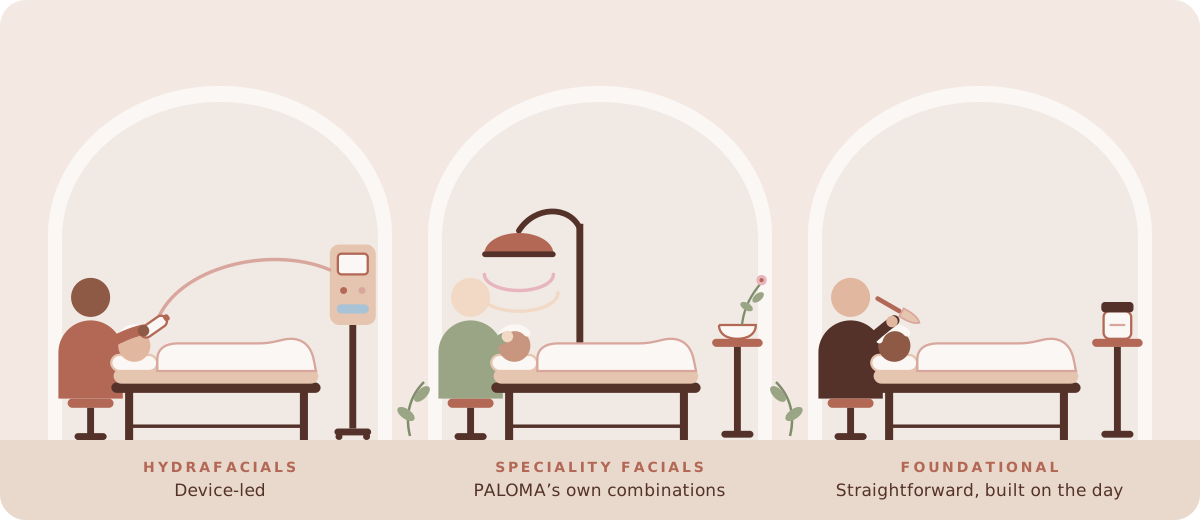
Tap a tier to see what lives in it.
Device-led. Dermaplaning, then hydradermabrasion: a wand that cleanses and exfoliates while serums go in.
- The Protector
- Our most popular HydraFacial: dermaplaning, hydradermabrasion and serums including salicylic and hyaluronic acid and honey extract, done under a crystal weighted blanket. Its prep note asks guests to stop retinol seven days before.
- The Pure Revival
- The same shape with a different serum set (glycolic and hyaluronic acid, algae extract), a personalized booster serum, and LED light at the end.
- Immortelle
- Ninety minutes. The Pure Revival plus an added booster serum and a full lymphatic drainage treatment.
PALOMA's own combinations, each built around a partner line and a feeling.
- Code of Youth
- Naturopathica botanicals. The menu calls it our anti-aging facial.
- The Clearing
- Glowbiotics probiotics. The menu calls it our acne facial.
- The Lightworker
- Glowbiotics brightening actives. The menu calls it our brightening facial.
- The Monsoon
- Honey, milk and hydrating botanicals, plus a leg and foot scrub. A moisture drench.
- The Alchemist
- Glowbiotics probiotics, a scalp massage, and kombucha. The menu calls it a soothing skin reset.
- The Sculpt
- A lymphatic drainage facial: gua sha drainage and sculpting, finished with cooling ice globes. Guests often book it before an event.
- The Clean Slate
- Seventy-five minutes: deep exfoliation, then intense hydration.
- Sacred Blooms
- Saint Jane botanicals, LED light and a curated soundscape. A full sensory ritual.
Straightforward and customizable. Great first facials.
- The Awakening
- Thirty minutes: cleanse, exfoliate, hydrate, with Naturopathica botanicals. A lovely add-on to a massage.
- Second Skin
- Dermaplaning, a blade that gently removes dead skin cells and fine facial hair, then a soothing mask.
- The Paloma
- Our customized facial. The Skin Therapist reads her skin on the day and tailors every step. The answer when she isn't sure.
When she names it herself
If a guest uses the word herself (breakouts, dark spots, fine lines), you can tell her which facial the menu names for it. That's the menu talking, not you reading her skin. "The Clearing is our acne facial, and your facialist will look at your skin at the start and tailor it." And when she isn't sure, or you aren't, there is always one good answer: The Paloma facial is built around her skin on the day, so she doesn't have to decide anything in advance.
Pregnancy or trying to conceive. Rosacea or any skin condition. Prescription skincare, retinol, or a recent procedure. Some facials come off the table for some guests, and that is never your call. Say “Let me check that with our Skin Therapist before we book,” and do.
She tells you about her skin. Her facialist reads it.
Chapter four
The power of sound
Sound is the quietest thing PALOMA offers and, for many guests, the one that surprises them most. Someone who has never meditated in her life lies down on a mat, the bowls begin, and ten minutes later she is somewhere she can't quite describe. You will be asked about it constantly, usually by someone a little skeptical. This chapter is so that you never answer with it's relaxing.
What sound is
Sound is vibration. Something moves, a string or a bowl or a voice, and pushes on the air around it, and that push travels outward as a wave until it reaches an ear, or a body. How fast the wave repeats is its frequency, measured in hertz (Hz): faster is higher, slower is lower. Low sounds are the ones you feel as much as hear, in your chest and through the floor.
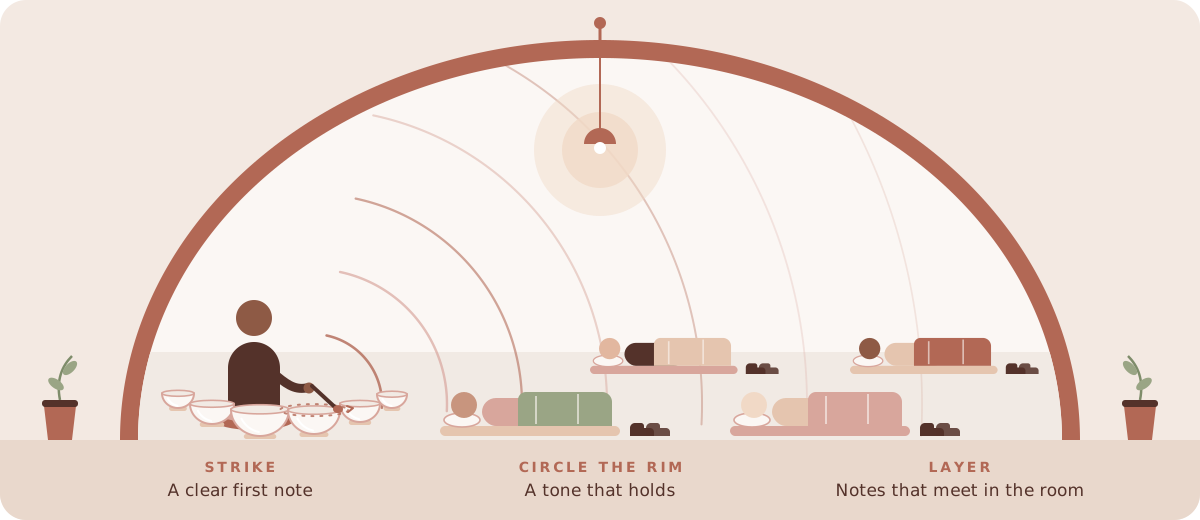
A crystal singing bowl is made from quartz, fused at very high heat into a smooth, frosted bowl. Each bowl sings one main note, decided by its size and thickness, with fainter overtones shimmering above it. It can be played two ways: struck with a mallet, for a clear first note, or circled, with the mallet run slowly around the rim until the bowl begins to sing on its own and the tone holds for as long as the instructor keeps moving.
Put several bowls in one room, each on a different note, and the sounds meet. Where two notes sit very close together you can hear a slow pulse, a gentle wah-wah-wah, as the waves fall in and out of step. Musicians call these beats. It's one reason a sound bath feels like it moves, even though no one in the room does.
What a sound bath is
At PALOMA, a sound bath is a live, full-body sound experience with crystal singing bowls. Guests take off their shoes and settle onto mats in the Dome, warm and dimly lit, with a blanket and a pillow. The instructor plays large crystal bowls, filling the room with rich, layered sound. Completely passive: no movement, nothing to do, and no prior experience needed.
- Sound Bath
- The bowls, the mats, about an hour. The best first ceremony for someone nervous.
- Reiki Sound Bath
- A Reiki practitioner moves quietly among the guests while the bowls play. PALOMA's most layered group experience, for guests who have enjoyed a Sound Bath and want to go further.
- Moon and solstice ceremonies
- Sound is part of them, alongside breathwork, journaling and reflection. She takes part rather than only receiving.
- Private sound
- A private sound bath or sound journey in the Dome, one to one or for her own group.
And what people report afterwards is yours to share, offered as a report: most people go somewhere quite far away in the first ten minutes. Some drift between awake and asleep, and a couple of people fall asleep every single time, which nobody minds. The common thing guests say afterwards is that they feel lighter or deeply rested.
A brain at rest
Your brain is always in a brainwave state: measurable electrical patterns that reflect how alert or settled you are. And your nervous system has a mode for alert and busy, and a mode people call rest and digest.
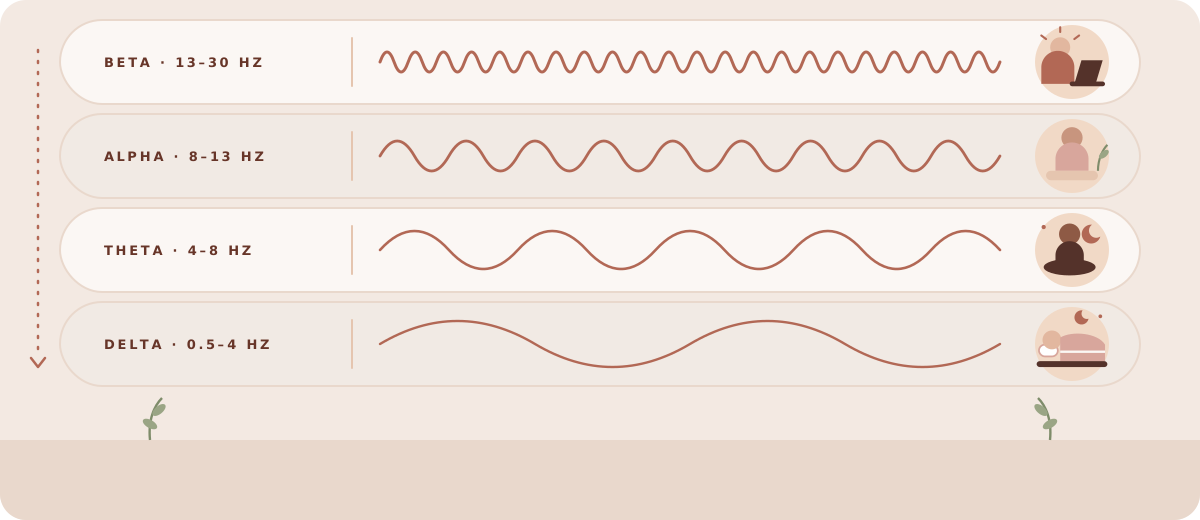
| Band | Frequency | Associated with |
|---|---|---|
| Beta | 13–30 Hz | Alert, busy-minded |
| Alpha | 8–13 Hz | Relaxed, present, calm |
| Theta | 4–8 Hz | Deep meditation, creativity, REM sleep |
| Delta | 0.5–4 Hz | Deep dreamless sleep |
Being studied, not settled: brainwave entrainment, the idea that the brain synchronizes to a dominant external rhythm, like a singing bowl. It is fascinating, and it is exactly the kind of why that stays with you. What a guest notices in a sound bath is hers to describe.
What you can say
Guests bring all kinds of words to sound: frequencies, vibrations, healing tones, a number like 432 Hz they read about. Her words are hers. You don't need to correct her, and you don't need to adopt them. What you can always give her is what happens, what people notice, and the sentence that answers the real question underneath a skeptic's:
Nothing to do, and nothing to believe.
Chapter five
Lymph and light
A good guide is curious. Here are two more pieces of the science underneath what PALOMA offers: the body's hidden network, and the light in the sauna. Both are yours to understand. Neither is what a PALOMA service does to her body. Hold that sentence as you read.
The body's hidden network
Most people have never thought about their lymphatic system. It is a second circulatory network running alongside the blood vessels, lined with one-way valves that let fluid move in only one direction. Along it sit roughly 600 to 700 lymph nodes, clustered in the neck, armpits, groin and abdomen: filtration stations where immune cells do their work.
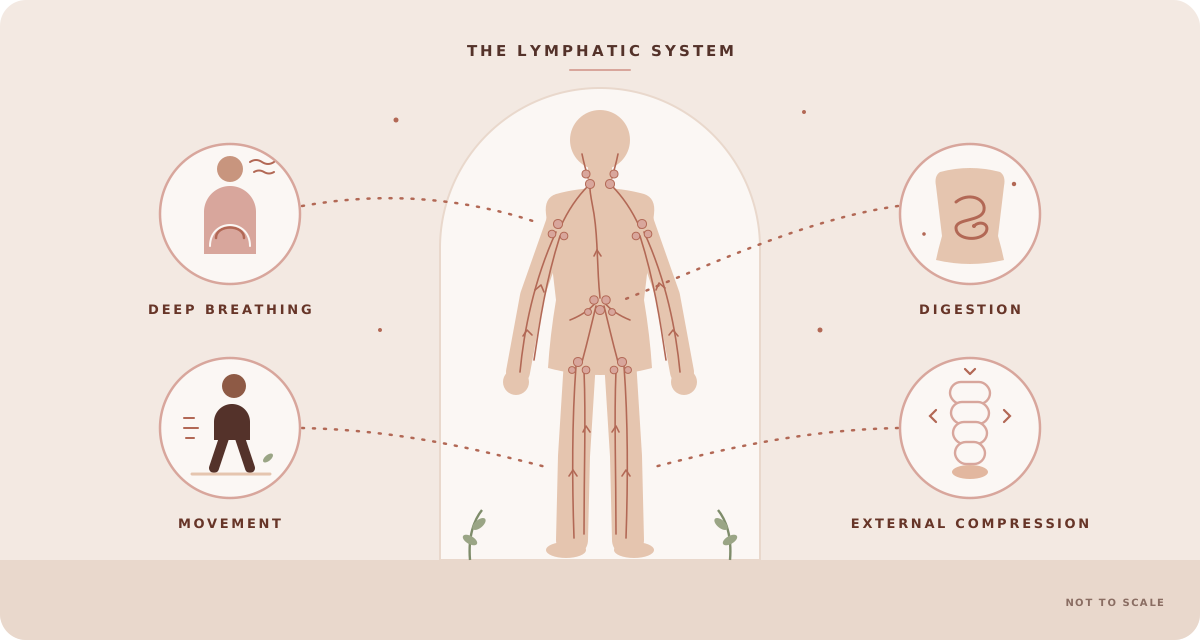
Here is the surprising part: lymph has no pump of its own. The heart moves blood; nothing moves lymph except muscle contraction when you move, deep diaphragmatic breathing, the movement of digestion, and external compression. And roughly 70 to 80 percent of the body's immune tissue lives in the gut. You now know more about this than most of your guests. Keep it as understanding. "That's stagnant lymph" said to a guest who feels heavy is reading her body.
Light, just below red
Infrared light sits on the spectrum just below visible red, in three bands that get wider as they go: near (700–1,400 nm), mid (1,400–3,000 nm) and far (3,000 nm and up). That's why the sauna can run cooler than a traditional one: the light is the point, rather than the air.
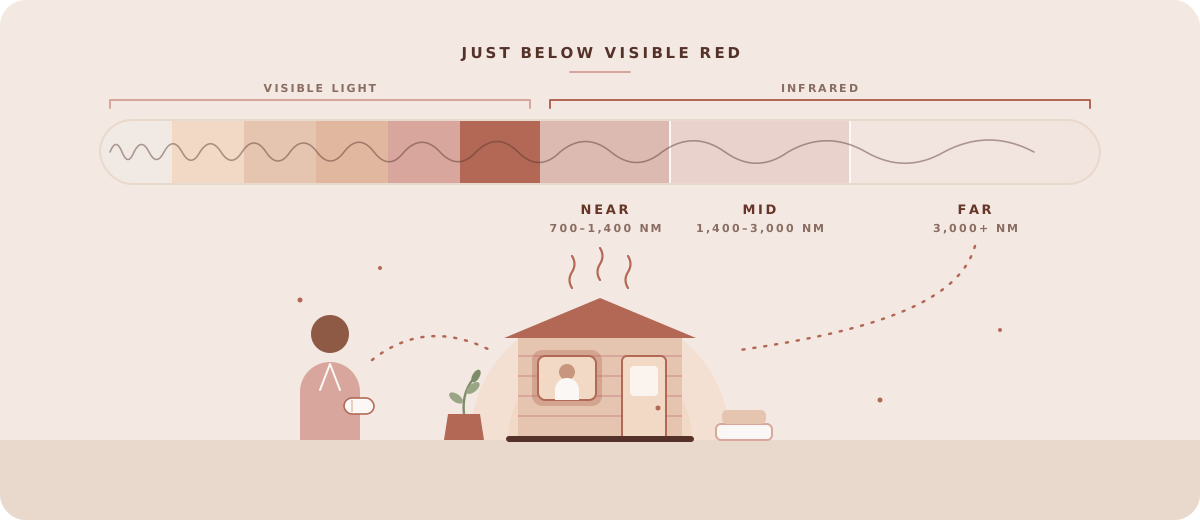
The chromotherapy colours carry associations, and you can name them as associations: green is associated with calm and equilibrium, orange with joy and emotional release. Then ask the best question in the family: what would you like to feel afterwards, energized or settled?
Describe freely. Explain carefully.
Chapter six
Aura photography, beyond pretty colours
Guests love the aura photograph, and many assume it's just pretty colours. You'll know better. Every cell in the body generates electrical activity: neurons fire, heart cells contract in coordinated cascades, muscles generate voltage. The aura camera's hand sensors read changes in the skin's electrical conductance, known as galvanic skin response, which shifts with emotional state and arousal. Software then maps those readings to colour.
The tradition is older than the camera. Modern aura cameras grew out of Kirlian photography, discovered in 1939 by Semyon Kirlian, which photographed the electrical discharge around living things. And ours is genuinely rare: these systems are made in very small numbers, and PALOMA is one of only a handful of wellness spaces in the region to have one.
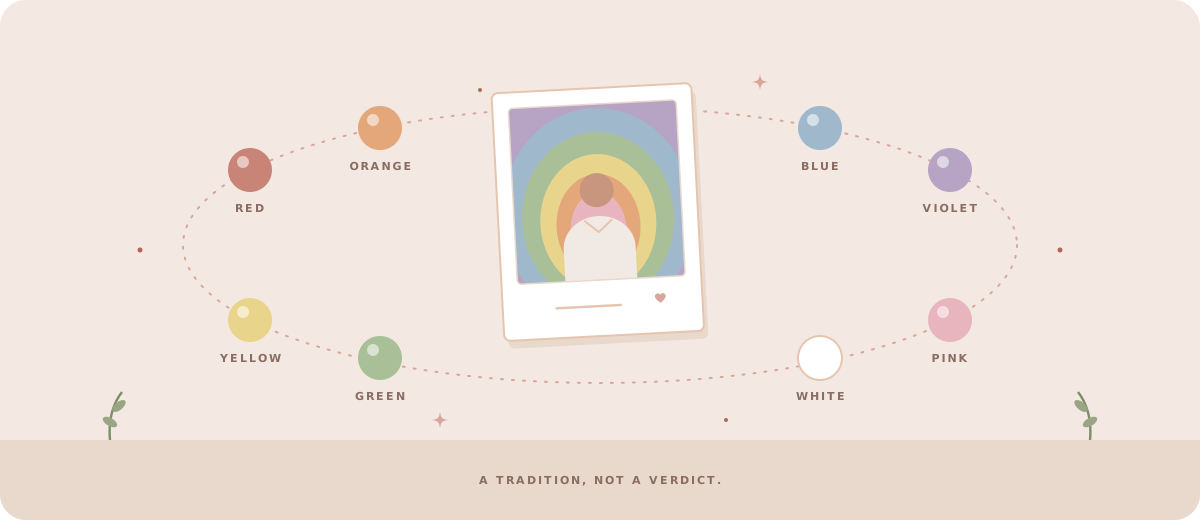
In aura photography's tradition, each colour carries associations, and so does where it appears around the body:
Vitality, passion, grounding.
Creativity, joy, social warmth.
Mental clarity, optimism, confidence.
Heart energy, balance, growth.
Communication, calm, intuition.
Deep insight, spiritual awareness.
Integration, spiritual clarity.
Gentle love, openness, sensitivity.
Above the head is associated with the higher self; the left side with incoming energy and the right with outgoing; the throat with expression; the heart with emotional state; the base with grounding.
The reading is an invitation to reflection, not a verdict. If a guest wants to talk about her photo, ask rather than tell: “Does that resonate? Is there anything happening in your life right now that connects to it?” The reading itself is the reader's, entirely. And don't explain what the camera measures as if it were measuring her.
You can know this. What a guest feels is hers to describe.
Chapter seven
Crystals: forms and traditions
Crystals are the only family on the map that continues at her house, and the one where touching is the whole method. How a guest meets a stone, and how she takes it home, lives in Retail. Here is what is yours to know: the forms, and the traditions.
The most useful thing you can know at the shelf works whatever the stone is: its shape. A guest who wants something to carry needs a tumble or a palm stone, and that is a form question you can answer about a stone you have never seen. In crystal tradition, each form carries its own association:
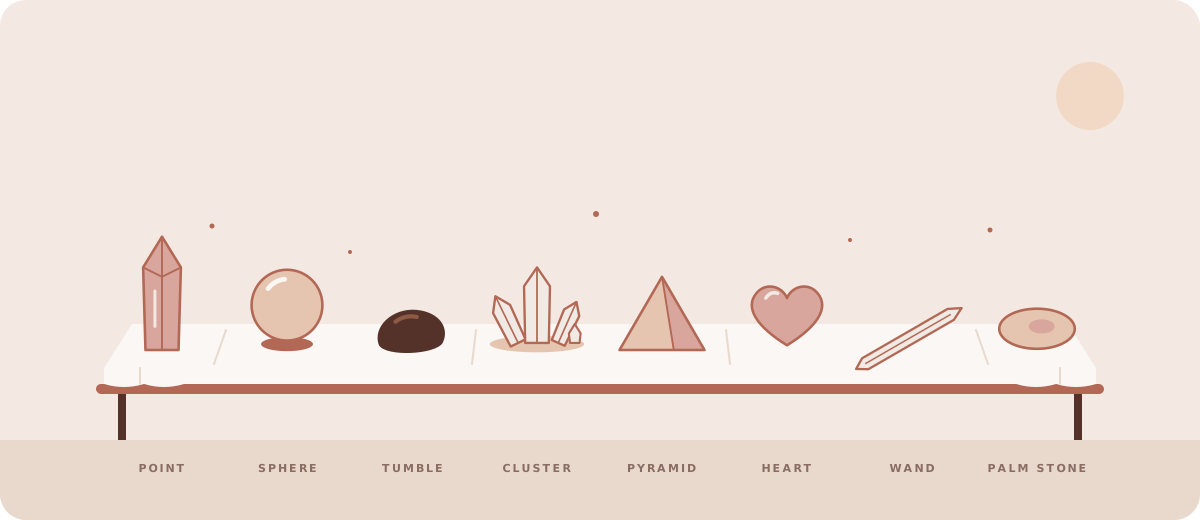
Directing focus, outward or inward.
Radiating evenly in every direction.
Smooth and gentle. Made for carrying and for pockets.
Associated with clearing a space and amplifying what surrounds them.
Intention-setting, focused through the apex.
Love and emotional balance. Often the one somebody buys for someone else.
Directional, traditionally used in cleansing.
Smooth and comforting. For meditation, and a hand that needs something to hold.
When she asks what a stone is for, give her the tradition and name it as one. "That's amethyst. It's traditionally associated with calm and with intuition." Traditionally associated with — four words that make the whole sentence honest.
She has chosen one. She asks what it's for.
Four answers about the same stone.
“That's amethyst. It's traditionally associated with calm and with intuition — and it's one people reach for without knowing why.”
Yes.
Traditionally associated with. Four words that make the whole sentence honest — you have told her what the tradition holds without claiming it as an outcome for her.
And the second half is true and better than the first: she already reached for it. That is more interesting to her than a property list.
The other answers, and why not
“That one's for anxiety — it's very calming.”
Two problems in nine words.
It named a condition and promised an effect. Anxiety may reflect a guest's own language; PALOMA does not prescribe or claim treatment — and for is doing the prescribing here.
“Honestly, whatever you want it to be — it's about your intention.”
Generous-sounding, and it abandons her.
She asked a real question and got a shrug. PALOMA has actual knowledge about these stones, and it's whatever you want withholds it while sounding open.
“There's a whole tradition behind each one — do you want me to look it up properly for you?”
Not wrong, and it's a step back from a question you can answer.
The tradition attached to a stone is exactly the kind of thing you may say — provided you say it as a tradition. Offering to look it up treats your own scope as smaller than it is.
- Properties are a tradition you name
- "Rose quartz is traditionally associated with love and compassion." Honest, warm, and true to the tradition.
- Benefits are a claim you don't
- "Rose quartz will open your heart." That is a promise about her, and it is not yours to make. The full property table is on the shelf; you don't memorize it.
You don't pick crystals. Crystals pick you.
Chapter eight
Knowing more than you say
Look at what you know now: how the modalities differ, how a facial tier is built, what a singing bowl is doing to the air, how lymph moves, what infrared is, what the aura camera reads. Your ability to speak knowledgeably about wellness is what turns a transaction into a trusted relationship. And you have noticed that every chapter drew the same line. Here it is in one place, because you are going to say less than you know, on purpose.
Start with the difference it makes. When a guest asks what actually happens during a sound bath, most people say it's relaxing. You can now say something much more interesting, because you actually know.
When guests ask “what actually happens during a sound bath,” most staff say “it's relaxing.”
Everything you learn sits in one of three places. Some of it is yours to say: what happens in the room, and what people notice, offered as exactly that. Some is yours to know: the physiology, the science, the history, which makes you a better guide and is not a sentence about her body. And some belongs to her practitioner: anything about her body, and why something works.
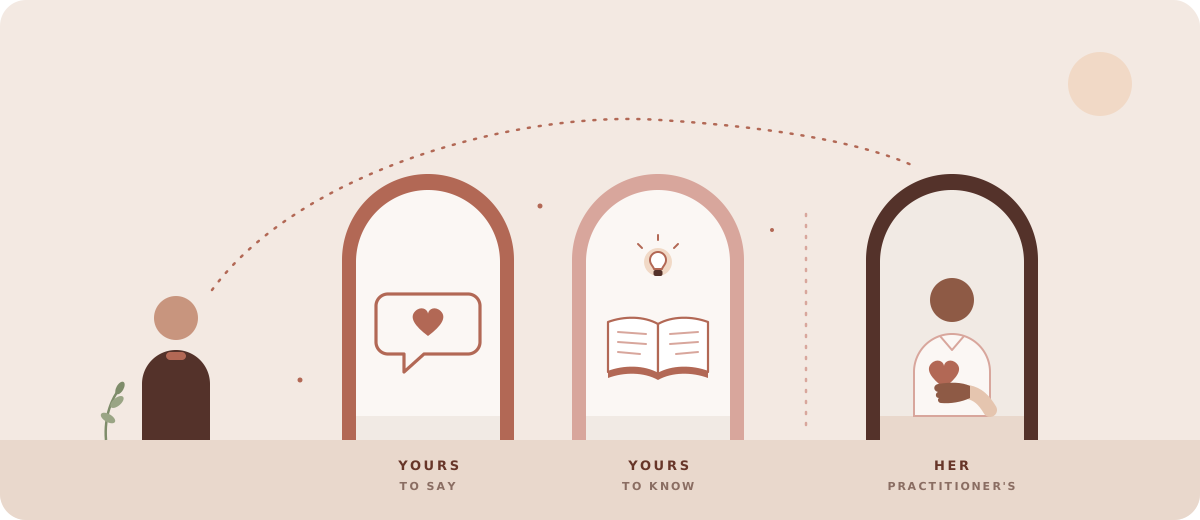
- Yours to say
- What happens, and what people notice
- "You'll be lying down, fully clothed, and it runs about an hour." "Most people go somewhere quite far away in the first ten minutes."
- Yours to know
- What makes you a better guide
- Infrared light sits on the spectrum just below visible red. Lymph has no pump of its own. Useful, true, and not a claim about what any PALOMA service does to her.
- Her practitioner's
- Her body, and why
- "It works by shifting your nervous system." That's a mechanism. "I had surgery a few months ago. Is compression all right for me?" That's her body. Both go to a practitioner.
The moment a sentence explains why, it has become a claim about a body. Watch for because, works by and that's why. Try sorting a few.
Whose is it to say?
The moment a guest mentions pregnancy, a medical condition, a medication or a recent surgery, the answer comes from a practitioner: her therapist, or the manager on duty if no therapist is free. Not from you, and not from a doctor's-note rule you half remember.
Your understanding got better. What you may say did not change.
Chapter nine
Listen, offer, route
Everything in this module comes down to three movements at the desk, and you will make them a hundred times a week.
- 1Listen for what she wants.“What would you like to feel afterwards: energized, or settled?”Released or restored. Her words, not a body part.
- 2Offer the experience.One step sideways and one step further, and let her pick the distance. Say what happens in each.
- 3Route anything about her body.Pregnancy, a condition, a medication, a recent surgery: her therapist, or the manager on duty if no therapist is free.
Try it once more, with the guest you will meet more than any other.
“I sit at a desk all day.” … “I just feel kind of... heavy and stuck.”
What do you do?
Tap the answer you would give.
If she describes symptoms, you listen; you do not diagnose.
Heavy and stuck are her words. Turning them into her lymph is reading her body.
Yes. You used what she said to choose, and you did not tell her what it means.
Naming two distances rather than two services lets her choose how adventurous she is feeling
You avoided the claim by avoiding the answer.
Follow-ups are usually about what happens in the room, which is entirely yours.
You know the map now. You know the modalities, the tiers, the sound of the bowls, the network under the skin and the light below red. You will always know more than you say, and that is not a smaller answer. It is a more reliable one.
Guide the experience. Do not interpret the body.
Key takeaways
- 1You are not expected to know every experience. You are expected never to be blank.
- 2What she does, and what is done to her — the difference that is always safe to give.
- 3Guide the experience. Do not interpret the body.
- 1Your understanding got better. What you may say did not change.
- 2Ask what they're hoping to feel afterward — energized or relaxed, released or restored.
- 3The moment a guest mentions pregnancy, a medical condition, a medication or a recent surgery, the answer comes from a practitioner.
- 1Handle them as held, not as stocked. Get them into her hands.
- 2Form is answerable about a stone you have never seen. Properties are a tradition, and you name them as one.
- 3Intention, cleansing, where it lives — the three things she will not think to ask for.